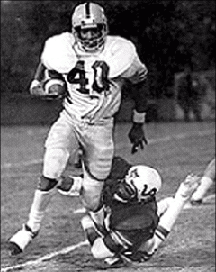
For Mike Haynes, former ASU football player and current Callaway golf executive, life has been measured by one triumph after another.
The most recent one for Haynes was being appointed a Callaway executive vice president earlier this year. It is a high-profile job that keeps Haynes busy year round.
Yet golf did not put Haynes where he is today, football and a desire to be the best did. And for that past life and commitment Haynes was recently honored with induction into one of football’s most hallowed shrines: The College Football Hall of Fame.
“I felt lucky to be able to play college football,” Haynes said. “I was a tall skinny kid coming out of high school. I wasn’t a muscle-bound kid that people were saying was going to make it to the pros.”
Yet Haynes, a cornerback, spent the better part of 14 years playing for the New England Patriots and Los Angeles Raiders in the National Football League. He was the first Patriot to return a punt for a touchdown and is still ranked second in total punt-return yardage (1,159) for the Patriots. In the process he also earned a Super Bowl ring with the Raiders in Super Bowl XVIII and induction into the Pro Football Hall of Fame in 1997.
But it all started right here at ASU.
Initially recruited by only a handful of schools, Haynes had played in three Fiesta Bowls and numerous college all-star games by the time he was through in Tempe. By the time the Patriots selected him with the fifth overall pick in the 1976 NFL Draft, football experts across the nation knew the name of Mike Haynes.
“When I was in college, I never thought about the College Football Hall of Fame,” Haynes said. “I was honored to be selected, but after the Pro Football Hall of Fame, it didn’t mean as much to me initially when I first received the honor. But by the time I got to the actual ceremony I started feeling that I had played with an awful lot of great college players and had had some great college teams. I felt like me going in as one player on those teams … that a little bit of them went in also. One player cannot make a team.”
After ASU, Haynes made the most of his chance in the NFL. He took every opportunity to improve his playing and even employed a chiropractor, personal trainer and a masseuse in the process. Then, during the off-season, Haynes started making yearly trips back to ASU to train with the track team.
“I wanted to learn more about running and how to breathe, proper arm action, stuff like that,” Haynes said. “I knew that I couldn’t get better if I stopped trying. So every year I worked really hard to get better.”
All of that hard work finally paid off for Haynes in 1984, when his Raiders won the Super Bowl, giving him the crowning achievement in an already stellar career.
“I think I was really fortunate to get there,” Haynes said of the Super Bowl. “I think of all the other great football players that are in the Pro Football Hall of Fame and College Football Hall of Fame that never got a chance to play in a championship game. What else is there to accomplish?”
When it was time for his football career to be over, Haynes, a 1982 finance graduate, soon received an opportunity that would begin his second career: corporate executive.
“I actually started with Callaway in 1994,” said Haynes of the California-based company. “They asked me if I would be interested in coming in to manage some of their license agreements that the company had gotten into and I thought that was a good place to come in. I had an interest in branding, which is really licensing. I thought that was a good experience for me. I loved golf, but I didn’t realize at the time that working for a golf equipment company probably meant that you’re not going to get to play as much as you used to. It took me a while to figure that out. By the time that I did I had already fallen in love with the company.”
Since then, Haynes has ascended to Vice President of Recreational Golf Devolpment with Callaway and has been involved with breaking down the economic and social barriers that have historically plagued the game.
Haynes believes that, while certain barriers still do exist, those who have a desire to succeed will find a way past the naysayers.
“When it comes to the barriers, I have a little bit of an issue with that,” Haynes said. “I’m not sure that that’s what’s keeping kids away from the sport. When I was a kid and first started playing baseball, I didn’t live close to a baseball field, but I had a baseball and a mitt and my brothers and I would play catch. We didn’t live close to a ballpark but we were able to be creative and come up with some things. We really had to go out of our way, but we loved the game. We would make the effort ourselves.”
Instead, Haynes feels that not enough recognition is given to people who could help make a difference in crossing the divide.
“I do believe that the thing that has kept people, minorities and women in particular, out of the industry is the fact that you don’t see them very often,” Haynes said. “For instance, in football there weren’t a lot of black coaches when I was a kid so I didn’t aspire to be a coach. If there were four or five coaches in any position, maybe I would have aspired to be a coach, but that wasn’t the case.”
So Haynes believes in lending a helping hand to those who already have a desire to learn and succeed. So much so that he personally endows a scholarship through the College of Business to help students who may have a hard time meeting the financial need of an education.
For this involvement, Haynes recently received the Distinguished Achievement Award from ASU. The award is given to business people who have not only achieved success in their professional careers, but have also helped the continual development of the College of Business.
“When I was at Arizona State, there weren’t a lot of minority kids in the business college,” Haynes said. “Not any that I can remember anyway. I thought that maybe we could do something to help kids, not just minority kids, but really any kid that really could use the help who’s already shown that he or she wants to go to college.
“I like to reward those things,” Haynes continued. “If I can keep a girl or a guy in college by giving them a little bit of money, trying to make their situation a little easier for them, I know that those kids, when they get out of college, are going to do the same things for other people in their community.”
Reach Al Stevens at al.stevens@asu.edu.