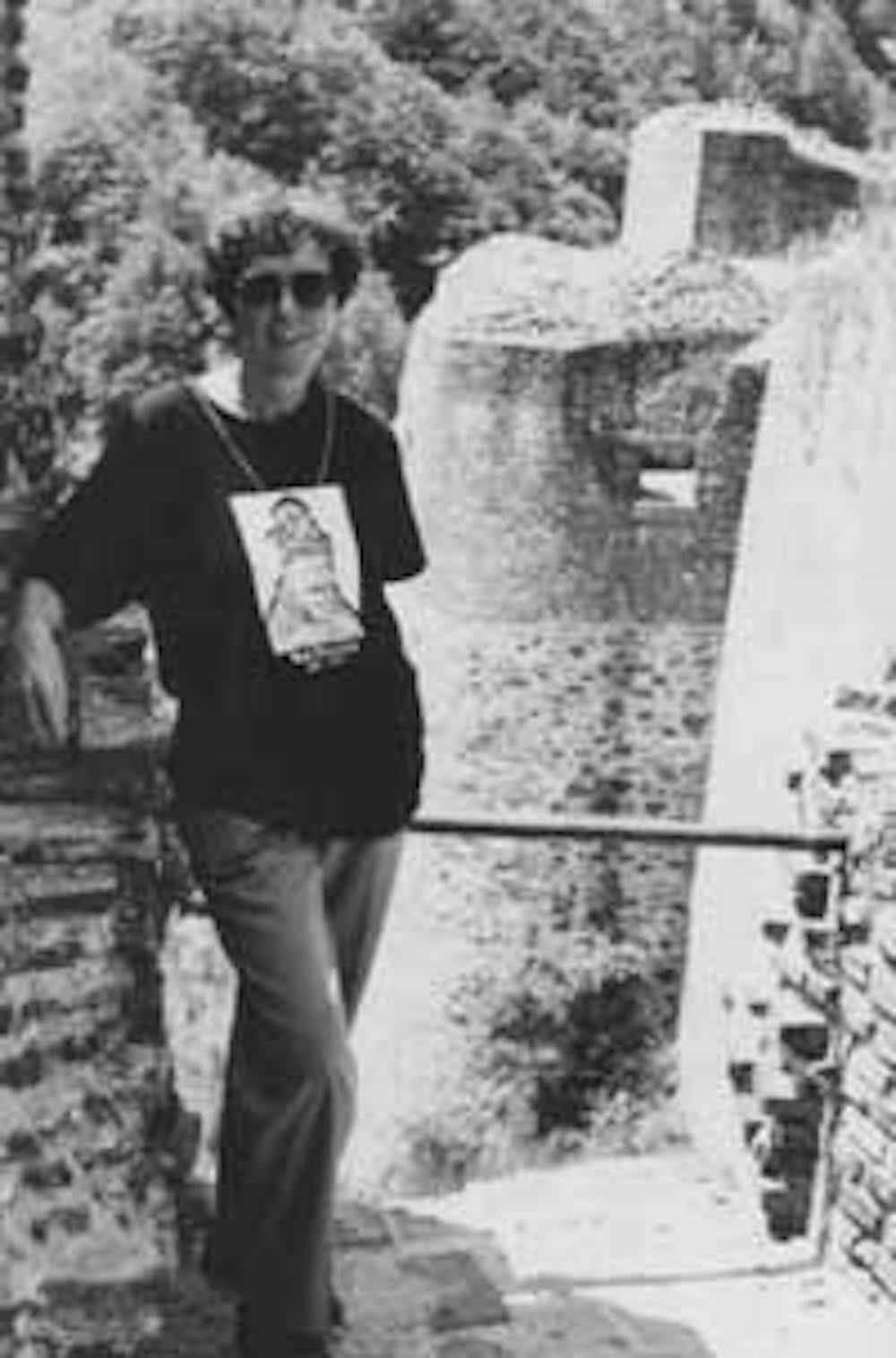
On Elizabeth Miller's necklace, a silver vampire bat is poised and ready to strike, sharply contrasting her unpretentious blue sweater and gray slacks.
The Dracula expert is not what one could easily classify as "Gothic." She has been hailed by many as the world's foremost authority on Dracula due to her extensive research in the field of Dracula- and vampire-related literature. She has written three books on the subject: Reflections on Dracula, Dracula: the Shade and The Shadow and Dracula: Sense and Nonsense.
Miller is currently working on a fourth, which will be a coffee table book on vintage Dracula imagery. She is also the president of the Canadian chapter of the Transylvanian Society of Dracula. But Miller, an English professor at Memorial University of Newfoundland, is definitely not a vampire.
This week, Miller will be touring numerous Arizona book haunts and conventions to dispel some Dracula myths and inform gothic adherents of their true heritage.
The recent influx of vampire/gothic popularity is evident by the numerous vampire movies in theaters, the Gothic subculture's uprising and the best-selling vampire novels by Anne Rice, among others. A theme park, Dracula Land, is in the works in Romania. Vampires have even made their presence known in science. The anticoagulant drug "Draculin" was discovered from vampire bats and is now being used to fight heart disease and strokes.
Be wary, some of Miller's revelations will rumble the foundations of contemporary vampire wisdom.
SPM: By your own definition, do vampires exist?
Miller: My definition of a vampire is "a corpse that returns from the grave to sustain its own existence by drinking the blood of the living." Using that definition, my answer is a resounding "No." If one were to accept a more general definition (i.e. a vampire is a blood-drinker), then of course vampires exist.
SPM: What's your opinion on the growing "Gothic" subculture in America?
Miller: I make no claim to be an expert on this cultural phenomenon, so this is just my opinion. I assume that for some Goths, the fascination is just another expression of youthful rebellion against authority. Fore more, I suspect the interest has to do more with matters of style and musical taste.
SPM: Could you explain the function of the Transylvanian Society of Dracula, with which you are involved?
Miller: It is a non-profit organization formed in Romania in 1991, following the fall of Communism. Its primary purpose is to use the entire Dracula phenomenon as a way of bringing together historians, folklorists, literary scholars, creative writers, tourism officials and other interested parties.
SPM: Do you have any new information regarding Dracula Land?
Miller: As far as I know it will be a "vampire theme park." Perish the thought I say that because of where it is to be built — in Sighisoara, the birthplace of the historic Vlad the Impaler.
SPM: Speaking of Vlad, in many of your texts you mention that he may not have been the inspiration for Bram Stoker's novel?
Miller: A widespread theory is that Stoker based Count Dracula on his employer, the famous Shakespearean actor Sir Henry Irving; that the novel was his way of getting even with a domineering boss. I am not convinced. More likely, in my view, Irving's stage performances of some famous dramatic villains may have shaped the image of the Count.
SPM: Was Dracula in part a representation of Stoker's own repressed desires or morbid personality?
Miller: We can dismiss the "morbid personality" easily: all the evidence we have suggests that Stoker was a genial Irishman. As for his repressed desires, who knows? There has been plenty of speculation: that Stoker's wife was frigid, that Stoker was a closet homosexual, that Stoker wrote Dracula while suffering from syphilis, that the novel was his response to his wife's menstrual cramps. I joke not!
SPM: There seem to be many sexual underpinnings evident in Stoker's work. To what extent is Dracula a manifestation of sexual repression?
Miller: The first serious analyses of Dracula were psychosexual. Any novel that deals with blood, death and sucking invites both Freudian and Jungian readings. There are many variations on this theme, ranging from viewing the novel as a violent sexual fantasy, to interpreting the count as the instrument that releases aggressive and unbridled sexuality in virtuous Victorian women. Maybe Dracula should be read as a Victorian male's worst nightmare. Closely related are issues of gender. While Stoker was writing the novel, the "New Woman" movement was attracting attention, most of it critical.
SPM: Regarding Frankenstein, is it true that the novel was written overnight by Mary Shelley as part of a friendly contest?
Miller: Here is what actually happened. The genesis of Frankenstein can be traced to a famous literary gathering on the shores of Lake Geneva. In the summer of 1816, Lord Byron and his doctor, John Polidori, were residing at Villa Diodati where they were visited by Percy Shelley, Mary Godwin (who would soon become Mary Shelley) and Mary's stepsister. One evening, after a collective reading of ghost stories, Byron suggested that each member of the party write a story of their own. Mary Shelley began what would become Frankenstein; she did not finish it until the following year. By the way, in response to his own challenge, Byron wrote a fragment of a tale which he soon discarded. It was picked up and reworked by Polidori, and was published in 1819 as The Vampyre — the first piece of vampire fiction in English literature.
Miller will be appearing at 10 a.m. Wednesday at the Kerr Cultural Center, 6110 N. Scottsdale Rd. Tickets are free. Call (480) 965-5377 for reservations. She will also appear on Thursday, Nov. 8 (Bram Stoker's birthday), at Changing Hand's Bookstore, 6428 S. McClintock from 6 to 8 p.m. Costumes are encouraged.