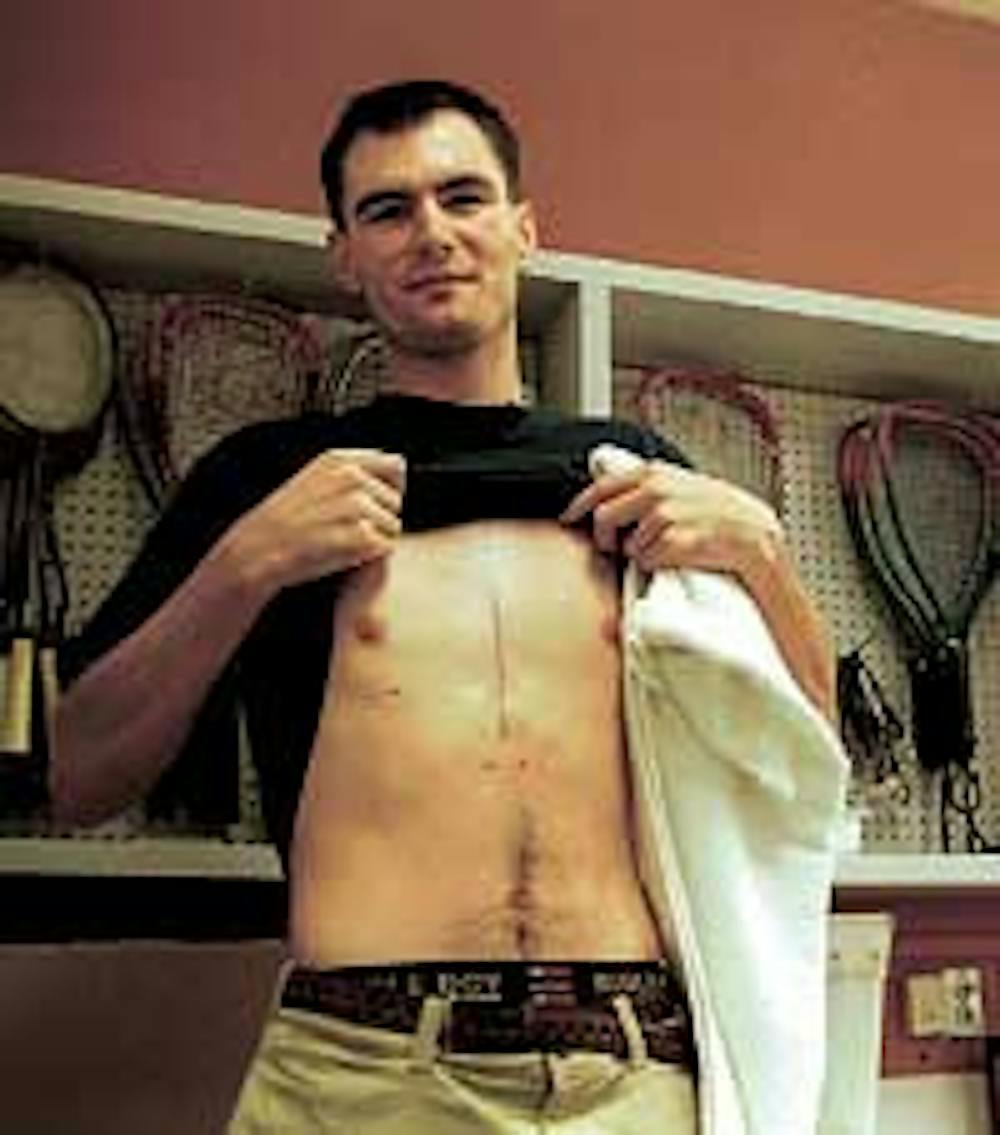
Open heart surgery has not stopped student Dave McHugh.
After surgery on Dec. 4, the exercise science senior is back at the Student Recreation Complex, working, joking around with his friends and tackling schoolwork.
In November, McHugh, 24, discovered that he had an enlarged heart after a nursing student did a random blood pressure check. The blood pressure reading was 220/30 and created instant suspicion since normal blood pressure is around 120/80.
One of McHugh's heart valves was leaking, causing his heart to grow more than twice the size of a normal heart.
Aside from a faulty heart valve, McHugh is in excellent physical condition, and many of his friends could not believe he needed surgery.
"My coaches didn't believe me when I told them," he said. "They thought I was joking."
McHugh has been training to become a professional cyclist since 1995. Although his training has been put on hold, he will be able to start again.
"He should have a full recovery," said McHugh's cardiologist Edward Perlstein of Lutheran Heart Hospital in Mesa. "He'll eventually be able to get back into training."
Although Perlstein seemed confident in McHugh's ability to put strain on his heart, he expressed hesitation toward McHugh participating in heavy competition.
"There is an increased danger, as far as crashing, which makes it probably not the safest sport for him," he said.
Since McHugh will have to be on blood thinners for the majority of his life to prevent blood clots, any sort of serious injury could bleed more than normal.
McHugh's opportunity for full recovery was only recently reassured. On Tuesday doctors discovered he had atrial fibulations, a fluttering of the heartbeat. His heart was not keeping a normal, rhythmic beat.
On Thursday he underwent a Cardio Version to reinstate a regular heartbeat. During a Cardio Version, the patient is given an anesthetic and is given an electric shock. The shock can sometimes restore a heartbeat.
The Cardio Version was successful, and McHugh is again on his way to recovery. If his heartbeat had stayed irregular, he would not have been able to overexert himself, and therefore would not have been able to train.
Doctors said McHugh's open heart surgery was well overdue.
"It's hard to tell exactly when he needed surgery, but it should have happened earlier than it did," Perlstein said.
But because McHugh was in such good shape, his enlarged heart went undetected. When he underwent surgery, the operation lasted two hours and cost about $75,000.
The cost will be absorbed by the state through "Access," a program that pays medical bills for people who are uninsured. The day after his surgery, a code blue was performed on McHugh. A code blue is administered after CPR fails and the hospital staff tries reviving the patient with electricity. After eight attempts at revival, the code blue stops and the patient is pronounced dead. McHugh was shocked six times.
"All I had to prove that it happened were the burns on my chest and people telling me what happened," he said. "I got a second chance. Not a lot of people get a second chance."
Reach the reporter at emily.murphy@asu.edu.