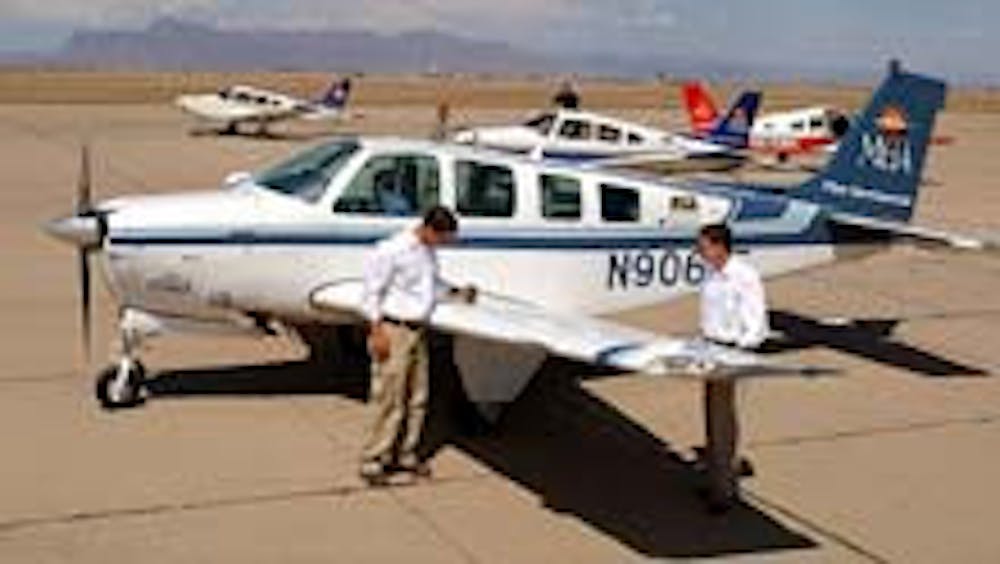
Kristyn Phelps remembers the anxiety of her first time flying when she sat in the cockpit, behind the numerous buttons and gauges, controlling a 35,000-pound plane.
"The first few times flying were intimidating, but it's cool to think 'I can make this plane fly, and it will do what I want it to do,'" said Phelps, a professional flight senior at ASU East.
Not many students get the chance to fly a plane, but for the 135 students enrolled in the professional flight program, they are able to get a hands-on experience, but for a price.
Dealing with the cost
Even though Phelps always wanted to fly, she said she was discouraged by the cost.
"The money was definitely a big issue, but it was something I really wanted to do," she said. "I decided to go for it and follow my dreams."
A flight degree from East campus doesn't come cheap; in addition to regular tuition, students pay $40,000 for four years.
The money goes toward the minimum of seven licenses needed to get flight credentials, as well as their time in the air.
Phelps said she had to use financial aid to cover the costs, but that it did not cover expenses beyond tuition.
"Currently, I am not flying because I don't have the money," Phelps said. "I am taking all the other classes I need, and then I will continue to finish my degree."
Mary Ann Turney, associate aviation professor, said a lot of students start the program, but for many it is just too costly to finish.
Professional Flight Instruction Service, a local flight school in Mesa, has a professional flight program similar to the University's, which costs just over $21,000 over four years.
Though Jeff Holeman, director of communications at East, said he could not comment on any particular flight school, he said going through the University program has several advantages.
"When a student finishes our program, they are guaranteed an interview with a major regional airline, Mesa Airlines, for a first officer position," Holeman said. "It really gets a foot in the door."
ASU East has a contract with Mesa Airlines, allowing them to conduct their flight training at the William's Gateway Airport, adjacent to campus.
Students are in the air approximately three times a week for an hour and half each time. They are required to complete 46 hours for the degree.
Before they can fly, however, they are required to operate a variety of simulators, which range from sitting in front of a computer screen to sitting in a cockpit.
Within the next few months, ASU East will be receiving two new simulators that Canadian company CAE installed, according to McCurry.
"These simulators are very comparable to a real jet aircraft in full motion," McCurry said.
To make the flying experience even more realistic, there is also an altitude chamber, helping to simulate high altitudes of up to 75,000 feet. It is one of three at a university in the nation, according to McCurry.
These 'chamber rides' take oxygen out of an enclosed space to teach students how to deal with a loss of oxygen while in a safe environment.
"When you lose oxygen, it affects your ability to do simple things like a puzzle or a game," said. "It's important that students learn how to deal with such a situation."
Preparing the students for a professional job is a goal that East takes pride in working on.
"The aviation industry needs well-trained professionals," Turney said. "The University does it better than anyone else."
Women in the field
Being that the industry is very male dominant, East is making an attempt to attract females into the program.
Currently East's program is about 17 percent women, which, according to McCurry, is a lot higher than other university numbers.
"We make an effort to be woman-friendly in what has been a traditional male industry and are learning what it takes to retain women in aviation," McCurry said.
The campus has two female faculty members, two female flight instructors and one female who gives flight tests.
"Women are not sufficiently encouraged," Turney said. "We do a special job of encouraging [women] and we're proud of it."
Phelps said being a woman made no effect on her decision to be a pilot.
"Women do have an advantage in getting hired and for advancement [in the field] because there are so few of us," she said. "But I don't think of it as more of an accomplishment because I am a woman. If you want it bad enough, you'll do it regardless if you are male or female."
Despite Sept. 11, 2001, McCurry said there has been a 13 percent increase in enrollment since last year.
"Surprisingly, there seems to be more of a demand for pilots," McCurry said.
In spite of the fact that major airlines are experiencing economic difficulty, according to McCurry, there will be plenty of job opportunities for their students.
"There are a lot of [pilots] scheduled for retirement within the next four or five years, so [students] can fill those open positions," McCurry said.
Reach the reporter at jennifer.summers@asu.edu.