Growing human tissue in a plastic device only seems as if it could happen in a sci-fi flick.
But this technology is closer to reality than one might think.
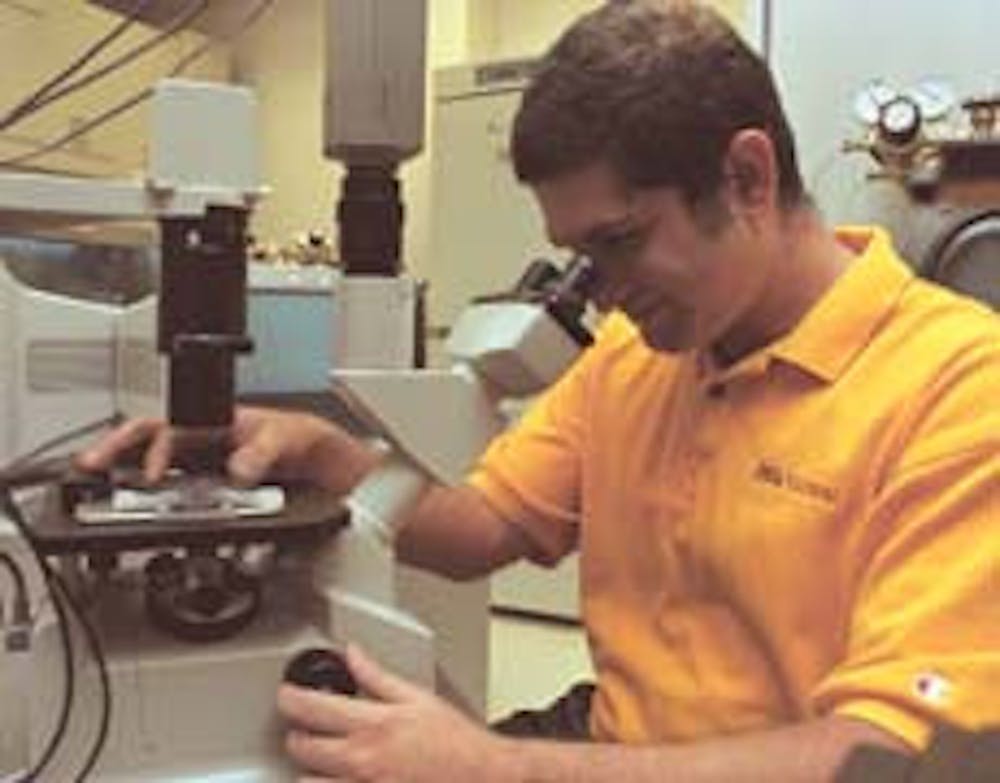
ASU biology professor Dave Capco and biology graduate student Shidfar Rouhani see many applications for their device, which duplicates the circulatory system of the body, called a mircocapillary bioreactor.
"Instead of killing thousands of rodents by giving them cancer and study the effect on them you could test it on the living tissue in the device," Rouhani said.
Rouhani added that a more practical application could be for women in childbearing age that may have cancer and require chemotherapy, which would result with infertile eggs.
But with this technology, a woman's ovaries could be removed and frozen, and when the woman wanted to have a baby they could be thawed and used.
The ovaries would be placed in the bioreactor and continue to grow until the eggs mature and are ready to accept the sperm.
"This would be better than freezing an embryo because many believe once the egg is conceived that is a life," Capco said. "If the mother were to die, the question always comes up with what to do with the embryo. Is it right just to throw a life away because the mother died?"
Capco and Rouhani took approximately two years to develop the device, which went through four or five designs, Capco said.
"It started the thickness of about four fingers and now it's the size of a pencil eraser," Capco said.
Rouhani said after much deliberation, they finally decided to make the device out of bulletproof plastic.
"Not because we expect anyone to shoot it," he said. "It needs to be able to take high temperatures [for sterilization]."
While Capco said he helped with this project, the real credit goes to Rouhani.
"He is a remarkable student," Capco said. "He had the bioengineering education to help him build the device."
The next step for Capco and Rouhani, is to pursue an international patent, so they can sell the device to a company for production, which has drawn widespread interest from Japanese-, Swedish- and Israeli-based businesses.
"It took a long time to get to the finish stage," Rouhani said. "This working device gives me lots of satisfaction."
Reach the reporter at susan.padilla@asu.edu.