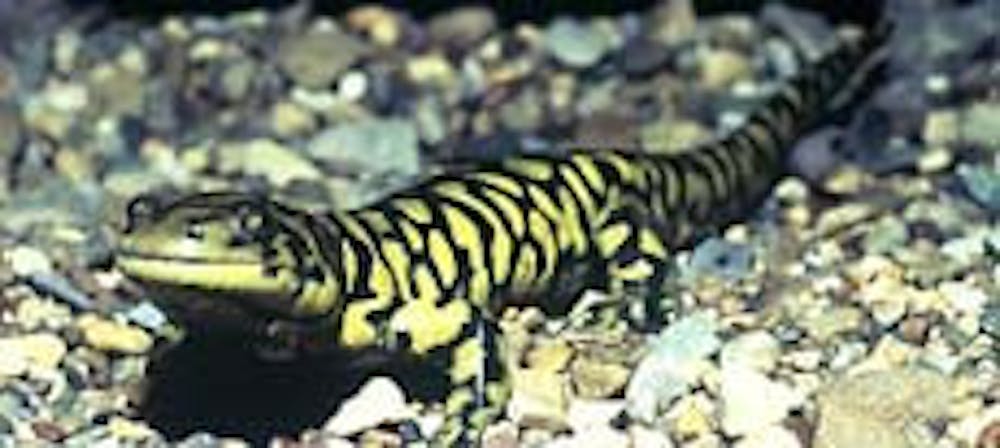
There is one type of animal that can tell us a lot about the condition of our Earth: amphibians.
Amphibians are good at noting changes in the environment that could also affect humans and other organisms, said ASU biology professor James Collins, who has studied the subject since 1997.
"They are the so-called canary in the mineshaft," Collins said.
The National Science Foundation has awarded a $3 million grant for three years of study by the Integrated Research Challenges in Environmental Biology program, a consortium of 15 universities and research institutes. ASU is the lead institution in the study.
Collins, who is participating in the study, is currently writing a book about amphibians, examining how habitat destruction affects the wildlife.
He said this is something that should concern everyone.
In recent years, there has been a dramatic loss of amphibians in the wild, a warning that the Earth is changing and probably not for the better.
Collins said toxins in the environment, such as pesticides and herbicides, might be contributing to the amphibian decline.
"Toxins could have debilitating effects not only on amphibians but also birds and human beings," he said.
Another factor could be high amounts of UV radiation coming to the surface of the Earth from the sun; this radiation makes amphibians more susceptible to illness.
"If it is UV, it goes back to amphibians telling us something is wrong," Collins said. "This would mean UV is a global problem."
While these problems may play an important role in the decline of amphibians, Collins said the largest problem for amphibians could actually be destruction of habitat.
"Folks [are] wrapped up in more exotic explanations such as toxins when in fact the biggest problem may simply be habitat loss," Collins said.
He also said people need to be more conscientious about the housing developments at the edges of our urban environments when there is still a lot of space in the cities that is unoccupied.
Not only does the loss of amphibian habitat to urbanization do away with the animals' homes, but it also puts herbicides and insecticides, which humans put on lawns and landscapes, closer to these organisms and makes them likely to be poisoned, Collins said.
"We have to be much more thoughtful about what we want the future to look like for ourselves, but also for the generations that follow after us," Collins added.
Jesse Brunner, a biology student working on his doctorate degree and the study, said Collins is a unique scientist because he can look at the larger issue.
"Many times we get caught up in the details," Brunner said. "But we need to remember to step back and see how what were working on interacts with other people are working on."
Reach the reporter at susan.padilla@asu.edu.