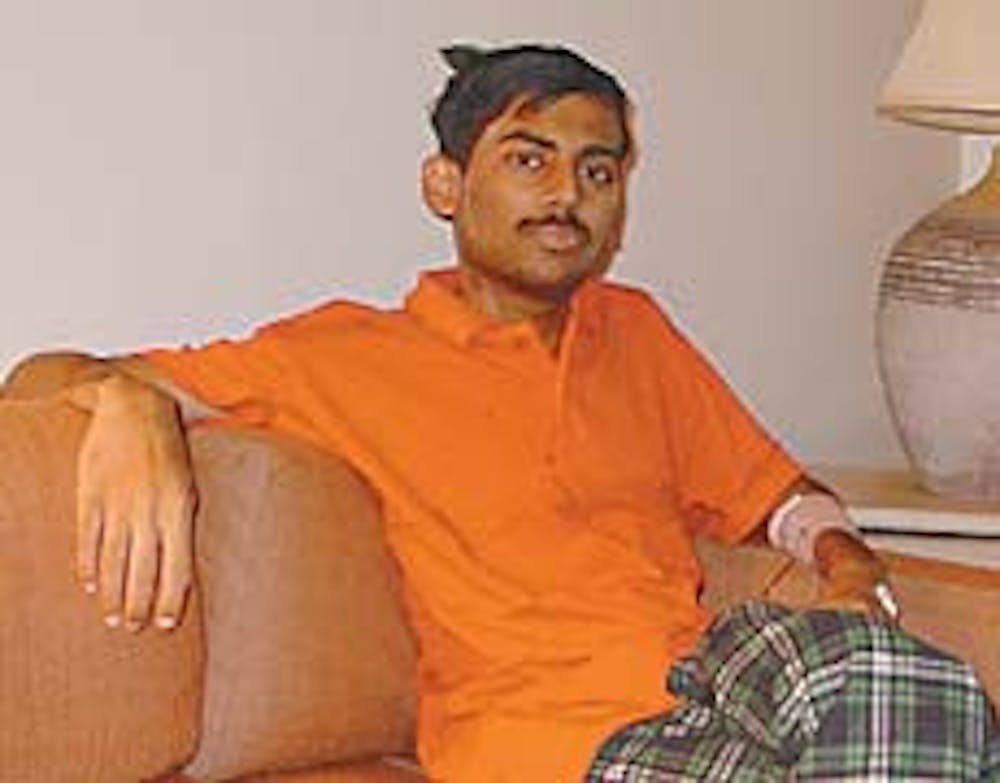
In November, life looked grim for Vamsi Gurram, an ASU student from India.
The electrical engineering junior, who had been living at ASU for three semesters, was turned away from the hospital with a devastating case of Valley Fever.
Valley Fever exists in arid desert areas when dangerous fungus spores become airborne and are inhaled. The illness is usually mild, but in Gurram's case the fungus spread to his bones and organs.
Without sufficient insurance and an ocean apart from his family, Gurram, who had been suffering from the disease since May, was in a desperate situation.
After a short period of care at the Scottsdale Osborn hospital, Gurram had to leave before a full recovery because his insurance would not cover a longer stay.
Aside from the inability to pay hospital costs, Gurram needed money -- nearly $1,800 a month -- for medication and living expenses; however, due to the disease, he was unable to work and provide financially for himself.
Amid what looked like dire circumstances, several fellow students came to the rescue.
Three organizations: AZINDIA, the Arizona Telugu Association and the Indian Students Association of ASU, have joined to help Gurram with his expenses.
"Our goal is $10,000," said Prasad Chavali, president of the Arizona Telugu Association. "We have raised $7,000, but even if we reach our goal, we won't stop trying to raise money for him. He will have to be on medicine for the rest of his life, and the medication is so expensive."
Chavali added that the insurance will only cover 90 percent of Gurram's expenses, which means he has to pay $100 a month for medication and will also have to pay for co-pays and have more tests done.
Because his illness is so debilitating, Gurram is not physically able to travel back to his home country. As a result, the organizations paid to bring his parents to the United States. They are expected to arrive in two to three weeks.
Sarath Akkineni, president of the Indian Students Association of ASU, said Indian students have contributed $2,500 of the $7,000.
Akkineni said that the student organizations are trying to help Gurram at home also, though it is difficult.
"Everyone who can help is a student," he said. "No one is home during the day to help take care of him. It has been very hard."
Chavali said Gurram is handling his situation well.
"His morale has been very high," Chavali said. "At first it wasn't. He asked why this is happening to him. It has been really tough for him."
Reach the reporter at susan.padilla@asu.edu.