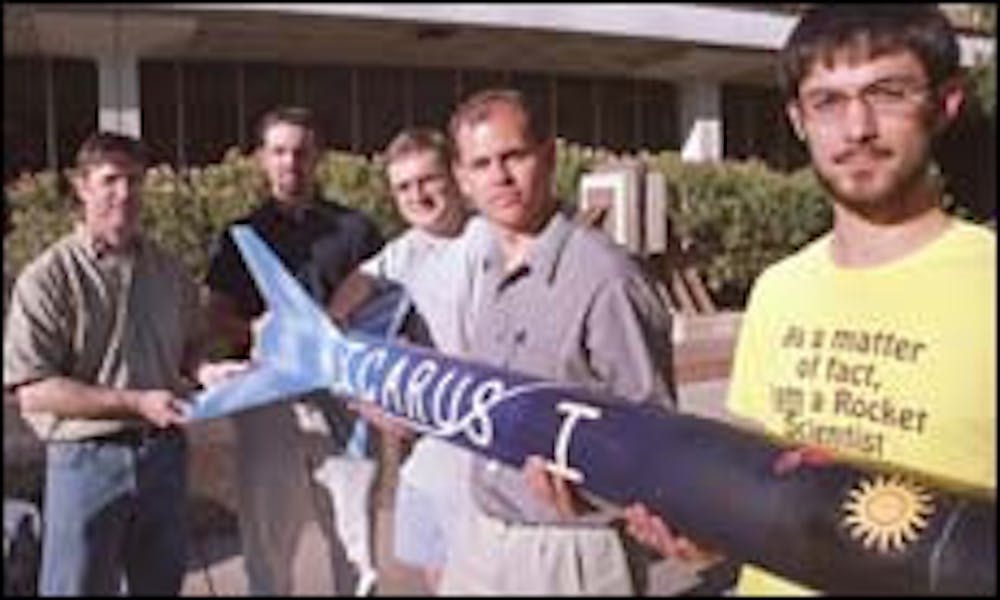
ASU aerospace engineering students who are creating the ICARUS II rocket will be going where no students have gone before.
A 17-member sub-group of the ASU chapter of American Institute of Aerospace Aeronautics is designing the first civilian-made rocket to break the space barrier and reach an altitude of 100 miles, said the institute's chapter president Justin Pucci, an aerospace engineering senior.
"It will open up the space industry to smaller players, not just NASA," Pucci said. "NASA's just dominated space for so long; people are just now getting the confidence to join in."
If successful, the rocket could provide more recruiting and income opportunities for the University, Pucci said.
"The rocket is a potentially big moneymaker," he added.
The rocket will be the first of its kind designed by college students, said Chris Neilly, an aerospace engineering senior and chapter secretary.
It will cost about $47,000 to construct, which is under the group's projected budget of $50,000, Neilly added.
The rocket is powered by a hybrid engine, which is environmentally safe and inexpensive, Pucci said.
"Basically the engine is constructed from hydrogen peroxide and polyethylene, or milk jugs," said chapter vice president James Young.
Although the rocket's final design won't be completed until March 29, certain aerospace companies are already interested in the rocket, Young said.
"We already have soft commitments from The Aerospace Company ... in Colorado and the National Space Biomedical Research Institute in Houston," he added.
Valana Wells, mechanical and aerospace engineering professor and project faculty adviser, said she is very impressed with the achievements of the ICARUS II project.
"It would definitely make us visible in the area of astronautics," she said.
The group will present the completed design to faculty in the department of mechanical and aerospace engineering at ASU for peer review, Pucci said. If approved, the launching is expected to take place in September.
Reach the reporter at nicole.girard@asu.edu.


