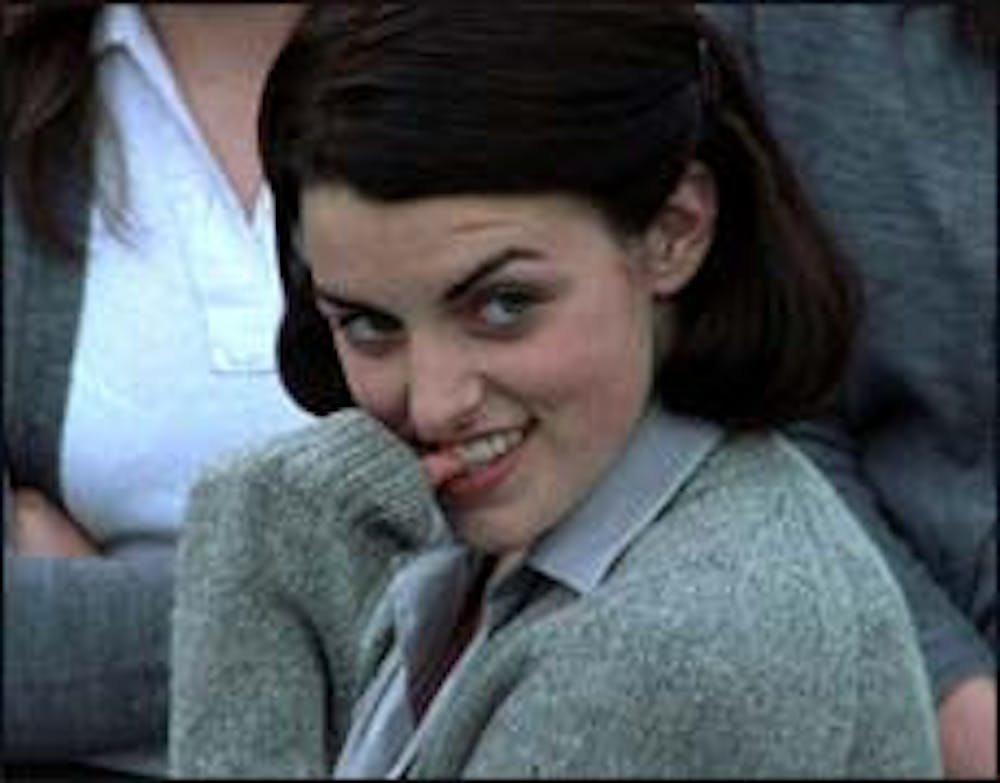
Beads of sweat drip off the brow of a priest as he beats tribal, Irish drum music into a crowd of wedding guests. The haunting sounds continue to boom through a too-full room as we focus on Margaret (Anne-Marie Duff). The plain looking brown-haired girl unwittingly follows her male cousin into a bedroom upstairs. First he gives her a deep kiss. Then, despite her cries, he rapes her. Afterward, she goes back down to the wedding party and quietly sobs to another woman.
News of the rape travels through the dim room more quickly than the intensifying drumbeat. Men and woman dart disapproving glances back and forth. Murmurs, whispers, bowed heads. The information finally reaches another priest and everyone knows what must be done.
The priest comes to Margaret's home the next morning and drives her away to a Magdalene Asylum for "bad girls"; evidently, she shouldn't have cried about being raped.
No words are exchanged in the first 10 minutes of Peter Mullan's (Trainspotting, Braveheart) The Magdalene Sisters, yet the quick camera shots and wailing drum song are powerful enough to immediately capture audiences. The film follows the lives of three "fallen" women who are condemned to a Catholic asylum to atone their "sins": Margaret, a victim of rape; Rose (Dorothy Duffy), a mother of an illegitimate child; and Bernadette (Nora-Jane Noone), a wide-eyed, pouty-lipped girl who is too pretty for her own good and therefore a dangerous temptation to boys. But to regain their purity, these branded "hussies" aren't in the asylum praying for God's forgiveness or uttering Hale Mary's; for penance they hand-wash laundry 364 days of the year. It seems that scrubbing sheets and soaking stained knickers gets you a first-class ticket to heaven.
While the film may seem like it is set in the Dark Ages, The Magdalene Sisters actually takes place in 1960's Ireland. The movie is based on accounts from women who actually survived the real-life asylums, named after the Biblical prostitute, Mary Magdalene, who seeks forgiveness for her sins.
The parents, who sent their daughters to Magdalene Asylums, condemned their children to sweatshop-like conditions. The nuns/wardens who ran the laundries did not allow the girls/prisoners to speak and often subjected them to beatings and humiliation. A memorable scene of the film shows a line of naked women and girls, reminiscent of concentration camps, absorbing ridicule from nuns who are judging each girl for titles of "hairiest," "biggest breasts" and "smallest bottom."
Noone was 17 during filming and said the movie was shot in Scotland because authorities and people in Ireland still refuse to own up to the controversy. Noone, who is Catholic herself, said she and her family were fairly comfortable with all aspects of the movie, even the nudity.
"Lots of the girls had trouble with the nude scene because many of them were Catholic," Noone says during an interview in Phoenix. "At the time I was doing the movie, my family knew [I would be nude], but they felt it was done very tastefully and that it was an important part of the story to be told.
"Some of the women who survived the asylums said the movie was mild compared to what they actually experienced."
Noone, 19, does such a flawless job of bringing fire and spunk to the character of Bernadette that you wouldn't guess that the movie was the actress's debut. Her depiction of Bernadette embodies the frustration, emotion and injustice of the situation. And you can't help but cheer for her as she roars with all her might while chasing nuns around the asylum with giant, metal candle stick holders.
Officials estimate that more that 30,000 women and girls were incarcerated Scottish and Irish Magdalene Asylums. The last one closed in 1996. While some have brushed off the movie as yet another opportunity to bash the Catholic Church, the film sheds light on a long-ignored, little-known, black eye in Irish history in a rousing, memorable way.
"The film is not anti-Catholic," Noone says. "There is a difference between religion and beliefs. If the people who had run these asylums had lived by their beliefs then none of this would have happened. It wouldn't have been pushed under the carpet. There is no need for people to be offended by the movie; it is just the truth."
Reach the reporter at lynh.bui@asu.edu.