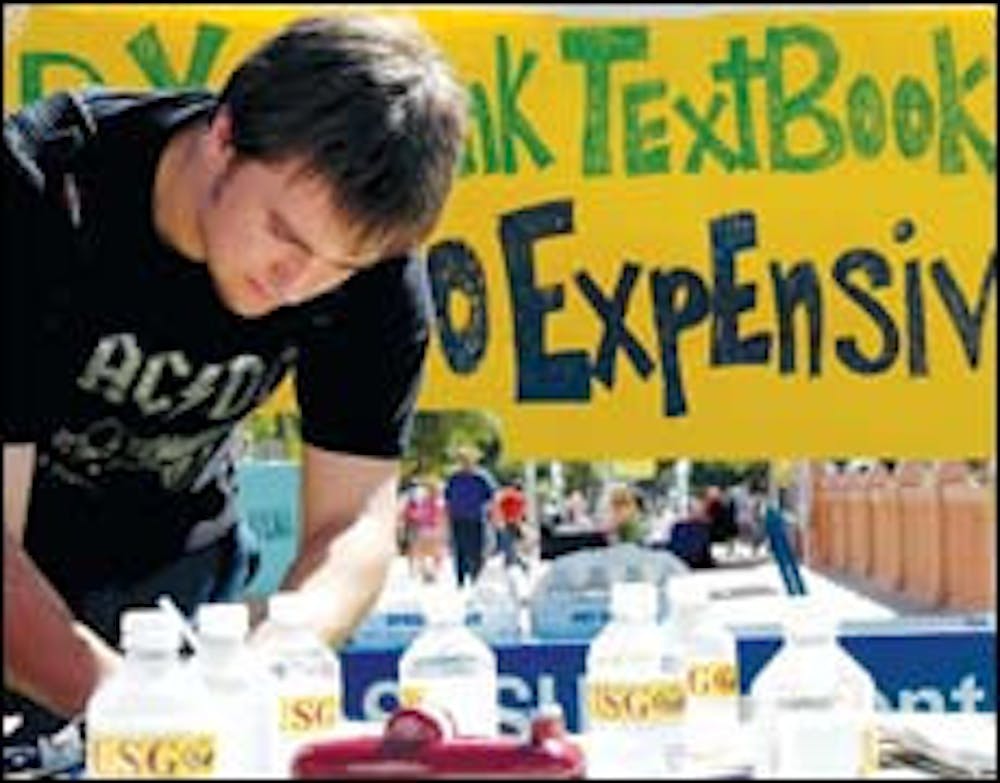
To protest textbook publishing practices, ASU's student government asked students to shred unwanted textbooks and supplements on Hayden Lawn Wednesday.
"Stop the Bundling Boondoggle" was part of a national student campaign to lower textbook prices. The rally was co-hosted by the Undergraduate Student Government and the Graduate and Professional Student Association.
Started by the California Public Interest Research Group, an organization that works with grassroots and advocacy groups, the campaign is trying to lower both textbook prices and the regularity of new editions.
Students were invited to destroy textbooks, workbooks, CD's and all other supplemental material. The pieces will be mailed to textbook publishers in protest.
About 200 people signed a petition supporting the campaign over the course of the day.
No books or materials were destroyed during the rally but that doesn't mean the event failed, said Ed Hermes, government relations director for USG.
Robert Fischer, vice president of external affairs for GPSA, said high textbook prices are an unjust burden on students.
"With the rising cost of higher education in general, it's critical for students to advocate, to be aware, to keep unnecessary practices from increasing the cost of education," he said.
Tim Gruhl, a mechanical engineering senior, said he didn't have books he wanted to shred but thought the campaign would work if USG garnered support.
"[USG] has to get the student bookstore along," Gruhl said.
The ASU Bookstore would like it if supplements and textbooks were sold separately, but it doesn't have the authority to make those decisions, Assistant Director Jim Selby said.
"We're not here to sell you a book you don't need," he said. "If [supplements] are not needed, someone should answer for it."
Publishers are adding supplements students don't need in order to raise their prices, Fischer said.
But Adam Gaber, the vice president for corporate communications at publisher Thomson Learning, said bundled materials are included only because instructors request them.
"What we're doing is satisfying market demand," Gaber said.
Supplemental materials are sold separately from textbooks, but teachers request them together, he added.
Instructors choose what they need for their classes, and people shouldn't question their judgment, he said.
"Professors are not impulse buyers," Gaber said.
Michelle Petersen, a Spanish lecturer and coordinator for Spanish 201 and 202, said supplemental material gives students essential added practice.
"I believe supplemental material is extremely important," she said.
Petersen said online textbooks and fewer supplemental materials might be cheaper but ultimately would not benefit the student.
"I don't think students would take it as seriously," she said.
State Press reporter Jourdan Rassas contributed to this article. Reach the reporter at michael.famiglietti@asu.edu.