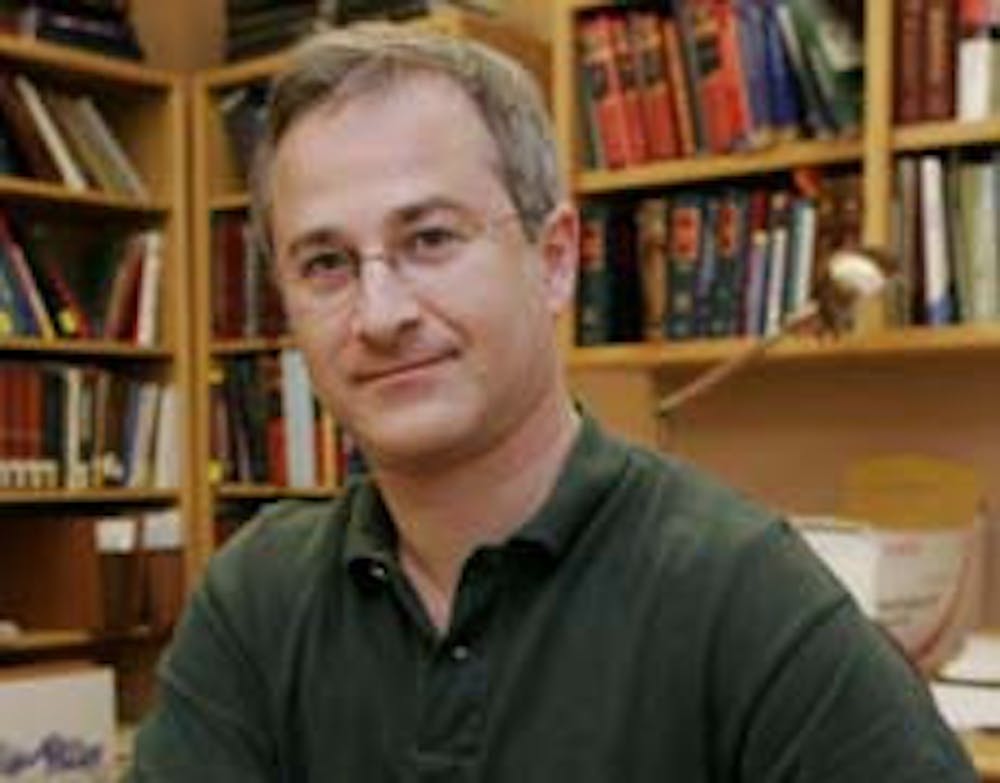
Thin, gold-rimmed glasses. Soft, carefully thought-out sentences. Office bookshelves covered in books, magazines and holiday cards.
At first glance, Orde Kittrie seems like every other professor.
But as a leader at the U.S. Department of State, he helped fight transnational crime and create Arab region anticorruption initiatives.
He now also has the distinction of being one of the top Latino international legal minds in the country.
An associate professor of law at ASU since 1994, Kittrie was one of four law school professors named in the Dec. 5 law-school issue of Hispanic Outlook in Higher Education magazine as one of the nation's top Hispanic international legal experts.
"My sense is [I received the distinction] because I've had a fairly interesting legal career and because I've been quite active in issues relating to the Latino community," Kittrie said.
He is also a faculty adviser for the Chicano Latino Law Students Association and is one of ASU's representatives to the Arizona-Mexico Commission, a government organization that addresses border issues.
He is also a legislative committee member of Los Abogados, the Maricopa County Hispanic Bar Association.
"We've [profiled] various Hispanic lawyers and/or law professors that we put in the law-school issue," said Suzanne Lopez-Isa, managing editor of the magazine. The edition has been running for eight years, she said.
Prior to his hiring at ASU, Kittrie worked for the U.S. Department of State for 11 years on a variety of issues, including computer crime, nuclear nonproliferation agreements and U.S.-Mexico border relations.
"It's great as a professor to teach a subject you've worked on for so many years," Kittrie said.
"He has just done so much diplomatic work," said Marilyn Gilroy, the magazine article's author.
"He's done work at the highest levels and lowest levels in terms of just helping Mexican-Americans and immigration issues."
Kittrie's background, record of service and his academic qualifications made him unique in the field of international law, Gilroy said.
Patricia White, the dean of the College of Law, also said Kittrie's experience is a great asset to the University.
"What professor Kittrie brings to the table is a wealth of important experience which enriches the lives of our students," she said. "He's energetic and devoted to students and is really throwing himself into this new career with great enthusiasm."
Patricia Aguirre, a second-year law student and president of the Chicano Latino Law Students Association, said Kittrie's work experience and cultural heritage are helpful for students.
"He has this very unique background that makes him more understanding and more sensitive to relating to students of different backgrounds, including students of color and the Latino community," she said.
Kittrie said the college's international programs have blossomed in recent years.
"This law school has gone from having relatively little to offer in international law course offerings to being one of the finest international law programs in the country," Kittrie said.
Lopez-Isa said encouraging students and professors with Hispanic and other multicultural backgrounds in the field of law is important.
Hispanic students are "coming from a multicultural background, so that's going to be able to let them think about how things are going to work in other countries and with other nationalities," she said.
In 2004, the College of Law awarded 77 degrees to students with Hispanic backgrounds, 13 percent of the 591 total awarded, according to the ASU Minority Review.
Kittrie said he wanted his students to develop skills they could use to make a real difference in the world.
"Whatever their political views are, I want them to feel they can and should make a difference in the issues they care about," he said.
Reach the reporter at james.kindle@asu.edu.


