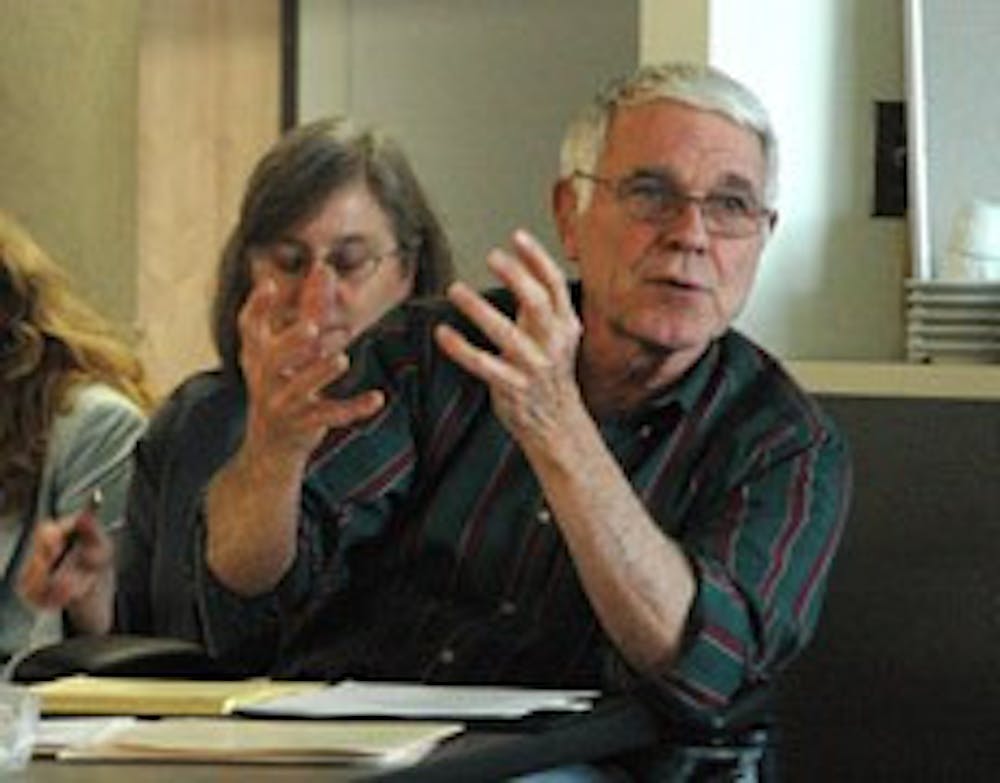
Professor Jane Maienschein has more than 4,000 books in her personal library. Her colleague Manfred Laubichler has more than 8,000 in his.
Now, these two biology and society professors, along with an international team, are building a digital library for everyone's use.
The online database, called the Embryo Project, will make information on controversial issues like stem cell research, cloning and abortion accessible to the public.
Maienschein is the director of ASU's Center for Biology and Society.
Through the Embryo Project, Maienschein, Laubichler and their team hope to enable scholars and voters alike to access information pertaining to embryo research.
Embryology is an important topic in today's society because of its public presence in politics and the ongoing discoveries made by scientists, Maienschein said.
At the same time, she said, the lawyers, judges, scientists and voters who are expected to make decisions about topics like stem cell research and cloning have very little accurate information at their disposal.
"It's really pathetic that the public is asked to vote on things like stem cell initiatives with so little understanding of what they're talking about," Maienschein said.
Funded by a three-year $750,000 grant from the National Science Foundation, the Embryo Project will look at various aspects of embryology - not just biological concepts.
"We don't go in the lab and tear apart embryos and study them," Maienschein said. "We study how people have understood embryos over history."
The database will include scientific, historical, legal, ethical and cultural literature of embryo research, Maienschein said.
It will be a valuable resource for scientists who often don't make the effort to look up historical concepts relating to their research, she said.
"In the science lab, you look at stuff from the last couple years at most because you're not trained to look at the older material," she said. "The most interesting work might be a hundred years ago.
"There were great ideas that were set aside because they didn't have the technology yet."
For example, the first work with stem cells was in 1907. Many people, however, think stem cells were a recent discovery when they came into the public eye in 1998, Maienschein said.
If scientists in 1998 had remembered the advances made about 90 years before, they might have pursued better multidisciplinary approaches to embryo research, she said.
Graduate student Mary Sunderland said scientists studying regenerative biology can use the database to access concepts developed in the late 1800s specifically pertaining to regenerative organisms.
About a hundred years ago, scientists were studying the planarian, a flatworm that has the ability to regenerate body parts that have been cut off, she said.
With the database, today's researchers can build off of old ideas, like studying the planarian, Sunderland said.
The ASU team is collaborating with international specialists in compiling relevant literature for the database, Laubichler said. Several workshops, including one held Sunday and today, will create a forum between experts in different fields.
"This is an ongoing effort to digitize our culture, our scientific heritage," Laubichler said.
Reach the reporter at: annalyn.censky@asu.edu.