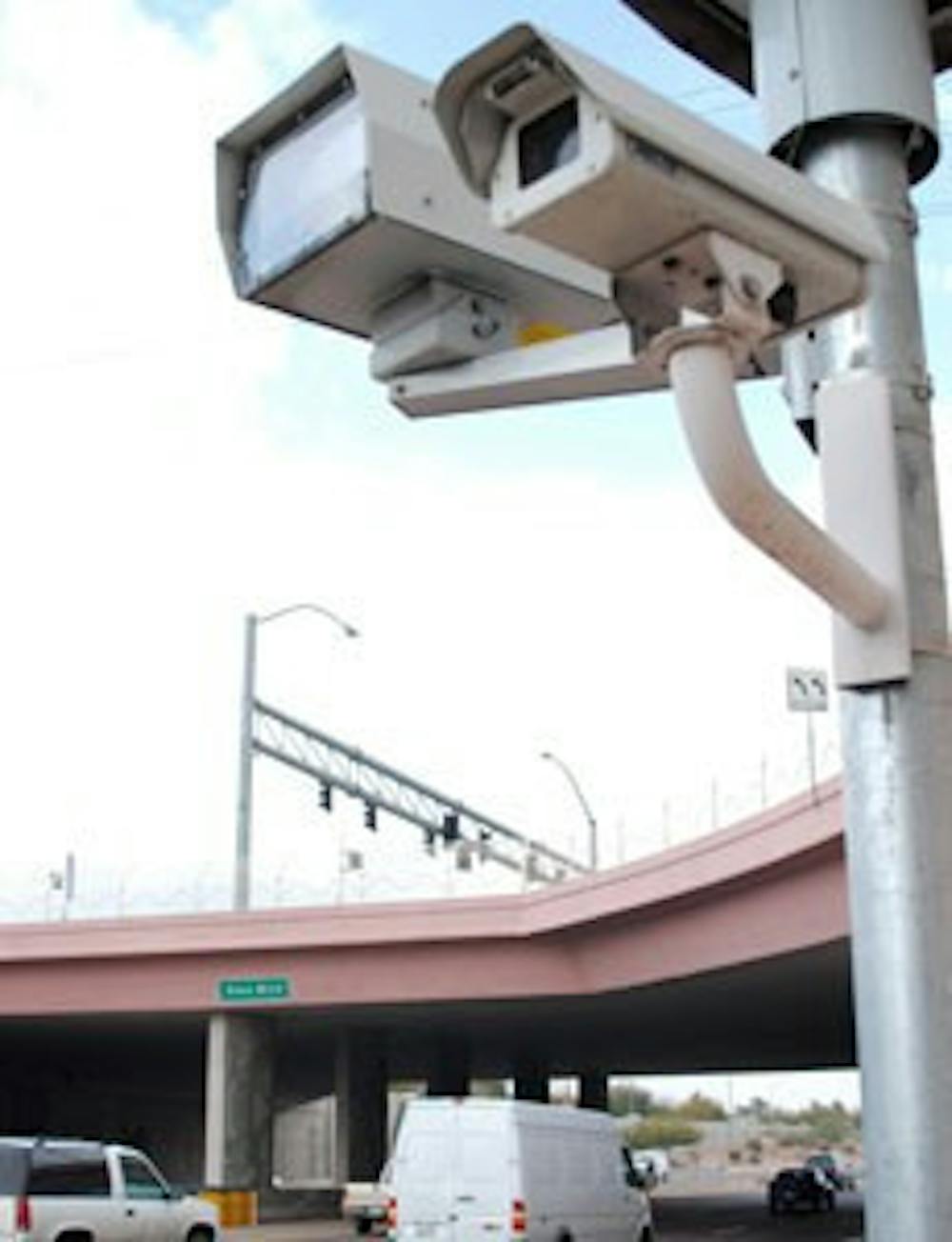
Six photo radar cameras along Loop 101 are set to be reactivated Feb. 22, but students like Hayat Bearat won't change the way they drive.
Bearat, a political science and journalism freshman who passes four of the six cameras on her way to ASU, said she hasn't noticed any differences in Loop 101 traffic since the cameras were turned off on Oct. 23, after a nine-month trial period.
And she does not expect any change when they are reactivated.
"People will pretty much drive the same [when the cameras are back on]," she said.
The Scottsdale City Council voted 5-1 to reactivate the photo radar cameras on Tuesday.
The cameras will photograph motorists traveling more than 10 mph over the posted speed limit of 65 mph.
Officials said this would keep the 101 safer.
"Once people are experienced with the cameras, they become more compliant with the speed limit," said Mary O'Connor, transportation general manager for the city of Scottsdale. "That reduces the number of collisions."
The average fine for those ticketed will be about $157, said Mike Phillips, media relations manager for the city of Scottsdale.
Phillips said there was one major reason for the council's decision to reactivate the cameras — public safety.
"Officers just don't have the same impact on the collision rate [as the cameras do]," he said. "The cameras slowed traffic, reduced collisions and made safer roadways."
He said the photo radar enforcement had "dramatic results" in regards to the number of accidents along the Loop 101.
While the cameras were in effect, there were more than 189,000 citations mailed out to motorists, an average of more than 778 per day.
Even with more motorists obeying the speed limit, Bearat said the Loop 101 is always crowded, with or without the photo radar.
Phillips and O'Connor said they have not heard of any traffic congestion issues related to the photo radar.
Simon Washington, an ASU professor of civil and environmental engineering, released a 92-page report evaluating the Loop 101 cameras in early January.
His reports stated the average speed of drivers on Loop 101 dropped about 9.5 mph while the cameras were in effect.
The portion of the 101 with cameras is anywhere between 30 and 60 percent safer when the cameras are activated, Washington said.
His research showed a decrease in the total number of accidents by nearly 50 percent and more than a 40 percent reduction in the total injuries.
Washington's research also concluded there are large economic benefits from the cameras as well.
"On an annual basis the 'public,' i.e., motorists who pass through this section of the 101, benefit about $10 million in reduced crash and injury costs," he said in an e-mail.
Gov. Janet Napolitano praised Scottsdale's photo radar enforcement in a letter to Scottsdale Mayor Mary Manross.
Phillips said Napolitano would ask the Arizona Department of Public Safety to take control of the cameras after June.
Reach the reporter at: samuel.good@asu.edu.