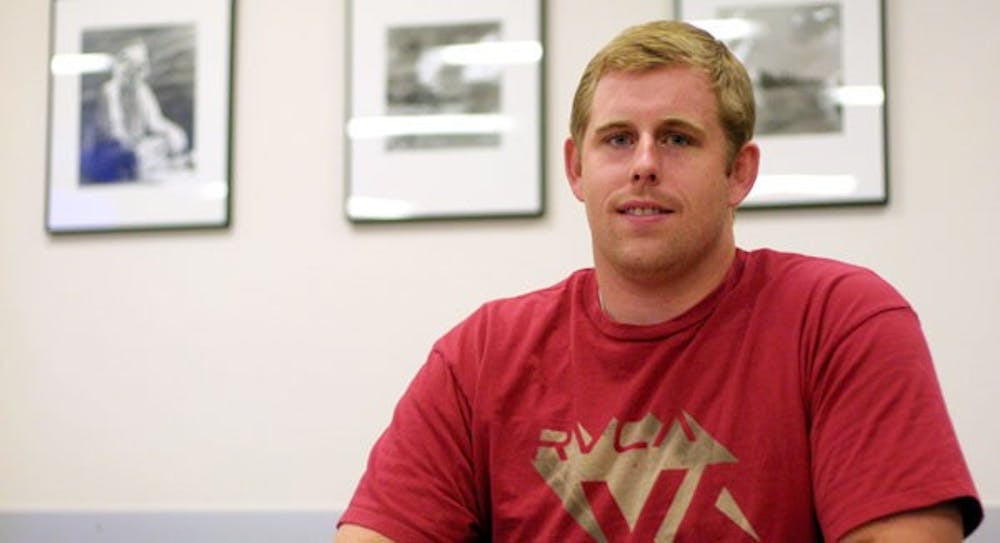
With natural disasters like Hurricane Katrina and the earthquake in Haiti and Chile, as well as poverty and homelessness around the globe, one ASU student decided there was a need for durable, low-cost and simple housing solutions in the form of shipping containers.
As part of the Edson Student Entrepreneur Initiative, Laron Turley, who graduated in May with a degree in finance and a minor in urban planning, received an award of $15,000 to pursue his business Home for Hope.
The Edson Student Entrepreneur Initiative at ASU provides funding and resources for student entrepreneurs.
“We’re designing and developing housing solutions that will help solve some of the shortages around the world because of disasters and poverty levels,” Turley said.
He wants to use shipping containers, which are large box-like structures, as basic housing. These would include sleeping compartments and a small living space.
He said traveling to Peru and other countries with areas of poverty, as well as his urban planning, construction management and design experience at ASU, led him to the idea.
Turley said he wondered “what can be implemented to help people that live in cardboard, live in tarps and have no real shelter, no real protection from the elements.”
The year-long Edson program based at SkySong, the ASU Scottsdale Innovation Center, starts July 1.
Turley is the team leader of his business, which includes three other students, two of whom attend other universities.
He said one team member is his brother, and he went to high school with the others.
“We’re very spread out, and we’re trying to figure out how to run a home base,” Turley said.
He’s considering shipping containers and other recycled materials, wood, Styrofoam and hard plastic for his housing shelter design.
“A lot of agencies and products out there are meant for short-term relief following a disaster,” Turley said, as well as transitional products.
However, he wants to create a long-term housing product to eliminate the need for transition.
“A lot of other products are like canvas tents or plastic-type products,” Turley said. “We thought with a shipping container…it’s very durable, it’ll last forever and can be transported fairly easily around the world.”
He said there are other companies with similar ideas, and shipping container houses are already being used, but one design for his housing product includes a living space extension.
“Our design actually expands the square footage of the container,” Turley said. “It actually opens it up and has compartments that slide out.”
One of the shipping containers he plans to use is 20-by-8 feet, which is only 160 square feet of living space, he said.
The “sleeping cabs” slide out from each end and can expand the square footage by 60 percent, as well as provide housing for up to eight adults.
“We turned something that is being used in other applications but expanding it with our design and allowing it to accommodate more people,” Turley said.
He said that is one way his team is trying to differentiate themselves from other companies.
“It’s hard; it’s competitive,” Turley said. “There’s a lot of different things out there and it’s kind of ‘who do you know’ in a lot of ways.”
Turley plans to market his idea and hopefully provide a functioning prototype to a shelter in Phoenix.
“Phoenix has a high number of homeless people,” Turley said. “We’d like to get in contact with one of the shelters here and possibly create a community of these container units that would be flex housing for homeless people as they…transition between homelessness and having a house.”
Although the main focus of his business is long-term housing, he’s also made a design for durable short-term housing that would use a tent and other materials
“We probably won’t go that route,” Turley said. “It’s something that would be deliverable almost instantly, really, after a disaster.”
For some places where it would be difficult to ship a container to, it could be delivered by plane and set up easily.
“We want to develop something that can be used in any situation, really, and maybe that’s multiple products,” Turley said.
Another product might include a kit with materials to improve shipping containers.
He said that he’d like to go global with his idea, but it can be cheaper for other countries to work with existing containers rather than pay for expensive shipping.
Turley might spend time in Brazil in July for an internship, so he said he wants to negotiate with the city of Rio Grande.
“We’re hoping to make a contract out of it and to do a small community of units there,” he said.
The funding from ASU will help Turley and his team by providing not only money, but also resources like contacts, mentoring and training.
“They really do provide you a head start on your project or your venture,” Turley said.
Scott Perkofski, the program manager for the Edson Student Entrepreneur Initiative, said this is the sixth year for the Edson Student Entrepreneur Initiative funding, which helps students develop entrepreneurial skills.
“We want to showcase the entrepreneurial attitude and spirit here at ASU,” Perkofski said.
Students will completely own their business, so ASU has no intellectual property rights, he said.
“The more successful our student ventures are, the more successful ASU is,” Perkofski said.
He said the only requirement is that the team leader has to be an ASU student at the time of application, which is in March.
Home for Hope was chosen for its originality and solid team management, he said.
“It was kind of a unique idea, using existing materials like shipping containers,” Perkofski said.
Reach the reporter at reweaver@asu.edu