
“Prehab rehab” isn’t the latest celebrity trend.
The high-tech process is actually an annual tradition for the ASU women’s tennis team and could be keeping the team healthier than standard training.
The team participated last week in the muscle evaluation process that ASU tennis coach Sheila McInerney calls “prehab rehab,” something it’s done for the last five years.
Each player was tested from head to toe at Physiotherapy Associates in Scottsdale, a clinic run by ASU alumnus and certified US Professional Tennis Association tennis teaching professional Todd Ellenbecker.
Ellenbecker is an expert in the different muscles that tennis players use and how to rehabilitate them.
The tests conducted give the athletes and coaches information about the athletes’ weaknesses so they can prevent injury before and during the season.
“It’s a really great program,” McInerney said. “We’re so lucky to have a resource like this at our back door.”
Some of the tests give the athletes information about themselves that they never even knew.
Last year, senior Micaela Hein learned she has one leg that is longer than the other.
“It helped a lot, knowing what is wrong with you and being able to do something about it,” Hein said.
After Hein discovered her weakness, she had a specialized workout routine designed to avoid injuring herself. Hein stayed away from track exercises, and as a result had fewer injuries and no issues with her feet last season.
“Injury prevention and maintenance can help you last the season or give you a competitive edge,” said Tad Pieczynski, assistant clinical director and physical therapist for Physiotherapy Associates.
Everyone on the tennis team held their breath while they watched their teammates take the dreaded abdominal test.
The abs test consists of placing a blood pressure cuff under the small of the back, and then lifting one leg up at a time while keeping the body in the same position. The player getting tested must repeat the exercise for nine additional repetitions.
In order to pass, the player had to maintain the same blood pressure. If the athlete rotated her body while doing the exercise, the pressure would change, indicating a fail.
The purpose of the test is to determine how developed the core muscles are. The ability to maintain the pressure while lifting each leg up indicates control of the deeper abs.
“Most people fail that test,” Pieczynski said. ”Most people, whether they have a six-pack or a gut, have weak middle abs.”
Last year, a few members of the team struggled with the test. Junior Sianna Simmons was one of them.
McInerney took the results to the team’s athletic trainer, and last season the team focused on workouts that developed the core muscles.
This year, every player passed the abs test with ease, which the team saw as an achievement worth celebrating.
The team also took more tennis specific tests. Some measured the player’s backhand or overhand strength.
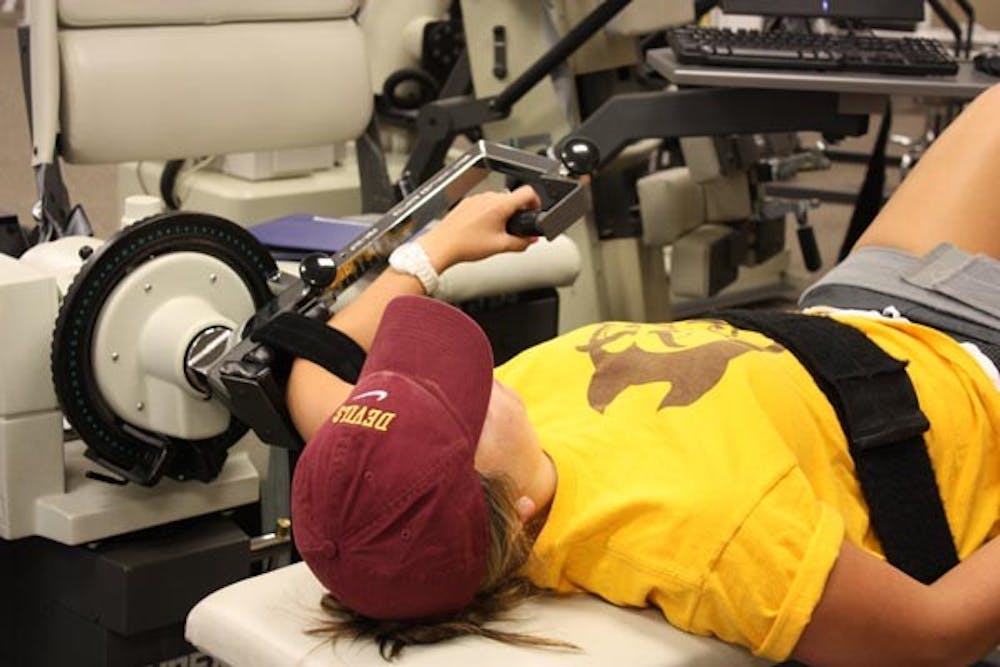
For those tests, the players used an isokinetic machine that isolated the shoulder area to test their muscle strength. The isokinetic machine was attached to a computer that measured the torque output of the muscles being tested. The results were converted to measurements that can be used to measure strength.
Happy with their results from Physiotherapy Associate, the team looks to have an injury free season and achieve a 24th straight appearance at the NCAA Championships.
Reach the reporter at nklauss@asu.edu