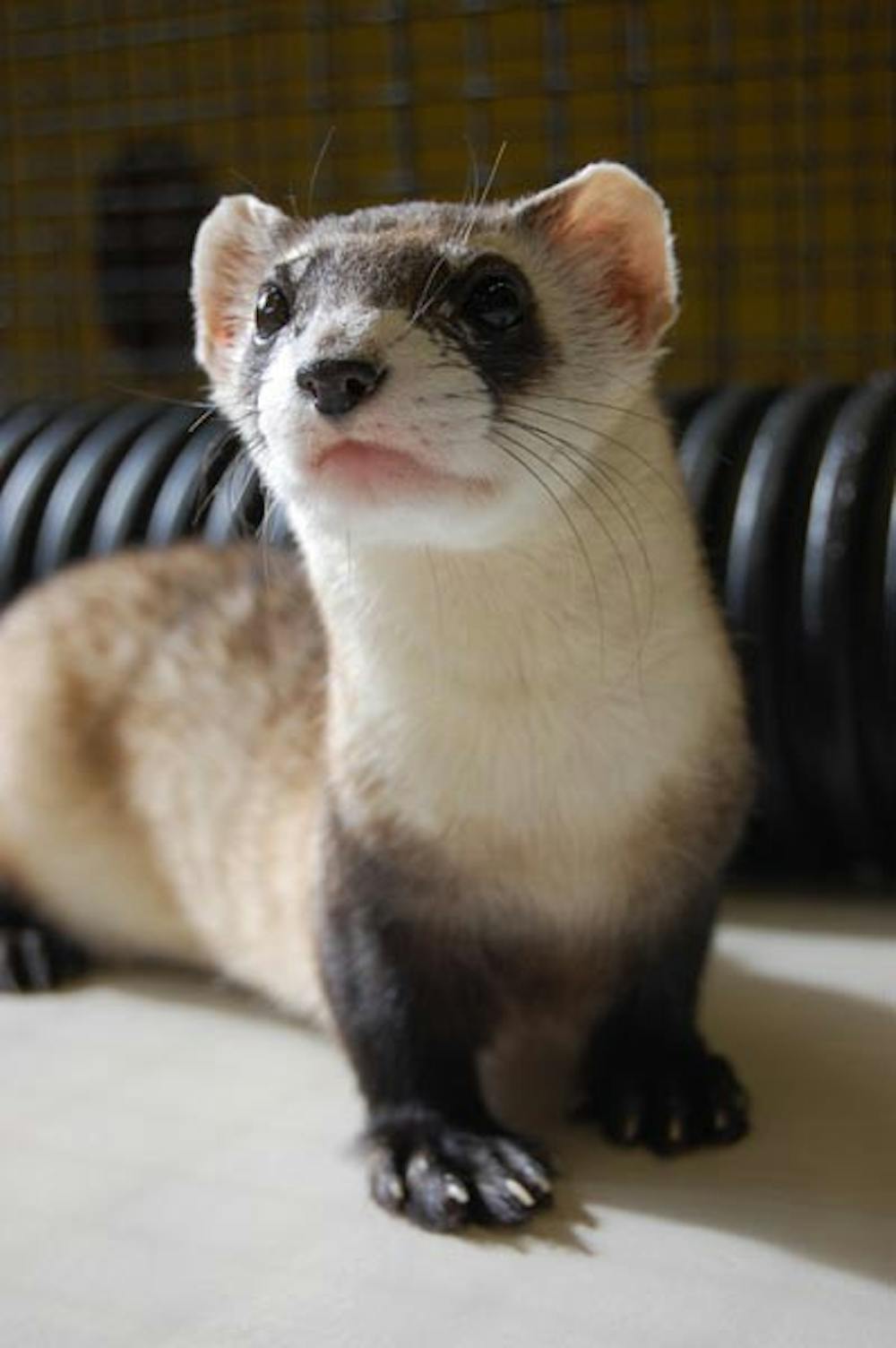
 FIGHTING FOR LIFE: The Black-footed Ferret is among one of 64 endangered species that are responding positively to the efforts of zoos and conservation efforts. (Photo Courtesy of the Phoenix Zoo)
A newly released scientific study shows one-fifth of Earth’s vertebrates are facing a dinosaurs’ destiny.
The study was un-embargoed Oct. 27 by the international journal Science during a convention on biological diversity in Nagoya, Japan, and uses data collected within the Red List of Threatened Species to analyze 25,000 species of vertebrates.
The Red List of Threatened Species is a comprehensive information resource on the global conservation status of plant and animal species. It is produced by the International Union for Conservation of Nature, the world’s oldest international ecological conservation network.
The study, which involved 174 authors from 115 institutions and 38 countries, confirms a rising global decrease in biodiversity, but it also demonstrates evidence supporting the positive effect of global conservation efforts, like at the Phoenix Zoo, said School of Life Sciences Biology Professor Andrew Smith.
Smith serves as chair of the International Union for Conservation of Nature’s Lagomorph Specialist Group, which focuses on 90 species of rabbits, hares and pikas, and was a contributing author for the study.
He said on a global scale, 41 percent of amphibians, 25 percent of mammals and about 13 percent of birds are currently facing survival threats that unless counteracted will lead to extinction.
“We found that about 90 percent of the species were doing worse, and about 10 percent of the species were doing better,” Smith said.
He said researchers are able to analyze the 10 percent of endangered species that are responding positively to conservation actions and discover what monetary investments and conservation efforts work effectively.
Smith said the study highlights the California Condor and the black-footed Ferret as two of 64 success stories.
He said these two species were extinct in the wild, but because of conservation efforts, in part by the Phoenix Zoo, they have been successfully reintroduced into several ecosystems globally, including Arizona.
The Phoenix Zoo is one of six global Black-footed Ferret breeding facilities. Other facilities are in Wolf Creek, Colorado, and Janos, Mexico.
“In the case of the Black-footed Ferret, there were only eight drawn from the wild to reproduce — that was all there was left,” said Stuart Wells, the director of conservation and science at the Phoenix Zoo. “There has been about 7,000 born [in captivity], 6,000 released to the wild, and it is estimated that there are about 1,200 living in the wild now where they were absolutely gone.”
Wells said in respect to the California Condor, the species population had declined to a non-viable level, which Smith said is around 50 animals. It was then bred in captivity and is now existing and breeding successfully in the wild.
Wells said the Phoenix Zoo is currently involved with six conservation projects featuring the Chiricahua Leopard Frog, Masked Bobwhite Quail, Mount Graham Red Squirrel, Narrow-headed Gartersnake, Three-forks Spring Snail, and the Black-footed Ferret.
He said the Phoenix Zoo is very selective in regard to the different species it will shelter for conservation.
Wells said the Phoenix Zoo tries to identify projects that have an active recovery component in place for reintroducing a species into the wild.
“We want to stick with a species that we can work with and make a difference in their survival,” he said. “We hope for some measure of success to be possible, but that doesn’t deter us from trying.”
Wells said through controlled breeding, organizations such as zoos are able to draw focus to little-known animal groups and play an important role in the intensive management of wildlife numbers.
An additional 20 percent decrease in worldwide biodiversity would have occurred without current global conservation efforts, according to the International Union for Conservation of Nature website.
Smith said while the study illuminates a spark of hope though animals such as the black-footed ferret and California condor, it also informs researchers that areas in Southeast Asia are currently experiencing the worst loss of biodiversity on Earth.
“If you had to put all your conservation efforts in the world into one place, that’s where you would put them,” Smith said.
The loss of wildlife in Southeast Asia is partly due to the eating habits within the culture.
“They eat everything that has four legs but the table,” Smith said.
Smith said other problems facing Southeast Asia’s ecological security are massive deforestation for oil mining and illegal trade of endangered species.
“I’ve been to the Guangzhou Animal Market and these animals are just crammed into these tiny cages, and they’re just stacked everywhere in these little stalls; it’s just the most incredible thing you’ve ever seen in your life,” he said somberly. “And there are huge, huge aquariums that have so many snakes in them the ones at the bottom are dead because of all the weight.”
The Guangzhou Animal Market in Southeast Asia is a black market that specializes in the sale of endangered wildlife. It is often dubbed the birthplace of SARS, the 2003 Severe Acute Respiratory Syndrome worldwide outbreak.
Reach the reporter at tdmcknig@asu.edu