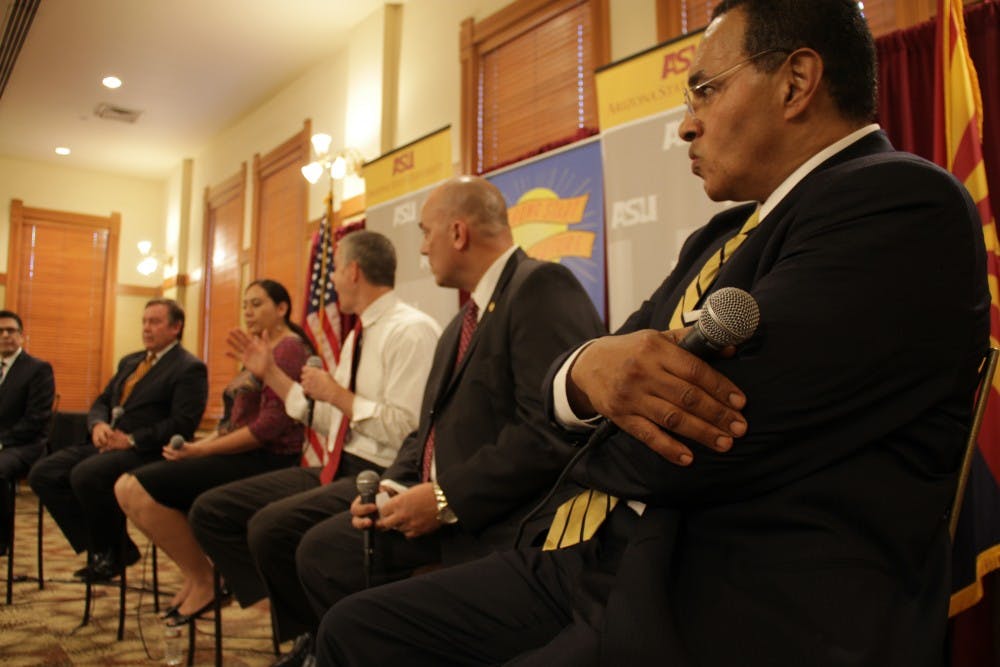
 Secretary of Education's Back to School Bus Tour stopped at Old Main on Wednesday afternoon and featured a panel of leaders in the education field answering ASU students’ questions. ASU President Michael Crow; Alejandra Ceja, executive director of the White House Initiative on Educational Excellence for Hispanics; Arne Duncan, U.S. Secretary of Education, Kent Scribner, superintendent of Phoenix Union High School District, and Freeman Hrabowski, University of Maryland, Baltimore County president, were on the panel. (Photo by Shawn Raymundo)
Correction added.
U.S. Secretary of Education Arne Duncan’s annual Back to School Bus Tour arrived at the Tempe campus Wednesday.
Duncan and a panel of educators spoke to a room filled to capacity with people waiting to hear the secretary's views and plans for minority students.
"You basically need a Ph.D. to go to college these days, and that's not fair," Duncan said.
The panel included ASU President Michael Crow; Alejandra Ceja, director of the White House Initiative on Educational Excellence for Hispanics; Phoenix Union High School District Superintendent Kent Paredes Scribner and Freeman Hrabowski, president of the University of Maryland Baltimore County.
The panelists discussed issues facing minority students, specifically Hispanic minority students, related to affordability and availability of college.
“Not every child starts the educational race at the educational starting line," Scribner said.
Educational starting points soon fell to a discussion about the economic affordability of higher education.
In recent years, tuition at institutions such as ASU and the University of Maryland has skyrocketed well beyond the affordability level for many minority students, Ceja said.
Camelback High School senior Vanessa Soto asked the panel about the increasing necessity for students to take out student loans to pay for their education. Crow stressed the fact that even though tuition has gone up, ASU, along with other universities, is doing what it can to accommodate those students.
“Our objective is to meet each student where they stand," Crow said.
The Federal Pell Grant Program for low-income students helps make college more affordable for students, and more than 9.6 million students received a Pell Grant this year, Crow said.
The government-funded grant provides up to $5,550 to students with financial need, as determined through the Free Application For Student Aid. The Pell Grant does not need to be repaid and is renewable annually as long as the students continue to meet the financial aid criteria.
The panel also answered questions about what secondary and higher education institutions are doing to help students become competitive in the workforce.
“The big deal is to get students involved in internships," Hrabowski said. “The key is hands-on experience.”
The panelists agreed that existing programs are not enough by themselves and shared many thoughts on what could be done to improve the system.
Crow said something had to be done to increase the vocabulary of children as young as 2-years-old. Duncan specifically talked about the importance of having programs such as Head Start to help younger children start off with a competitive and enthusiastic mind.
Nevertheless, Duncan said many of those ideas would take time to pass because of the current Congressional climate.
“Congress is pretty dysfunctional right now, sadly," he said. "When they get their act together, there is no better place to start than education.”
Reach the reporter at Anthony.A.Marroquin@asu.edu or follow him on Twitter @tonymarro11
Correction: The caption accompanying the photo in this article did not contain the full name of Freeman Hrabowski's institution. It has since been updated.