 You know something's wrong when corporations and activists are actually working together.
On Sept. 10, Reddit, Kickstarter, Mozilla, Etsy, Wordpress and many other major web-based companies will answer Internet activist group Fight For the Future’s call for an “internet slowdown."
The corporations will participate in the “Battle for the Net,” adding widgets on their website displaying a proverbial “spinning wheel of death” to raise awareness and show what the Internet would look like without net neutrality. These companies should be commended for fighting for a cause that is both vastly important and vastly underrepresented.
At first look it may not seem like a big deal. It’s just web data right? But the issue goes far past web content and into ideas like freedom of speech. By allowing the Federal Communications Commission to dissolve the principle of net neutrality, the idea that all web content should be treated equally by Internet providers, we are placing the future and the power of the Internet into the hands of the people who would abuse it the most.
But what does that mean? It means that they can create a “two-tiered” Internet, separating web traffic into a fast and slow lane for different companies. Putting most websites in the slow lane and allowing wealthy corporations and big companies to pay hefty fees to access a fast stream of Internet will essentially allow discrimination via the Internet. It means that Internet service providers could shake different sites down for extra fees like they did with Netflix last spring. It means that they could block content and speech they disagree with and reject applications that compete with their own.
Basically, it could mean a lot of things — none of them good.
Perhaps the most scary implication is the extensive and growing nature of the Internet itself. The web is still a fairly new-found asset. This is a place where someone raised $55,000 on Kickstarter to make himself a potato salad but also a place where awareness can be raised about issues such as net neutrality without the worry of censorship by private corporations.
The Internet community is still in its early stages of development. If this immense and almost unlimited power is handed to private corporations, then it will no longer be individuals expressing their culture and building something both incredibly strange and incredibly human. It will be cable giants like AT&T;, Comcast and Verizon using the Internet like a joystick.
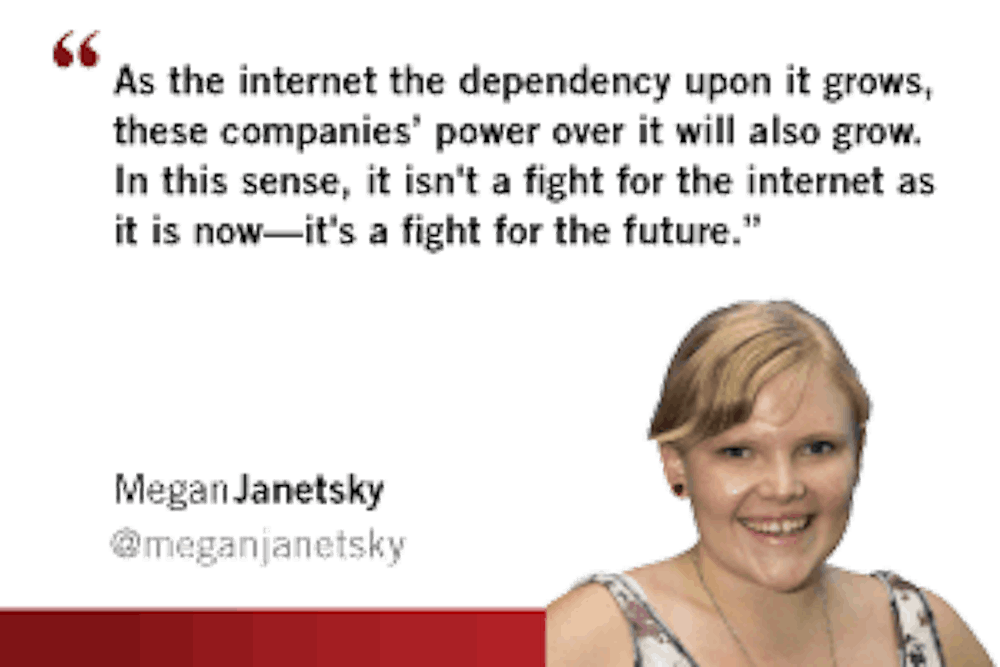
As the Internet the dependency upon it grows, these companies’ power over it will also grow. In this sense, it isn't a fight for the Internet as it is now — it's a fight for the future.
The Internet right now is a level playing field, a place where both big money companies and smaller, individual start-ups have fairly equal chances at success. If this equality is dissolved by the FCC, it will give the cable giants a free pass to mold the future of the web. The dynamic could shift in ways no one can predict.
It’s essential that the Internet stays an independent entity, one where both individuals as well as major corporations, like the ones actively supporting this fight, can exist outside the influence of excessive fees and censorship.
Reach the columnist at mjanetsk@asu.edu or follow her on Twitter @meganjanetsky
Editor’s note: The opinions presented in this column are the author’s and do not imply any endorsement from The State Press or its editors.
Want to join the conversation? Send an email to opiniondesk.statepress@gmail.com. Keep letters under 300 words and be sure to include your university affiliation. Anonymity will not be granted.
Like The State Press on Facebook and follow @statepress on Twitter.