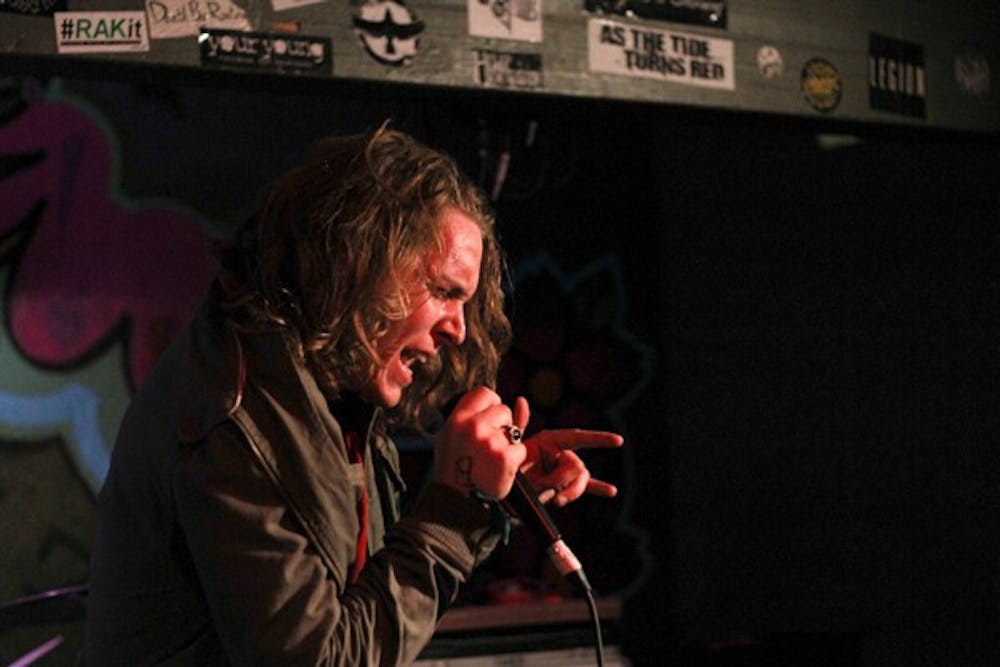
 Dane Jarvie sings during a performance at The Nile Underground on Sep. 9. (Photo by Zane Jennings)
By completely losing itself in its music, Senteons becomes one of those bands that is not only a good listen but can be taken as a form of visual, experimental art.
Bandleader Dane Jarvie has a long tradition in the local Tempe and ASU music scene, as he served as the chief of media of The Underground Foundation at ASU in its formative days.
Joined by his brother, drummer Luke Jarvie; guitarists Maz Barrezueta and Kevin McHone, and bassist Nick Regal, Jarvie set out to make something completely different with Senteons. The product is an interesting blend of more relaxed Mars Volta-esque spacey guitars with a tinge of psychedelia and early 2000s alt/indie rock male vocals.
I first heard about Senteons fall semester of last year. Last spring, the band dropped its first EP and engaged in a fairly intensive media campaign to promote the new release. Since then, Senteons appeared multiple times in various local publications, such as the Phoenix New Times, and have developed a reputation as one of the more atmospheric music experiences around.
A week ago, I attended The Mantooth Groups’s Hail The Sun show at the Nile Underground to see this for myself.
I can assure you it is something to see.
really liked the senteons set
— zane (@humanzane) September 10, 2014
The basement was sweaty, smelly and everything it should be. People were outside smoking in between bands, the streets were quiet and underage attendees sat inside holding awkward conversations while awaiting the next act.
It wasn’t too long until the band’s sound check was finished and the band had huddled up to get pumped for the show.
Minutes into the opening song, the rumors about Jarvie seemed to come true. Rarely do you see a local musician completely lose himself in his craft, but on a warm September night in the Nile Underground, I witnessed just that.
After the performance, I followed up with Jarvie over email with some questions about the group.
The State Press: What would you say the ethos of Senteons is?
Dane Jarvie: Our specific intentions regarding how we want the music to affect the audience will always change with every release.
One thing that has remained constant is this desire to create conceptual art, as a way to respond to a feeling of solipsism indicative of our generation. It’s a way for us to assimilate with our environment, or at the very least, acknowledge and work in tandem with it — to interpret it. Then again, I’m a romantic.
SP: It seems like every detail of the music is meticulously fleshed out — is this part of your overall mission?
DJ: This was never a conscious choice, and to be honest, every time I thought of artists I admired, I always imagined them to spontaneously create everything in one swoop. Seemingly un-edited, tastefully un-refined. To me, it seems that a lot of indie bands in vogue right now aim to record music in such a way that gives the impression of effortlessness — lo-fi recording techniques, warm sound, raw takes, etc. It’s a great thing to aim for. A very cool trick.
As a collective, we tend to romanticize the end product, the album, the song, far more than the actual process of its creation. It’s hard for us to imagine that this elating and immediate art form could be edited and revised 100 times over; it’s hard for us to imagine the work involved; how easy it is to let personal relationships fall apart during the writing/recording process.
After a while, songs tend to have a life of their own, and they take you where they want you to be taken. You begin to feel more like a passenger rather than a conductor towards the end of the writing process. Certain impulses drive your decisions, and the songs, once recorded, become unrecognizable. What you initially wanted and felt from the song changes, and you are typically left with another emotion entirely — regardless of key or scale.
I can’t speak for everyone. Maybe it’s different with more established art forms like country or blues. But this seems to be a fairly typical feeling amongst other artists I’ve talked to involved in experimental art forms.
SP: Some bands focus on the amount of content and try to get as much out there as fast as possible and play as many shows as they can. To my understanding, Senteons went the opposite direction, and you took quite a bit of time producing and setting a media campaign for your EP. Why was this important to you?
DJ: It takes a while for our band to decide on which songs we want to use for a record. We all have different tastes and goals for how we want music to sound, and that often can lead to conflict and a heap of scrapped ideas. Though we, as a band, have put out a limited amount of recordings, I personally have hundreds, maybe thousands of songs sitting in my computers hard-drive, collecting dust.
What takes the most time is deciding on a collection of songs that make some sort of unified statement, or are cohesive in one way or another. I could string together a bunch of random songs and call it an album, but it really becomes an art form when a collection of tunes flow into one another without fuss. Like one continuous song. That’s one of the aims of our band right now.
SP: What was the process like?
DJ: The process writing/recording our last collection of songs was definitely unorthodox because we had a different bassist at the time, and only four members. It was us figuring out ourselves and each other for the first time. It was us trying to construct our own sort of language from scratch, that would allow us to articulate abstract concepts and ideas. Above and beyond, it was a learning experience. A period of immense confusion and growth. A lot of the things we did in the last body of work, we would never repeat again in a million years. But I’m grateful for them happening.
SP: How did the band come together?
DJ: My brother Luke and I started the band. It was initially just us jamming. We slowly had members rotate in and out until we found a combination of people who worked.
SP: When playing live, it seems like you completely lose yourself to your music — to a level that I have never seen on the local level and am hard pressed to find on the mainstream. What is going through you when you're performing?
DJ: The easy answer is that consciously very little goes through my head when performing live. I try to not to think too much and let the music take control. Nothing is choreographed, nothing is staged. I listen to the music. If the music tells me to do the mashed potato, then I’ll do that.
SP: Who are your biggest influences?
DJ: They change every day. G.I. Gurdjieff, Bjork, Fela Kuti. I don’t get attached to any particular artist at one time, I try to keep an open mind. The worst thing a creative can do is to fixate on one or two artists. It opens up the chances for imitation. Be your own favorite artist and harshest critic. Pay close attention to yourself.
SP: What can we expect from Senteons moving forward?
DJ: We’re writing a new album. I can’t tell you an exact release date yet, but I can tell you it will be our best material to date. Stylistically, much will change.
Reach the reporter at zjenning@asu.edu or follow him on Twitter @humanzane
Like The State Press on Facebook and follow @statepress on Twitter.