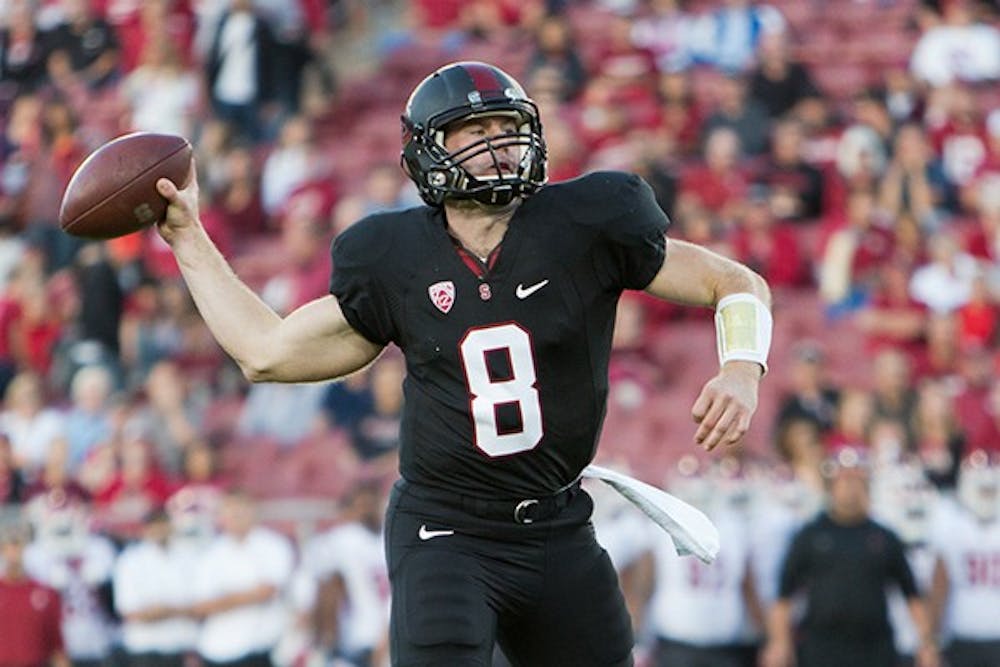
 Stanford quarterback Kevin Hogan throws the ball in a home game at Stanford. (Photo Courtesy of The Stanford Daily)
It's a Pac-12 showdown of top-25 teams in Tempe on Saturday night. After failing to chop any trees last year in two attempts, No. 17 ASU football hopes to defeat its kryptonite, No. 23 Stanford.
The Stanford Daily was kind enough to answer some questions for The State Press to give the opponent's perspective on Saturday night's game. Thanks to Daily football writer Winston Shi for participating.
State Press: Stanford seems to be a team without an offensive identity right now. The running game hasn't looked as physical as in the past. Is that the case? What do they have to do to score points on ASU?
Stanford Daily: Honestly, it all comes down to the performance of the offensive line. Stanford lost four starters from last year's OL, including three all-conference players and one Pac-12 honorable mention, and that's really been the only thing disrupting the overall continuity of the offense. Otherwise, most facets of the offense have either returned or gotten better. Kevin Hogan is back. The top three wideouts were all back (although Devon Cajuste is out this game after suffering a nasty injury against Washington State last week). The tight ends that redshirted last year have played far better than anybody could have expected — third-string TE Greg Taboada caught two touchdowns against WSU.
Regardless of who gets the majority of Stanford's carries, the run game would be fine if holes were opening up. Right now, they haven't been. That's to be expected when you replace four starters, and Stanford has recruited well on the OL, so I'm optimistic. However, the fact remains that although the OL opened up big holes against WSU, the run game has otherwise been spotty against Power 5 competition. I think there's a good reason why David Shaw's repeatedly called for passes from the shotgun spread on third-and-short this season.
If ASU's defensive line plays well, Stanford will have trouble. If it doesn't, Stanford has the talent at the skill positions to score its fair share of points. So far, the Cardinal have had the misfortune of playing USC, Notre Dame and Washington, all teams with excellent defensive lines, and all very tough acts to follow. We'll see whether ASU can meet that standard.
SP: Speaking of scoring, that's something the Cardinal haven't done much of in the red zone, with only 68 percent efficiency. What has caused those woes, and is there a fix in sight?
SD: It's easy to blame Jordan Williamson for his missed field goals, and indeed, after his stellar performance last year, his miss rate this year has been inexcusable. However, he should not be kicking so many field goals in the red zone to begin with. Teams can win championships by holding offenses to field goals in the red zone, and although Williamson kept Stanford's overall red zone scoring rate high last year, red zone TD percentage is something that's been declining for a while now. It's strange because Stanford has the big threats that you want in your red zone passing game. But while a lot of Stanford's failures can be chalked up to chance, the Card's execution has been a major issue.
Quite frankly, Stanford's red zone struggles have not been that much of a surprise. Stanford kicked Oregon up and down the field last year (the Cardinal led 26-0 in the fourth quarter), but the Ducks held Stanford to field goals in the red zone, and after some special teams miscues and late defensive breakdowns, Oregon made it a one-score game. Last year Stanford could blame red zone issues on a lack of tight end depth. That excuse is gone. I think the issues will right themselves, but it's not like Stanford's going to be automatic either.
SP: Has David Shaw talked about the two games last season at all? Todd Graham says he isn't using them as motivation, but he clearly hasn't forgotten about them.
SD: In his Tuesday press conference, Shaw didn't talk much about the Sun Devils. He's preparing for both potential quarterbacks, and he's got a healthy respect for Jaelen Strong. All of that makes sense, to be honest. ASU doesn't look like it's missed a beat with Bercovici. But I'm sorry that I can't really go in depth for you here. There's no need for Shaw to give Todd Graham any bulletin board material.
One thing I'd say is that Stanford will likely not overlook the Sun Devils. Stanford may have beaten them twice last year, but opening the season 3-2 will humble most teams. I expect the Cardinal to come out firing on all cylinders.
SP: Ty Montgomery is the guy on the offense and special teams we all know of and know is dangerous, just like A.J. Tarpley is on the defense. Can you name a player on offense and a player on defense that non-Stanford fans/students don't know who you think will make an impact?
SD: On offense, I have to point out the sophomore tight ends. Austin Hooper, Eric Cotton and Greg Taboada have all been excellent in the passing game, providing the sort of reliable outlet for the intermediate-level passing game that Stanford simply did not have last year. They've also been great going deep and in the red zone. Will they be as great as the previous troika of tight ends (Coby Fleener, Zach Ertz and Levine Toilolo)? We can't make those comparisons yet — all three of those players are now playing on Sundays. But they're as good of a tight end group as you'll find on the West Coast.
On defense, I should give props to the defensive line, especially nose tackle David Parry. Like most nose tackles, Parry doesn't really rack up that many stats, but he should be in serious consideration for first-team All-Pac-12, and his ability to penetrate the offensive line makes him a dark horse candidate for Pac-12 Defensive Player of the Year. Stanford's linebackers typically rack up the big sack totals in the Cardinal scheme, but as Connor Halliday will tell you, Parry's often the guy who has quarterbacks running for their lives.
SP: Finally, how does this defense click? Allowing 10 points per game — in the Pac-12, nonetheless? That's insane. What's the secret to its success, and is there a point of weakness where ASU should attack?
SD: Stanford does what it's always done: sit back in coverage, play conservatively, stop the big play and wait for the offense's drive to stall. Opposing teams have some success against Stanford when they're extremely well-drilled in the short passing game, but ever since Stanford figured out how to stuff the jet sweep, not much else has been successful against the Cardinal. Stanford's kickoff and punt return defense is lights out: because the defense can get consistent pressure with four rushers, is solid on the blitz and rarely makes big mistakes, eventually something bad will happen for the offense.
It's not even about sacks, really — it's about making the offense waste downs. Stanford gets a ton of sacks, but under Derek Mason the defense cared more about consistent pressure and forcing incompletions, hurries and checkdowns. Current defensive coordinator Lance Anderson is more willing to bring the blitz, but the principles remain the same. Let's put it this way: WSU's River Cracaft broke the WSU record for catches playing Stanford, but when you factor in sack yardage, the Cougars averaged about three yards per attempt. That's pretty darn good.
Quite frankly, I'd be more worried about Stanford's defense tiring out. If ASU can hit 90-100 plays using the hurry-up, no-huddle offense, they'll be able to make more big plays.
SP: And your prediction?
SD: Stanford 27, ASU 24, but to be honest, this game could go either way.
Photo Courtesy of The Sanford Daily
Reach the reporter at ewebeck@asu.edu or follow him on Twitter @EvanWebeck
Like State Press Sports on Facebook and follow them on Twitter @statepresssport