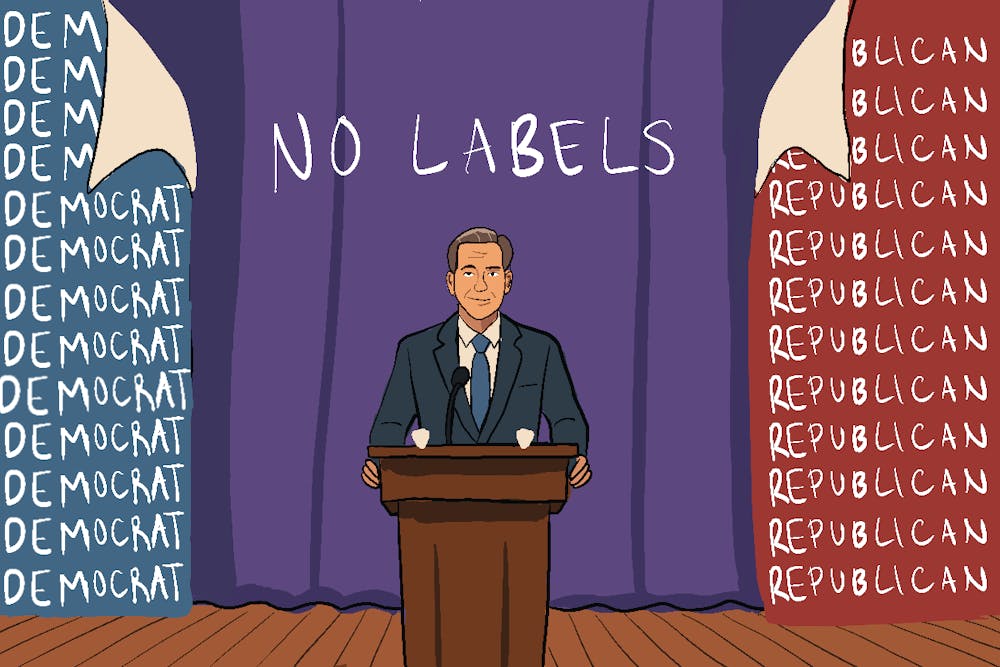
The Arizona chapter of the No Labels Party hopes to bring independent campaigns and candidates to voters amid increasing frustration with the partisan divide in politics.
As of July, over 1.5 million Arizona voters registered as "Other" or independent, which is about 34% of all registered voters in the state, according to the Arizona Secretary of State's office.
The No Labels Party is trying to capitalize on this large segment of voters seemingly dissatisfied with the Democratic and Republican parties, according to Paul Johnson, the chairman of the Arizona No Labels Party.
"Independent and unaffiliated voters have grown to be the largest group inside of Arizona," he said.
Despite Arizonans' interest in supporting third parties, independent candidates still struggle to get on the ballot. They face two barriers: a lack of a platform to support them and a higher signature count to have their names listed as options.
A candidate running under "Other" in the state primary needs more than 42,000 signatures to qualify, roughly six times more than Republicans and Democrats.
"That was done intentionally," Johnson said. "It was done and designed to try to keep independent voices out."
By officially establishing the No Labels Party, the new minimum requirement is 1,288 signatures. This is Johnson's way to open up the system and allow independent candidates to get onto the ballot.
As for the type of candidate the party looks to support, Johnson said there is no preference between those candidates leaning left, right, or center – they're just looking for those with frustration with the current two-party system and who have goals of reducing partisan divide.
However, the No Labels Party would prefer younger candidates – Johnson himself ran for the Phoenix City Council at just 25 years old – in an attempt to bring fresh blood into the world of politics.
"To think that I'm 20 years younger than the president of the United States blows my mind," Johnson said. "We need to get young, bright, intelligent people in."
To reach these potential candidates, the No Labels Party and Johnson have focused on outreach to organizations and groups catered to younger people to increase its name recognition.
"I come out, I give a slideshow, and I talk about what we're doing and talk about how they can get involved," Johnson said. "I listen to them and what they think matters, but I'm out there trying to engage people."
While the sheer number of independents in Arizona may paint a promising future for the No Labels Party, the historical struggles of third parties in the United States still stand as potential roadblocks. Chief among these roadblocks is the threat of third-party candidates having their policies or ideological grounds absorbed by one of the two major parties.
"If a third party has a good issue or a good argument, one of the two major parties, or both, are likely to say, … 'Maybe they're right, or maybe we ought to adjust our own policy positions to accommodate that new set of interests'," said Steven Smith, a professor in the School of Politics and Global Studies.
Smith added that this trend is especially prevalent for more moderate parties like No Labels and said this can leave the third party with "the rug pulled right out from underneath it."
Smith said the winner-take-all style of electoral votes presents yet another hurdle for third parties.
"For a third party that gets very successful and becomes the second most popular party, they still win no electoral votes, because they came in second," Smith said. "So it's not enough to beat one of the major parties. You have to start beating both major parties, at least in some places, in order to get any representation in government."
This uphill battle could discourage voters from supporting third parties, Smith said.
"Those 20-year-olds have had the same political dilemma: Go with the party that doesn't have much of a chance of winning, or go with the party that at least has some chance of winning, and pretty much that's what they've decided to do," Smith said.
This doesn’t mean that support for third parties is nonexistent among college-aged students, especially those at ASU.
Isaac Burdge, a fourth-year student studying chemical engineering, is a member of the ASU chapter of the national Young Democratic Socialists of America, a third-party political organization.
Burdge described the success he’s witnessed for YDSA at ASU despite their third-party status.
"Our chapter, we had our kickoff yesterday, we had a very good turnout, a lot of new members," Burdge said. "I know other chapters have seen even larger turnout."
Figuring out how to sustain membership is crucial. Burdge said that third-party support tends to increase after each election cycle before it tapers off when a new administration settles in, which is partly why he's skeptical about newer parties like No Labels.
"Even after the burst (of support), we're still able to sustain ourselves ... now through 2025, so I'm very confident we can sustain ourselves," Burdge said. "I'm not so sure with these newer parties.”
While the No Labels Party itself was founded in 2009, the Arizona chapter is no longer affiliated with the national party, making it a new organization still figuring out its message.
"We might call the No Labels Party the 'No Names' Party, because we don't know what they stand for," Smith said.
This perceived lack of identity for the No Labels Party has been picked up on even by those the party hopes to recruit: college-aged voters like Burdge.
"I don’t think (the No Labels Party) really has any guiding principles to lean on," Burdge said. "I think that's going to make them very ineffective."
For Johnson, the lack of a traditional ideology for the party gets at its entire purpose: a party that can be used by candidates with a range of views who are simply frustrated with how divided politics have become.
"How can you be pro-labor and not be pro-business?" Johnson said."They're connected. How can you be pro-business without being pro-education?”
The underlying issue for political experts like Smith is that no matter how many Arizonans register as independents, history has shown that Johnson’s formula for independent, moderate appeals has been largely unsuccessful, with Smith noting minor parties that last are typically more extreme.
This has not stopped Johnson and the Arizona No Labels Party from attempting to rewrite that history and engage college-aged people to do it.
"I need young, bright, capable people who are willing to step up and be willing to learn and willing to listen and willing to work with people that they may not agree with right up front, and to try to help us change this system," Johnson said.
Edited by Mia Osmonbekov, Henry Smardo, Katrina Michalak and Ellis Preston.
Reach the reporter at sluba@asu.edu and follow @samluba6 on X.
Like The State Press on Facebook and follow @statepress on X.
Sam Luba is the Lead Community and Culture Reporter at The State Press. He is a junior studying political science and justice studies with a certificate in political history and leadership. This is his fifth semester with The State Press, working previously as a Senior Reporter and part-time Politics reporter.