A Tuesday night lecture celebrating Constitution Day prompted conversation and debate about the governing document's applicability.
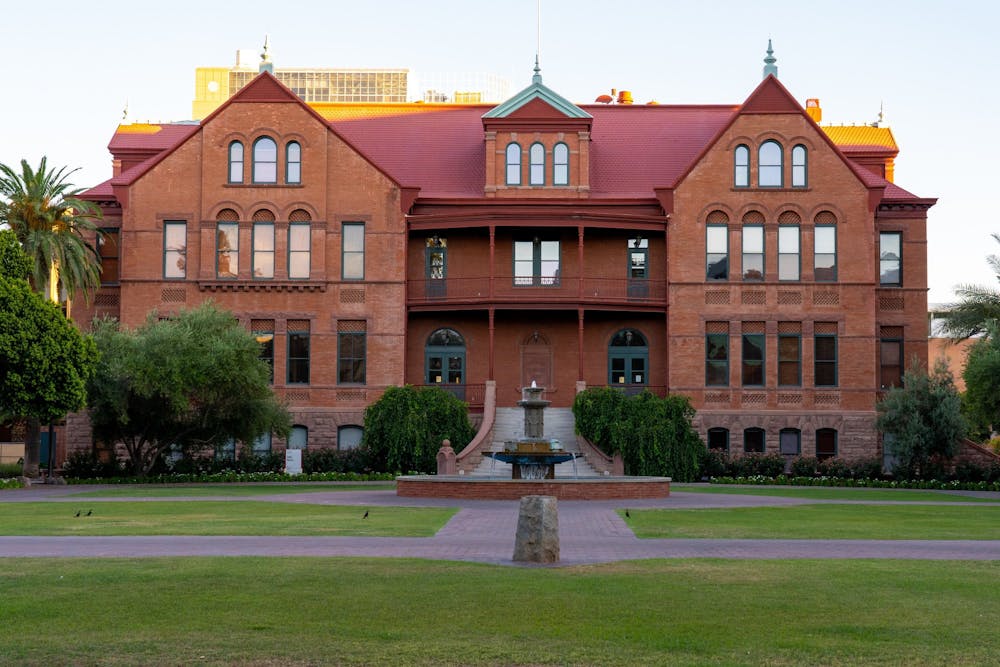
The School of Civic and Economic Thought and Leadership held its annual Constitution Day lecture at Old Main, marking 238 years since the signing of the U.S. Constitution. The foundational document was signed by delegates on Sept. 17, 1787, before being fully ratified by the states in 1788.
Charles C. W. Cooke, a senior editor at the National Review and the event's lecturer, said the Constitution's attention to human nature is one of the reasons the document has persevered through the history of the United States. The title of Cooke's speech was "The United States Constitution: A Work of Enduring Genius." While his speech mainly focused on optimism in the Constitution, some students shared their own concerns regarding its usage in contemporary politics.
"The drafters of the Constitution ... were obsessed with human nature," Cooke said. "They wrote the Constitution that accepted human nature as a constant, rather than try to change it by force."
Cooke said a popular criticism against the document's value is that the founders could not have imagined the modern world when writing the Constitution. He said that "doesn't particularly matter."
"I don't think you get, over a quarter of a millennium, to be in the position the United States is in now by accident ... It is true that the founders couldn't have imagined the modern world, but they did imagine an amendment process," Cooke said.
The amendment process allows the Constitution to adapt to changing times, but aspects of the document like the separation of powers have been weakened, Cooke said.
READ MORE: ASU hosts debate on national debt via The Steamboat Institute
One common concern among students in attendance was overreach by the executive branch. Elvie Eaton, a sophomore studying civic and economic thought and leadership, said while some components of the Constitution are being upheld, other aspects are lacking.
"For the most part, it's succeeding in its separation of powers," Eaton said. "But I do think we've seen recently some presidents take more power than maybe they originally should have."
Emory Maksymov, a junior studying management, said she also worries about overextended presidential powers. She said President Trump's disregard of Congress' TikTok ban in January is an example of this concern, something Cooke also mentioned.
"I know it's starting small, but I do feel like that is an unfortunate precedent to set that he can just start ignoring rulings like that," Maksymov said.
Sophia Thomason, a senior studying civic and economic thought and leadership, said the issues and complaints facing the Constitution aren't new.
"Originally, I was of the mind that we are actually in a constitutional crisis," Thomason said. "But when I think about some of the common complaints … I don't think (they're) actually that unique to our present day."
Even with their worries, Maksymov and Thomason said they aren't extremely concerned about the state of the Constitution.
"We're probably upholding the Constitution to the same degree that we have been throughout all of time, and our time is not as perilous as everyone might be thinking it is," Thomason said.
Cooke also attributed the political security of the U.S. to constitutional provisions.
"I don't think we are quite as divided as we were in, say, 1800," Cooke said. "I do think that, without the federal system now, we would be in danger now of breaking apart this country."
According to Cooke, the answer to the questions facing the modern U.S. is hiding in plain sight — right in its governing document.
"What I am celebrating here today is the Constitution actually exists right now," Cooke said.
Edited by Carsten Oyer, George Headley and Pippa Fung.
Reach the reporter at msweador@asu.edu and follow @miasweador on X.
Like The State Press on Facebook and follow @statepress on X.