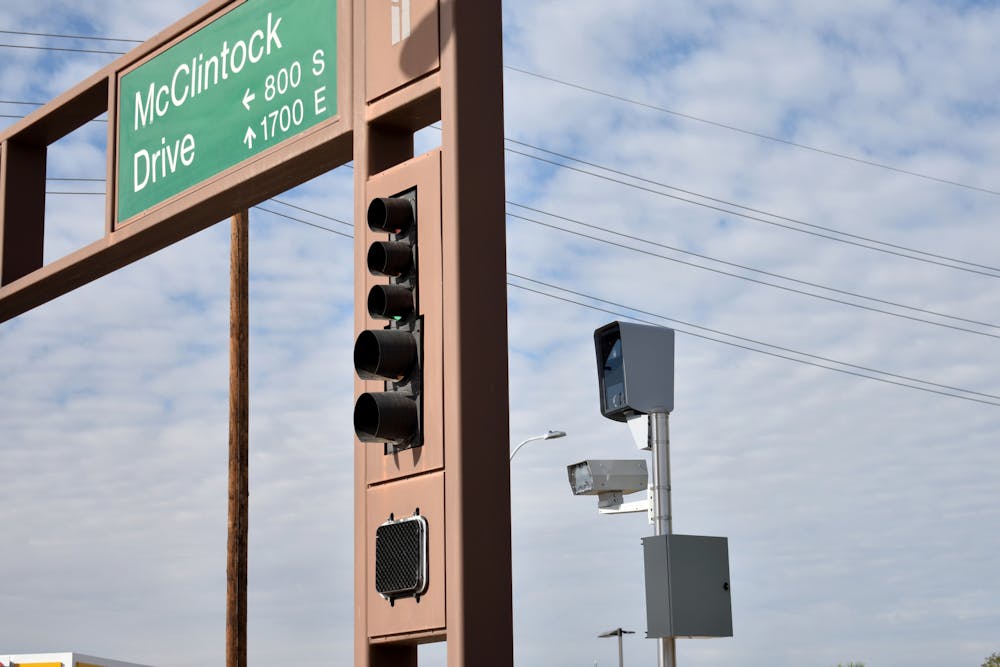
The Tempe Police Department maintains the necessity of recently installed traffic cameras, while many returning students noticed the addition of the equipment and questioned its effectiveness.
The City of Tempe, alongside Verra Mobility — a "provider of smart mobility technology solutions," according to its website — installed cameras at 14 intersections across the city.
"(We) want to try to reduce the severity of our injury collisions," Thomas Haubold, Tempe police traffic program supervisor, said. "We do that by getting people to stop at red lights, and we get people to slow down so they're not taking so much speed into those collisions."
The program serves as part of a larger goal: Vision Zero.
Vision Zero is a data-driven policy that aims at reducing the number of deadly and serious injury crashes to zero in Tempe.
The 2024 Arizona Crash Facts summary by the Arizona Department of Transportation found that Tempe saw 6,637 crashes, 2,049 of which caused some form of injury.
A map of vehicle collisions in Tempe can be viewed here.
Haubold said the cameras, when triggered, take photos of the vehicle's driver, license plate and progression through the intersection.
When the City of Scottsdale installed its own traffic cameras in 1996, the city experienced a reduction in the amount of crashes within its area.
Jenn Ramirez-Mendoza, a senior studying political science, said the cameras have raised unnecessary anxiety among drivers, especially students who are new to the area.
Ramirez-Mendoza said she has become "hypervigilant" about her driving since returning to campus.
"I haven’t really noticed a decrease in people speeding," Ramirez-Mendoza said. "I’ve noticed it got a little bit worse."
Ramirez-Mendoza said she and her peers share a sense of paranoia when driving. While they have begun to slow down, others still follow closely behind them at higher speeds.
READ MORE: Insight: Arizona drivers are leaving me infuriated and late to class
Unlike Ramirez-Mendoza, Jazmin Perez, a senior studying elementary education, said she was unaware of the cameras at first.
Perez said she understands why the presence of the cameras around Tempe is necessary. She said the photo enforcement is a smart idea and, other than slower traffic, is a proactive policy.
Perez's only concern lies in the photos being taken by the system, she said.
"I don’t know what it’s being used for," Perez said. "The assumption is that it goes into my record ... but if it’s out there, how would I know?"
Haubold said the images are kept for about three years if a citation is warranted. If no crime was committed, then the images are disposed of.
Haubold said not to immediately stress if you see the camera flash, as it could be catching someone who is next to you or in the same intersection. In the event that it was you, there are additional protocols in place to ensure that a citation is rightfully issued.
"All photo enforcement citations are first reviewed by an expert review processor at Verra Mobility and then sent to local law enforcement for verification," a spokesperson for Verra Mobility said in a written statement. "All citations are approved by law enforcement before being issued."
In a written statement, Haubold provided data showing that 76,128 events were captured by the cameras between their installation on June 6 and Sept. 1. Out of that number, 12,840 citations were issued.
"The city feels like, through this program, we can definitely reduce the number of fatalities and reduce our injury collisions," Haubold said.
Edited by Carsten Oyer, George Headley and Ellis Preston.
Reach the reporters at emalvar9@asu.edu.
Like The State Press on Facebook and follow @statepress on X.
Emilio is a junior at Arizona State University and this is his second semester at The State Press.