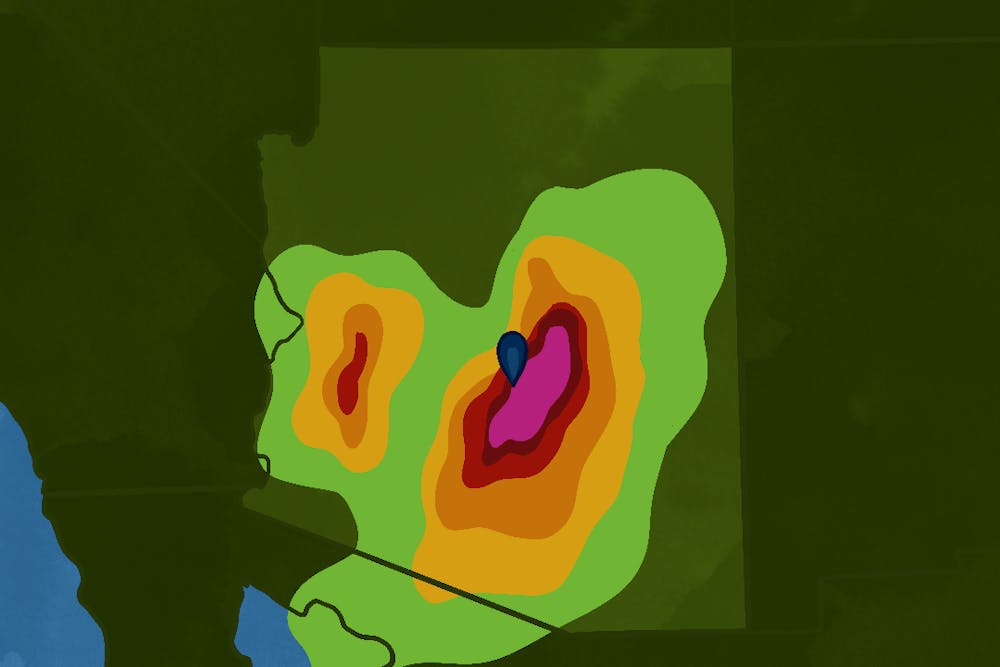
Dust storms are nothing new to Arizona, a state that sees the massive walls of dust roll in every year. In the past month, the Phoenix area saw two major storms, causing flight cancellations, damaged property and overall trouble.
What is a dust storm?
At a surface level, a dust storm is exactly what it sounds like: a storm made of dust. Some people tend to think of dust storms as just giant walls of dust covering large stretches of land for hours on end. However, the inner workings of the storms reveal a more complex story.
"Some (storms) can just be kind of a massive, kind of hazy dust that can move in and settle for a period of time," Ryan Heintzman, an assistant teaching professor at the School of Geographical Sciences and Urban Planning, said.
The storms are only found in the dry desert climate. The lack of rain, combined with the dry land, makes the environment perfect for dust accumulation. When a storm forms, the amassed material gets picked up and causes the massive walls of dust.
Typically, these summer storms form in tandem with thunderstorms. This means dust storms are usually followed, or accompanied, by rain and major winds.
"The air within (the thunderstorms) begins to descend — because it's cold, rainy air, so it's denser than the air that's around it — that can sometimes descend out of the storm quite rapidly," Heintzman said. "That rapid descent then hits the ground and has nowhere to go, so that air spreads out and forms strong winds and so you can have a wall of dust."
Though the terms "dust storm" and "haboob" are widely used in the Valley, there is controversy over their interchangeable use. While they both describe the same phenomena, the Arabic term, haboob, tends to be associated with a bigger storm, while dust storms are smaller-scale versions of the same event.
The health concerns behind dust storms
When caught in a dust storm, exposure to dirt and chemicals from the dust can lead to health issues.
"The dust storms pick up all the kinds of things that are in the soil, and as they pick those up and bring them up in the air, you will inhale them," Pierre Herckes, a professor at the School of Molecular Sciences, said.
The storms can contribute to a range of diseases, but one commonly associated with dust storms is "valley fever." Valley fever is a fungal infection spread by coccidioides, but the connection of dust storms to the infection is a myth.
Dave Engelthaler, executive director of the Health Observatory at ASU Knowledge Enterprise and director of TGen North, has found during an on-going study that there is no correlation between dust storms and valley fever at all.
"It's still a mythology," Engelthaler said. "People still believe it, but there's zero scientific evidence to show that these dust storms actually drive valley fever cases."
Even though valley fever is not caused by dust storms, the storms still come with a plethora of health risks. Health issues like asthma and other respiratory diseases can worsen from the inhalation of dust particles during a storm.
"People who have COPD or chronic obstructive pulmonary disease, they can breathe in or what they breathe in can really start to aggravate their COPD and then get into something that's closer to respiratory distress," Engelthaler said.
Safety concerns
"The safest thing to do is, once the dust storm hits, you just stay put until it's gone or until at least the dust is less heavy," Heintzman said.
Arizona has prime conditions for a flash flood, and the rain that comes with dust storms makes for a possible dangerous situation.
The downpour that comes with the thunder and dust storms makes flash flooding a dangerous reality. Flash floods are more common in the desert due to the physical layout of the landscape and soil types that tend to have fast runoff, Heintzman said.
In addition to the danger of flash flooding, the storms can also harm local infrastructure and wildlife due to high wind speeds.
"You've got strong winds that can associate with the outflow boundary that can topple trees or break tree branches or damage infrastructure," Heintzman said.
For residents of the desert, a dust storm is more than just a bit of weather in the summer; it is a meteorological event that can cause major damage.
"You've got lots of concerns related to dust, things like traffic, air quality, health concerns," Heintzman said. "It's a pretty important topic for a lot of people to understand."
Edited by Kate Gore, Senna James and Ellis Preston.
Reach the reporter at myerrag1@asu.edu.
Like The State Press on Facebook and follow @statepress on X.
Meghana Yerragovula is a reporter for the state press. She is on her second semester writing as a reporter.