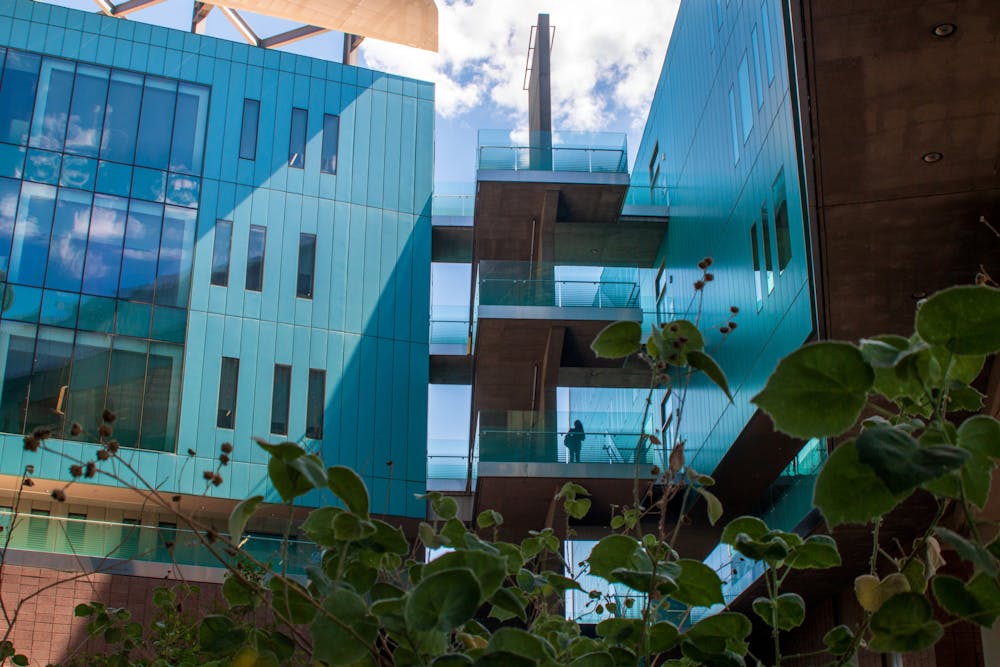
A recent donation of $115 million, the largest ever philanthropic gift to ASU, will enable the founding of the new Rob Walton School of Conservation Futures.
The foundation of the former chairman for Walmart's board of directors, the Rob Walton Foundation, made the unprecedented donation. The funds will allow for increased collaboration with global partners as well as advancements in conservation research and education.
The School of Conservation Futures will be a part of the Rob Walton College of Global Futures. The school will aim to enhance conservation efforts by uniting scholars, professionals and non-traditional learners with a variety of perspectives.
Miki Kittilson, dean of the Rob Walton College of Global Futures, said in a written statement that the investment will establish new academic programs and will offer scholarship funds for students, including for immersive programs and field work.
"Students in the school, and across other programs in the college, develop solutions-relevant skills through applied projects and opportunities for place-based learning with local communities and partners around the world," Kittilson said.
While still in the early stages of resource allocation, the school is planning shared curricula, projects for students, capstones and global experiences, said Joshua Abbott, the director of the School of Sustainability.
He also noted the Rob Walton School of Conservation Futures has already developed some short courses and lifelong learning products for professionals.
"Our degree programs will be available in 2026," Kittilson said. "Learners can already enroll in the Conservation Futures Academy, which offers courses for working professionals. The academy currently has offerings for mid-career upskilling and executive education."
Peter Seligmann, distinguished professor of practice and former CEO of Conservation International, said the school will partner with Conservation International, a not-for-profit organization working on showing the relationship between ecological health and humanity. It will also work with Nia Tero, an institution focused on supporting Indigenous peoples in securing their territories and culture.
The school will incorporate biodiversity research using conservation experiences on various scales. Abbott said the school will look at "classic questions of conservation," focusing on local, national and international biodiversity issues.
Kittilson also said the school will look to face environmental issues and redefine the field, engaging in conservation within areas like science, technology, policy and finance.
"There is no other school like the Rob Walton School of Conservation Futures – it is one-of-a-kind in its holistic, forward-looking approach to securing and regenerating biodiversity and ecosystems," she said.
READ MORE: Walton Center for Planetary Health opens with goal of innovative sustainability
Great strides have been made in the fields of conservation and sustainability, and the school looks to continue taking steps toward improvements in leadership and educational efforts. Seligmann will play an important role in the new school.
"We're facing a continuing deterioration of the environmental health that affects all families (and) all people," Seligmann said. "We need to be readjusting and reimagining how we learn, what we learn and how we use that new knowledge ... in strengthening the organizations and the institutions and the awareness of people."
ASU's innovative approach to try to "forge new pathways into the future" along with its "explorative spirit" sets it apart from other locations and makes it conducive to integrating the new program, Seligmann said.
Leadership in the Rob Walton College of Global Futures has expressed optimism for the impact of the new school and the role of conservation education for students.
We are going to be all in on conservation and conservation education, Abbott said.
"I want all those earliest students to dive in deep, learn with eagerness and critically think about how the school operates," Seligmann said.
Edited by Kate Gore, Henry Smardo and Pippa Fung.
Reach the reporter at jdtamay1@asu.edu follow @JTamayo46036 on X.
Like The State Press on Facebook and follow @statepress on X.
John Tamayo is a science and technology reporter in his first semester with The State Press. He is a senior majoring in Physics and Philosophy.