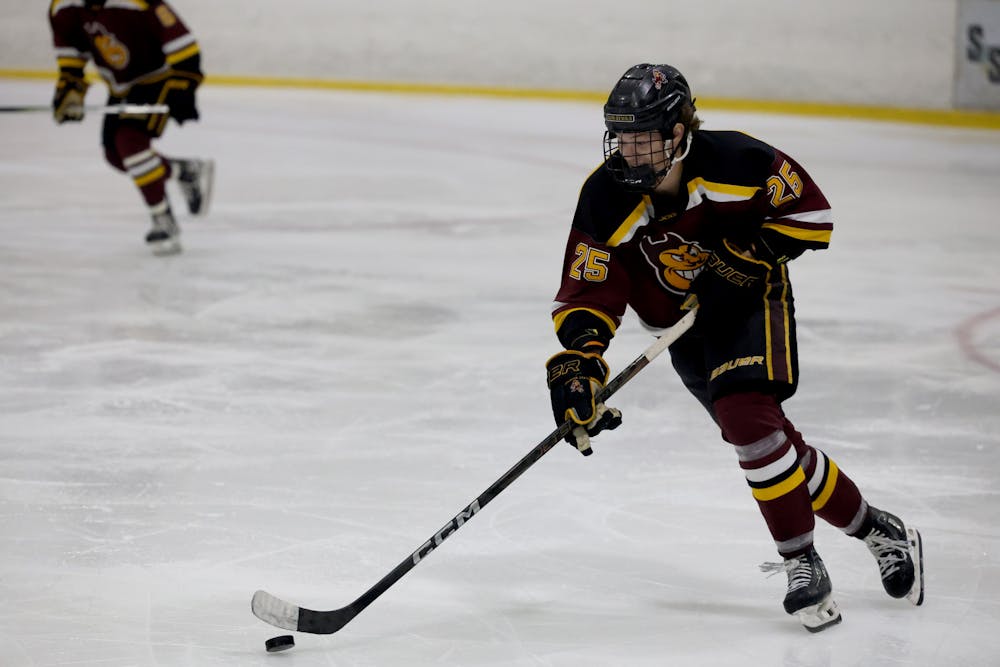
Alongside the fanfare and excitement of the start of the hockey season at ASU, a lesser-known but equally important part of Sun Devil hockey has returned to the ice: Division I club hockey. Under the American Collegiate Hockey Association, ASU club hockey has solidified its presence on campus and persisted as a stronghold of hockey pride and community.
Coming off of a losing 2024-25 season in the Western Collegiate Hockey League, the Division I team is still looking to create a strong season centered around the team's new head coach: former NCAA Sun Devil and ECHL professional hockey player Johnny Walker. Players note that the rookie coach has already made a considerable impact on the team.
"The boys love him," said Kade Olsen, a senior on the DI team and a mechanical engineering student. "Everyone listens to him, everyone respects him and he's been a big difference this year."
For Walker, finding his way back to ASU was a manner of returning to his roots and giving back to the community that raised him.
Walker grew up in Arizona and played for head coach Greg Powers for five years before playing professional for two and half years.
"Just being able to really coach them makes me miss playing for sure, but it's awesome," Walker said.
Along with bonding coaches and players, the ACHA has opened the door for many hockey players to pursue their sport in college.
"None of the players on our ACHA (Division) I team would go to ASU if we didn't have that team," Ted Burr, the general manager of ASU ACHA Hockey, said. "A lot of people just come to ASU for a chance to play hockey."
The far-reaching effects and deep foundations of Sun Devil club hockey are evident in Olsen, a Canada-native whose decision to come to ASU was partially reliant on the opportunity to play four years of hockey.
However, the ACHA team is not only responsible for bringing in large numbers of out-of-state players and providing hockey to so many college athletes; its existence is what created the opening for ASU's NCAA team to exist in the first place.
"If it wasn't for the ACHA hockey team winning the national championship in 2004, there probably would not be an NCAA team," Burr said. "That was the starting point to really get serious conversations going about getting some money (and) endowments to create an NCAA team."
As a result, the Division I team is home to many top athletes looking to make a bid in the professional world. While one may think that club hockey is less competitive or harbors less talent than its NCAA counterparts, the DI team consistently puts this myth to rest.
"Nobody truly understands how good these players are," Walker said.
Additionally, the Division I team is not as separated by the distinction between NCAA-level play and club-level play as one may think. Players have the opportunity to move between the two levels if they decide they need a change.
"There's actually some guys that used to be on ASU's NCAA team that came over to play ACHA," Burr said. "We've had a few players on our Division I ACHA team get moved up to play NCAA."
READ MORE: Valley vacancy: ASU hockey moves into the post-NHL era
Just as the NCAA has worked to bring ice to the desert, ACHA has been building a foundation and passion for hockey within the Valley.
Walker said that without the Coyotes in Arizona, "the next biggest thing is ASU hockey," but tickets can be difficult to come by and pricey for fans and families.
"It's a great opportunity that we have to still provide really high-caliber hockey for kids in the Valley to be a part of," Walker said.
The DI hockey team is not just building pride for hockey but pride for the players' community, their team and their chance to play the sport that they love.
"A lot of us are living away by ourselves, so just having a culture, having a family, having the boys have your back — that's what we're trying to do," Olsen said.
Edited by Alan Deutschendorf, Senna James and Ellis Preston.
Reach the reporter at bcsmit41@asu.edu.
Like The State Press on Facebook and follow @statepress on X.
Brooklyn Smith is a reporter for the Sports desk at The State Press. She is majoring in English Literature and Economics. This is her third semester with The State Press.


