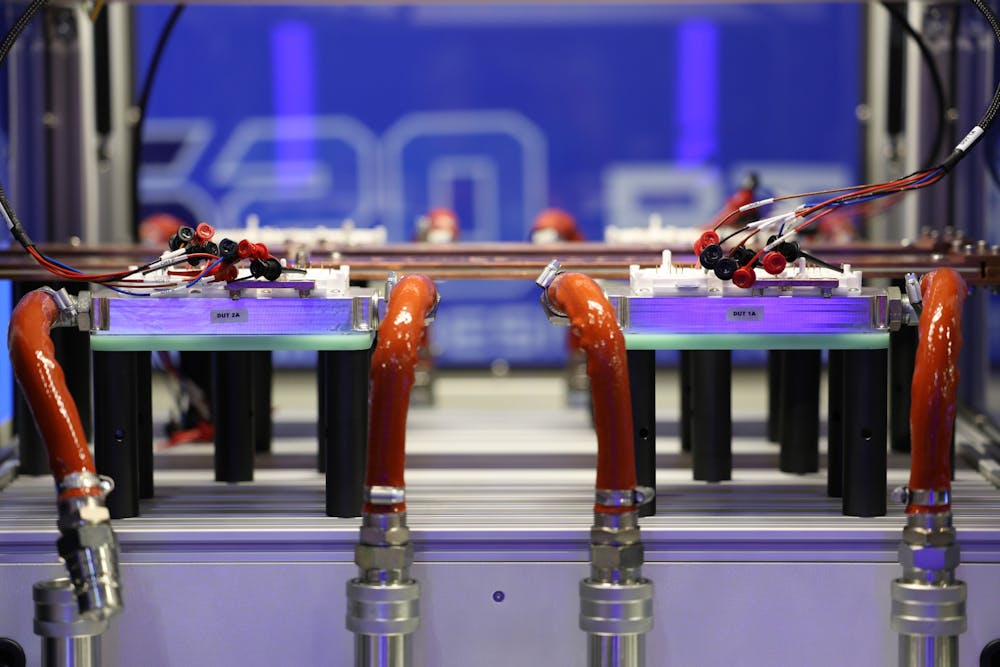
As federal funding cuts in August stalled projects like ASU's $1.1 billion semiconductor advanced packaging and prototyping facility, uncertainties are stirring within the industry in Arizona.
Months later, students, researchers and the University are pushing forward and adapting while the Arizona semiconductor industry keeps moving, despite the unknowns.
READ MORE: ASU announces semiconductor facilities, partnership with Department of Commerce
For some student researchers involved in ASU's semiconductor scene, the funding cuts hit unexpectedly.
In August, the Department of Commerce cut $7.4 billion from the National Center for the Advancement of Semiconductor Technology, which included funding toward the University's facility.
Carson Gockley, a graduate student studying electrical engineering, has been working at ASU NanoFab since he was an undergraduate. As a process engineer at ASU NanoFab, he supports the University's pilot-line semiconductor production for research groups and companies in prototype.
"Regarding the disruptions at Natcast, I was surprised at how suddenly it all happened," Gockley said in an email. "Without going into specifics about any projects, I had a contact at Natcast that one day just stopped responding to emails. It was like they had dropped off the face of the Earth."
The sudden fund withdrawals have also raised wider concerns about federal scientific research. Judith Barish, the coalition director of CHIPS Communities United and an advocate, said the funding cuts reflect a troubling trend at the federal level.
"The cuts are terrible," Barish said. "It's part of a pattern that we've seen with this administration of cutting funding for science. It's a huge mistake."
Alex Stephenson, co-president of the Sun Devil Semiconductor Club and a junior studying electrical engineering, said he was disappointed to hear about the cuts, noting their current impact on the U.S. economy and job market.
With the cuts, Stephenson said many programs are pulling back or being more exclusive with doubts over securing funding. Some uncertainty stems from graduate students and research staff who depend on consistent support to pursue their projects.
"People who are looking at doing Ph.D., some of those positions may not get as much funding or there's concern over the future of that funding," Stephenson said. "I know there have been certain cuts in areas in order to preserve Ph.D. funding."
A lot of money goes toward setting up and maintaining a clean room and the equipment with it, Gockley wrote, which raises questions regarding funding sources in the future. He said research groups on campus may also have trouble ensuring support for the salaries of their graduate students and post-doctoral students.
While Gockley and Stephenson emphasized the impact on students and researchers, Barish mentioned how funding challenges raise questions about community involvement and transparency in the semiconductor industry.
"These companies are massively funded by taxpayer dollars, so it is only fair that we have a voice in how they operate," Barish said.
READ MORE: Chip in for Arizona: Students compete to shape the future of the semiconductor industry
While some people believe the semiconductor industry needs to better their transparency to the community, Stephenson said the University did a "really good job communicating with people at the federal level."
The University has also continued to pursue projects related to semiconductors, such as the newly opened Materials-to-Fab Center.
The center is a $270 million collaboration between the University and Applied Materials. It aims to put Arizona in a strong position in semiconductor innovation, accelerating the development of next-generation chip technologies which are crucial for AI, computing and national security, according to ASU News.
Despite setbacks and concerns, Arizona's semiconductor industry momentum remains strong, some of which is fueled by the growing demand for AI.
"Though the funding cuts to Natcast are certainly a blow to Arizona's semiconductor sector, it still has lots of momentum from the AI boom and I don't see that slowing down any time soon," Gockley wrote. "I expect that the effects of those funding cuts will be seen much later down the line instead."
Edited by Senna James, George Headley and Pippa Fung.
Reach the reporter at mmart533@asu.edu.
Like The State Press on Facebook and follow @statepress on X.
MJ Martinez is a senior reporter at The State Press. She has worked for the paper for 3 semesters, working previously as a SciTech Reporter.