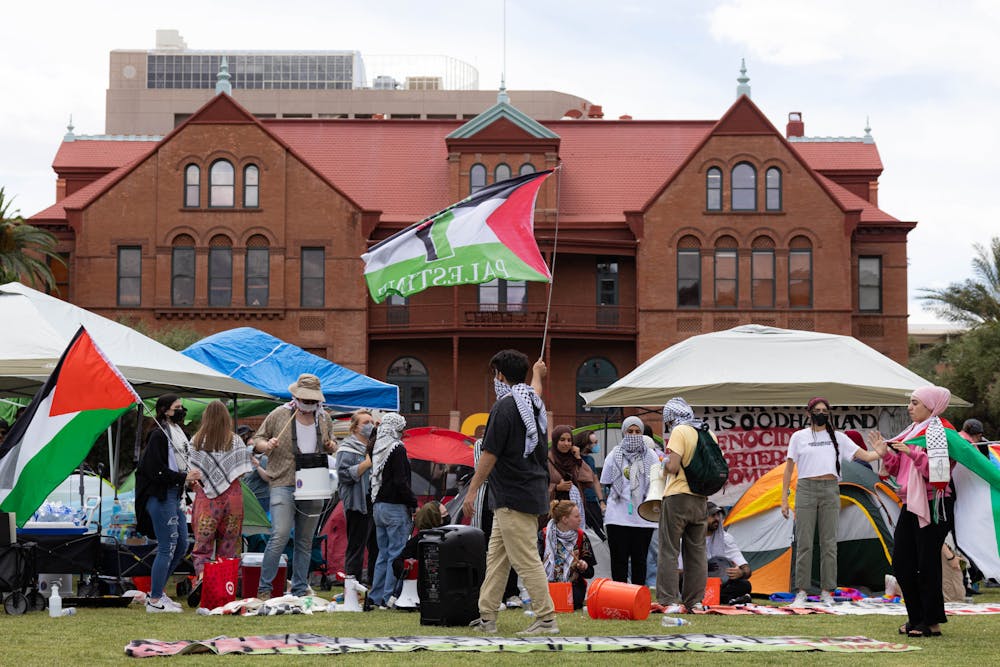
Muslim women arrested during the Old Main pro-Palestine encampment last year — including three former ASU students — filed a lawsuit against the University on July 11 alleging ASU police violated their constitutional rights by removing their hijabs.
The complaint alleges male officers from ASU Police Department, Tempe Police Department, Maricopa County Sheriff's Office and the Arizona Department of Public Safety demanded the removal of the head coverings of Fatima Jabardi, Noor Odeh, Noura Abdalla and Salam Jabaieh after arrest. Everyone but Abdalla was a student, according to an emailed statement from their attorneys.
Defendants include the Arizona Board of Regents, the University, school officials such as President Michael Crow, Arizona Department of Public Safety, multiple police officers and current MCSO Sheriff Jerry Sheridan.
Despite the plaintiffs' explanation about the religious significance of the hijab, law enforcement forcibly removed the head coverings and did not return them, leaving the women uncovered during the bus ride to and at the jail, according to the complaint.
David Chami, one of the attorneys representing the four women, said police lacked justification for removing the hijabs, since the protest was nonviolent and the "tight fitting garment on someone's hair" cannot hide weapons.
"They're fully aware of the religious significance of the hijab and for the religious importance of male officers not physically touching a female hijabi woman," Chami said in reference to the police. "There's no need to do so. It just violates common decency and the rights of that woman."
Sabreen Abdirahman, a sophomore studying criminal justice and history who was not involved in the case, said she started wearing the hijab at a young age and would feel "very violated" if someone removed it against her will.
"The hijab is such an important part of my life, and I wear it for religion, and so having someone feel the need to take it off for whatever reason would not elicit the best feelings for me," Abdirahman said. "It's just really wrong, especially considering the fact that most people at this point understand that people who wear the hijab wear it because of faith and not because they're trying to hide anything."
The U.S. Department of Justice launched an investigation into ASU PD for potential civil rights violations regarding the removal of the hijabs around six months after the encampment.
Police reports examined by The State Press showed MCSO instructed ASU PD officers to remove the hijabs. Email correspondence, also obtained by The State Press, showed ASU PD requested assistance from MCSO to transport arrested protesters to jail.
READ MORE: 'ASU Liberated Zone' hosts press conference, condemns treatment of student protesters
Jabardi was apprehended by an ASU PD officer on April 27 at 1:42 a.m. and was placed in zip tie handcuffs before being searched. The officer noted that Jabardi was searched prior by MCSO.
According to the police report, the officer informed Jabardi he would leave her hijab on while searching her due to the "great importance to her culture." He explained MCSO might force him to take it off, although he disagreed, "due to their own policy on what is allowed to be brought into jail."
MCSO told the officer to remove Jabardi's hijab despite his objections and attempts to persuade them otherwise, according to the police report. The officer wrote that he explained to Jabardi that MCSO required him to take off the hijab, but he used her jacket's hood as a replacement to "preserve her cultural belief" and "ensured her hair would not be shown and was successful in doing so," according to the report.
READ MORE: ASU Police Department breaks down how it keeps campus safe
Abdalla, the plaintiff who was not a University student, was arrested and searched by a different ASU PD officer who removed her head covering that had been secured with hair pins, according to the police report written by that officer.
The officer said in the report that Abdalla requested the hood of her jacket to be placed over her head. The report also stated no female officer was available to conduct the search. It was also noted that an on-scene MCSO detention supervisor said the headwear counted as Abdalla's property and was placed into a property bag.
There was no mention of the religious significance of the hijab within this police report.
Odeh was arrested at 1:40 a.m. and sent to MCSO for processing, but the police report by the officer did not include more details about what happened with her head covering.
In the report detailing the processing of Jabaieh, an ASU PD officer stated she was "wearing a religious head wrap" but MCSO told him it "needed to be removed before she was placed on the transport bus." The officer said MCSO removed the head wrap "out of view of other men."
The University and The Maricopa County Attorney's Office both declined to comment, citing active litigation.
A spokesperson for the Arizona Muslim Police Advisory Board said in an email that MCSO's religious head covering policy was "finalized and implemented" in October 2024. The policy directs officers to remove and search religious head coverings, or RHCs, "in private" while emphasizing that a removal is essential procedurally.
"For safety purposes, the temporary removal of a RHC from an individual during a search for weapons or contraband during an arrest or during incarceration, is subject to occur, as required or as necessary," the policy states.
The American Civil Liberties Union previously successfully sued MCSO for violation of religious freedom in 2009 for requiring a Muslim woman to remove her religious head covering while in custody.
Michael Yancey, another attorney representing the four women, said in an email statement that the lawsuit is still in its early stages and it's unclear when it will go to trial, with months of litigation ahead.
"The average federal civil rights case doesn't reach trial until two to three years after filing, depending on a plethora of factors," Yancey said in the statement. "This is a factually simple case on the surface, but legally complex. I don’t anticipate it moving rapidly."
Edited by Senna James, George Headley, Tiya Talwar, Sophia Braccio and Katrina Michalak.
Reach the reporter at mosmonbe@asu.edu and follow @miaosmonbekov on X.
Like The State Press on Facebook and follow @statepress on X.
Mia Osmonbekov is a senior reporter. She previously reported for Arizona Capitol Times, Cronkite News DC, La Voz del Interior and PolitiFact. She is in her 7th semester with The State Press working previously as the opinion editor and assignment editor.