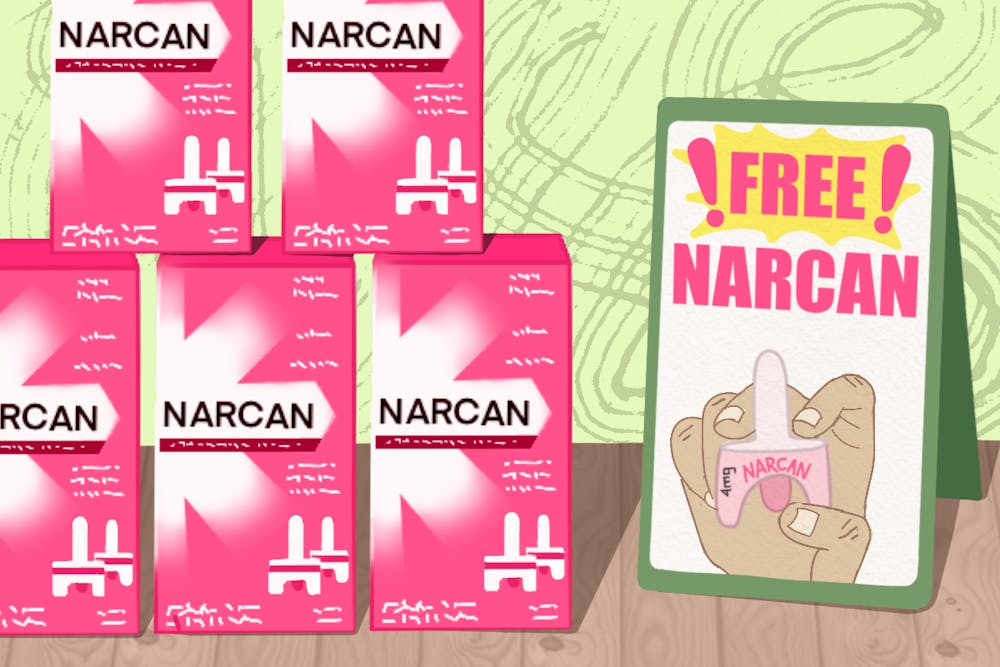
In the event of an opioid overdose, naloxone can restore normal breath to a person whose breathing has slowed or stopped — potentially saving a life, according to the National Institute on Drug Abuse.
Naloxone and resources can be accessed by students in several ways across campus and around Arizona.
It can be administered in two forms: nasal spray or an injection, both approved by the Food and Drug Administration.
Prepackaged nasal spray, Narcan, is a needle-free device that is sprayed in one nostril while a person is lying down. Injectable naloxone, ZIMHI, is typically injected into muscle or under skin, according to the NIDA.
In 2023, the FDA approved Narcan, the naloxone nasal spray, for over-the-counter use without a prescription. Narcan can be purchased at retail stores for around $45 for two doses of the medicine.
Where to find it
There are several places students can find naloxone, including libraries, websites and campus health services.
ASU Health Services provides naloxone to students by request at the front desk or during an appointment with a provider. Students can receive the medicine free of cost after attending campus-sponsored educational training related to the National Opioid Epidemic.
The City of Phoenix issues free naloxone kits at all 17 of its libraries. The city also offers a variety of online training videos to show citizens wanting to carry naloxone how to properly administer it.
"You can go grab a kit, one kit or two kits if you need to share with someone, and walk out," said Yanitza Soto, a public health adviser for the city of Phoenix. "That's what it is intended for is to be an open resource for the community."
Data from Maricopa County reported 1,218 fatal overdoses in Phoenix in 2023. The substantial numbers drove the city's decision to make kits available to the community, Soto said.
Community organizations are also options when looking for harm reduction resources and education.
Shot in the Dark is a volunteer-led nonprofit organization that provides safe-use supplies and harm reduction resources across Maricopa County. It has five sites across the Valley that provide naloxone kits and other resources for those who need them. Nearby site locations can be found by texting Shot in the Dark's support line.
In 2023, Shot in the Dark reported over 6,000 distributed naloxone kits and 315 overdose reversals.
"Education around those different types of things (naloxone kits) has been really, really huge for getting it out there and getting it across the Valley," said Amber Maiberger, Shot in the Dark's chair and finance coordinator as well as an ASU senior program coordinator.
Sonoran Prevention Works is a harm reduction organization that supplies naloxone kits across seven counties in Arizona. Kits are offered at various locations within the website schedule.
The organization also has the Naloxone by Mail Program for those who do not live near their current outreach sites.
Sonoran Prevention Works provides volunteer opportunities like kit making parties to teach community members more about harm reduction resources.
"You can just pop in and help them build harm reduction kits," Laura Lightfoot, a Ph.D. student working with the Arizona State Unintentional Drug Overdose Reporting System, said. "It's just a great organization to get involved in if someone was really interested in harm reduction work."
The impact
Anyone can carry naloxone and administer it on someone experiencing an overdose. However, a potential bystander was present in nearly 43% of overdose deaths in 2023, according to data from Centers for Disease Control and Prevention.
"One hundred percent (naloxone is) something people should have," Maiberger said. "It should just be a natural part of first aid."
Negative stigmas surrounding drug use and naloxone resources can prevent people from seeking the health and support services they need, according to a stigma reduction article by the CDC.
These resources and organizations aim to increase the education surrounding misconceptions on what a drug user looks like and what naloxone use is, Lightfoot said.
"We talk about harm reduction and naloxone and try to encourage and empower students to understand that drug use is not a personal failing, and that we shouldn't be stigmatizing these groups," Lightfoot said.
Regardless of the stigmas, having access to naloxone can be vital to keeping students and those around them safe.
"It can be so empowering even if you're not a drug user, to know that you can respond," Lightfoot said.
Edited by Natalia Rodriguez, Senna James, Sophia Braccio and Pippa Fung.
Reach the reporter at dbell39@asu.edu and follow @dhemibell on X.
Like The State Press on Facebook and follow @statepress on X.
Dhemi Bell is the editor for the Community and Culture desk. This is her third semester with The State Press, working previously as a part-time Community and Culture reporter.