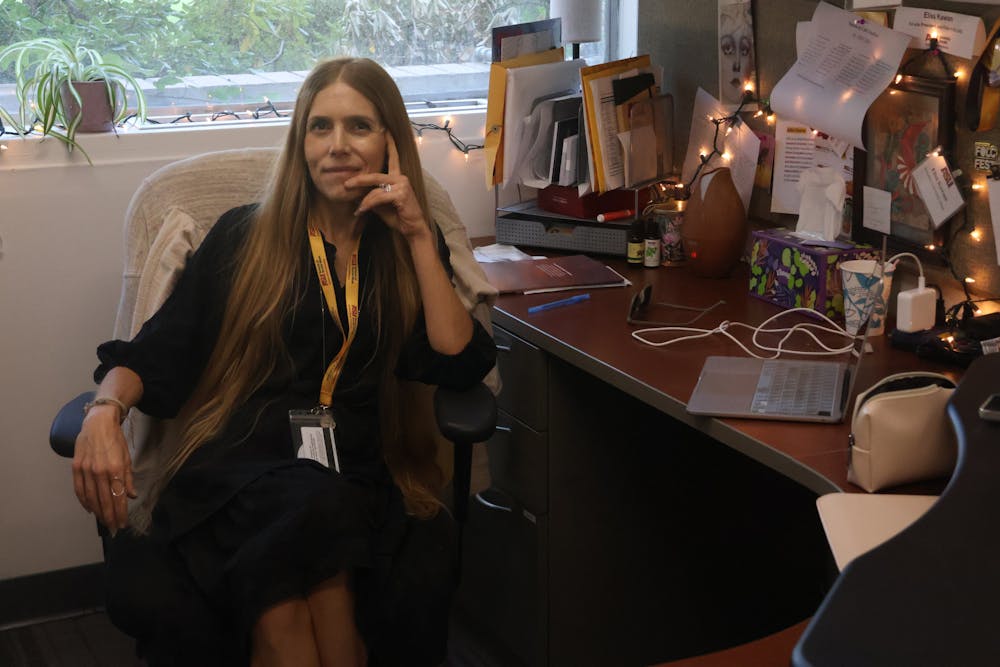
The President of the University Senate said while titles and degrees may separate students from faculty and administration "at the end of the day, we're all just Sun Devils doing the same stuff."
President Elisa Kawam, a professor in the School of Social Work and director of the Master of Social Work program, said the University Senate is "a deliberative, discussion-based body to represent the faculty and the academic professionals across the University."
Kawam is in her second term as president and said she is the first to run for the position more than once.
She said she had not thought about joining the University Senate until a colleague suggested it, so she ran for president of the Downtown Phoenix campus and has been in the body for four years. Later, Kawam was nominated to the position in which she currently serves.
Kawam splits her time between her role as University Senate president in Tempe and her faculty role at the Downtown Phoenix campus.
Some of her responsibilities as University Senate president include responding to colleagues and requests from the administration, preparing for University Senate meetings and making sure leadership is representing the voice of the faculty body appropriately.
"We don't operate without serious consultation and collaboration with ... our leaders," Kawam later said.
Her day-to-day revolves around meeting with people, discussing policy and writing emails, reports and new bylaws.
"My philosophy on leadership is servant leadership," Kawam said. "I think leaders are here to serve."
Besides Kawam and her secretary, each campus has its own president, a president-elect and a past president — adding up to a total of 14 members in the University Academic Council, which serves as the executive board of the University Senate.
"Even though I'm the 'president,' there's a lot of people that are part of this and a lot of conversation that goes (on), it's not just me, thankfully," Kawam said.
The Polytechnic campus University Senate president, David Burel, is a professor in the School of Applied Sciences and Arts.
He said one of the challenges the University faces is making sure all campuses are represented. Burel believes the four campus presidents serving concurrently with a president-elect and a past president is a strong way of addressing that difficulty.
His role as University Senate Polytechnic campus president is to look into campus-specific concerns and facilitate discussions with other campuses, Burel said.
He said the appeal to being in the University Senate is the system of shared governance with the administration, adding that "if you're on the Senate, or if you're a Senate president, even more so, you're often the first to know about major things that are going on at the University."
In his role as a campus University Senate president, Burel said he has been able to meet and interact with faculty from the other campuses.
"Being someone that can be a point of consultation and conversation with the administration is really helpful," Burel said. "I look at it as an opportunity to help be that linkage between what faculty at large or a campus might say and the administration."
Phil VanderMeer, an emeritus history professor in the School of Historical, Philosophical and Religious Studies, is Kawam's secretary of the Academic Assembly and University Senate.
The Academic Assembly is the overall collection of faculty members at the University.
VanderMeer said the range of activities and responsibilities for the University Senate is wide, including "everything related to curriculum, drop/add policy, any concerns or issues related to retention or graduation, honorary degrees, relationships with other universities in the state."
Beginning as a senator from the emeritus college, VanderMeer said he was then asked to serve as secretary five years ago, and has been reappointed since. He also served as president of the University Senate for the 2008-09 academic year.
Since then, he has seen the University grow enormously, VanderMeer said, including a larger research portfolio that brings added responsibilities.
Kawam said faculty, staff, administrators and students are all part of the same team.
"I want students to know that their faculty care about them, and we care about them as people, and we care about them as students, and that we want to support them," Kawam said. "I know sometimes we can be a scary lot, we can be intimidating, but we take your futures very seriously."
Edited by Carsten Oyer, Senna James and Sophia Braccio.
Reach the reporter at elbradfo@asu.edu and follow @emmalbradford__ on X.
Like The State Press on Facebook and follow @statepress on X.
Emma Bradford is a senior reporter for The State Press. She has previously worked at the Cronkite News Washington, D.C. bureau as a politics and money reporter. Bradford is currently also an editorial intern for AZ Big Media. She is in her fifth Semester with The State Press, previously working on the politics desk as both a part-time and a lead reporter.