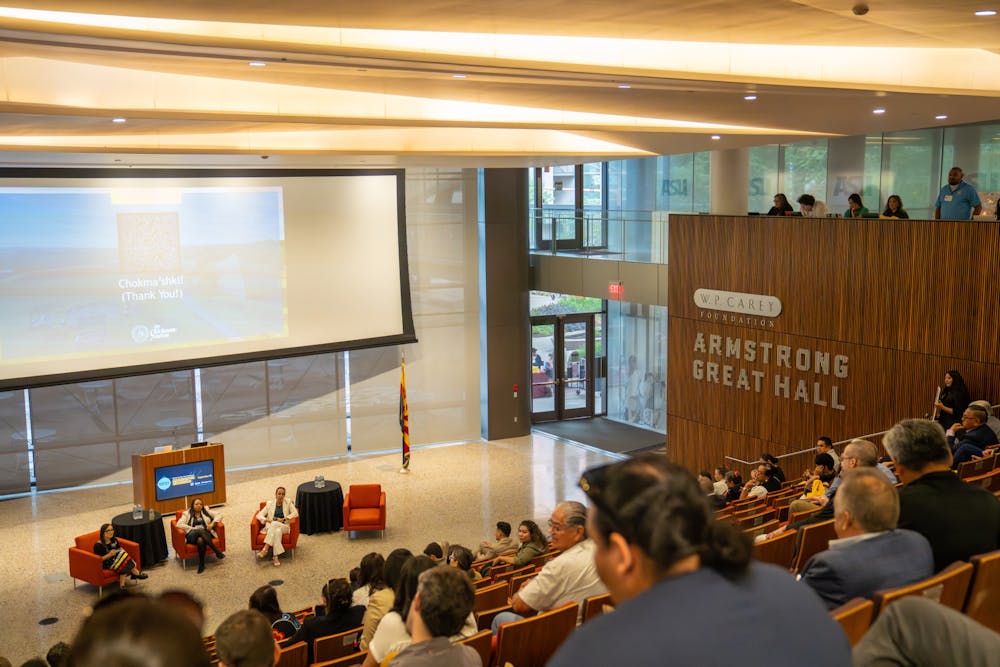
ASU Law hosted "Wiring the Rez: AI in Indian Country," an exploration of artificial intelligence and its impact on Indigenous communities, on Sept. 26 at the Beus Center for Law and Society.
Some tribal nations, like the Cherokee Nation, are choosing to take an active role in shaping AI usage, framing AI governance as an extension of sovereignty rather than as a technological issue.
Multiple organizations worked to bring together legal experts, community leaders and technologists to discuss sovereignty, data governance and cultural priorities for AI adoption.
Grace Signorelli-Cassady, an attorney and presenter, said AI could improve the negotiating strength of tribes that regularly engage in complex transactions such as oil and gas leases, real estate purchases and other agreements.
"Our topic is AI and economic growth in Indian Country, specifically how AI supports negotiations, economic strategy and enterprise growth," she said. "What I'm specifically talking about is ways that you can use AI to support negotiations."
Signorelli-Cassady contributed to creating a bot that uses input data, such as a tribe's historical lease data, royalty rates, rental amounts and past outcomes, to suggest a fair market price. She said the AI can use public data as well, but using the best possible input is important.
However, AI is not being used to replace human expertise entirely. Signorelli-Cassady said pricing and legal experts, as well as other professionals, are still important to include in negotiations.
Shawni Laffoon, a grants manager at environmental consulting firm 7Skyline, ASU alumna and member of the Colorado River Indian Tribes, said a goal of hers is to continue supporting tribal energy sovereignty.
"A few team members (at 7Skyline) are using Gemini, using Copilot, using ChatGPT, so that was just us doing our own little research," she said. "Coming here and seeing that ASU uses those platforms, it's just like, 'OK, we're heading in the right direction.'"
Gary Marchant is a regents and foundation professor of law and faculty director of the Center for Law, Science and Innovation. While addressing the global and ethical dimensions of AI development, he said the U.S. is facing a difficult choice between slowing development and risking falling behind other countries, or continuing to push forward rapidly despite federal regulation.
"This technology is not going to completely change our lives for the next week or the next month or even the next year, but if you look five or 10 years in the future, our role is going to be completely different," he said.
Currently, there is a lack of comprehensive federal regulation for AI. As a remedy, Marchant said his team is working on private governance frameworks to give companies the option to voluntarily use oversight.
"Should we be talking about these immediate concerns and risks — like privacy, bias, discrimination and security — which are existing risks, or should we talk about these long-term risks?" Marchant said.
Regardless of worries surrounding current AI use, Laffoon said hearing from experts in the field helped reduce her concerns about AI.
"It's nice to hear all the risks, what solutions there are and that it's okay to use AI, but also reminding us that we are still in control," Laffoon said. "It won't overcome us if we don't let it."
Edited by Kate Gore, Henry Smardo, Sophia Braccio and Pippa Fung.
Reach the reporter at afrahma1@asu.edu.
Like The State Press on Facebook and follow @statepress on X.
Ariana is a sophomore studying Biomedical Informatics. This is her first semester with The State Press.