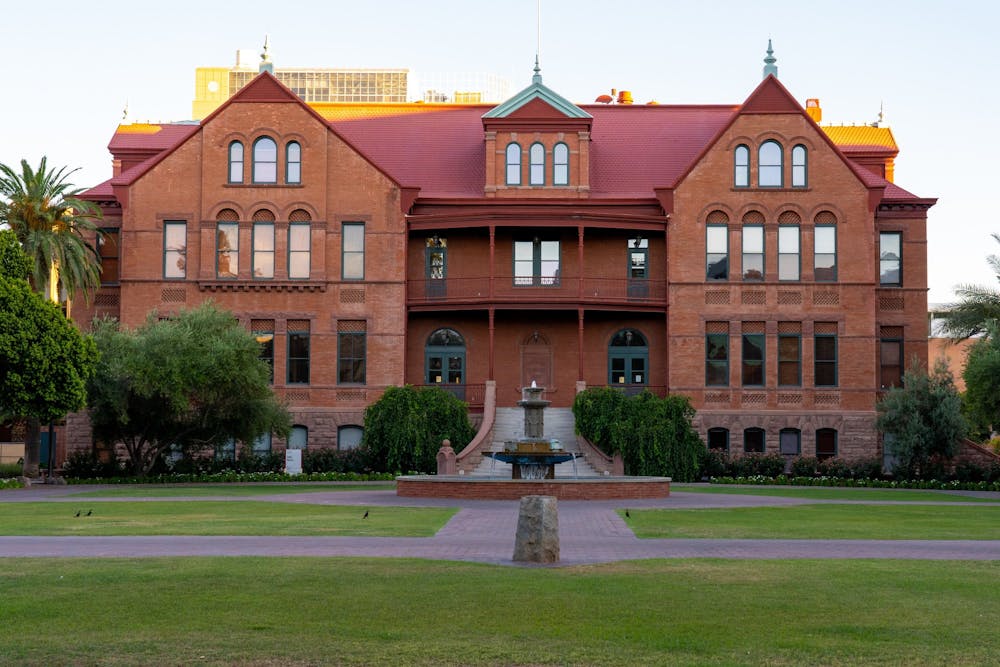
Several professors within ASU have expressed mounting concerns about the safety of themselves and their students, stemming largely from fear of retaliation against the curricula they teach.
These concerns from University professors come amid national events, and have sparked similar fears for professors across the country.
One such event was the designation of "Antifa" as a domestic terrorist organization by the Trump administration on Sept. 22. Antifa, which is shorthand for anti-fascist, is an umbrella term that describes far-left-leaning militant groups that often resist fascists or neo-Nazis.
READ MORE: College Republicans United at ASU plans event for students to report people with Antifa ties
Shortly after the designation was signed, Mark Bray, a professor of history at Rutgers University and the author of a book titled "Antifa: The Anti-Fascist Handbook," fled the country to Spain with his family. This came after Bray began receiving threats against his life and had his home address posted online, as reported by The Hill.
Relocation is not entirely uncommon for professors with concerns for their safety, and this practice was even utilized on a smaller scale by a professor on the Tempe campus.
Rashad Shabazz, a professor at the School of Social Transformation, said he worked with the Threat Assessment and Management Team at ASU to relocate his classes in the wake of Charlie Kirk's death, moving them to different rooms than those made publicly available online.
Shabazz's decision was prompted by his concerns about how easy it was to locate him at any time of the day. He saw this creating a safety risk not only for him, but for the students in his classroom as well.
"If someone wanted to come and find me and harass me, I can take care of myself, but I got 35 students that I have to take care of," Shabazz said. "Whether this person just wants to be belligerent or whether they want to harm me, I still have (my students') safety I have to take care of, and I'm concerned about them, not just me."
The safety concerns felt by some professors have trickled down to students.
"A learning space is supposed to be open, it's supposed to feel safe, and if the teacher doesn't feel safe, that means students aren't going to feel safe to express what they are concerned about," Jacob George, a senior studying political science, said. "It doesn't allow for a quality learning environment."
For Shabazz, there are some tangible steps the University can take to better uphold and protect professor safety, involving limitations on the information that is available about professors.
"Our courses, they don't need to be publicly searchable," Shabazz said. "The only people who need to know where they are is the students, so it should just be in My ASU. It should not be public."
The current free flow of information about professors, aided by the internet, has allowed for harassment and threats to their safety to expand even beyond their immediate area.
"You have people who look at things like the professor watchlists and fire off their hate-filled speech, and they have nothing to do with ASU," Michael Ostling, a professor at Barrett, the Honors College, said. "They're not alumni, they're not students, they're not parents of students ... There's a magnifying effect created by the internet, basically social media."
One manifestation of this "magnifying effect" that Ostling touched on is the "Professor Watchlist," a website founded and run by Turning Point USA, that professors, such as Shabazz and Ostling, are listed on.
The site says its mission is "to expose and document college professors who discriminate against conservative students and advance leftist propaganda in the classroom." Images of professors can be found on the site with a variety of tags, ranging from "corruption" to "terror supporter."
For professors like Owen Anderson, a professor in the School of Humanities, Arts and Cultural Studies, the Professor Watchlist is akin to a "nutrition label on food."
Anderson is listed as a "Recommended Professor" on the website, and he said he was the first to be given that distinction. He also serves as the faculty advisor for Turning Point USA at ASU.
"Parents and students need to know what they're getting to decide for themselves," Anderson said in a written statement. "That is called honesty in advertising."
Despite Anderson's support for the watchlist, he himself has had experiences with harassment based on the curriculum he teaches.
"Last semester, I was targeted with workplace sexual harassment when my office door was vandalized with a lewd image directed at me and my political beliefs," Anderson said in the written statement. "Now, every time I go to work, I have to ask myself, 'Will I be harassed again, or will I be treated with the fairness and respect that everyone deserves in the workplace?'"
Turning Point USA did not respond to request for comment.
Ostling argued that disagreements between professors and students or others should be settled through respectful conversation rather than harassment.
"Sometimes it's my job as an expert, in the fields in which I am an expert, to tell a student that I think they're wrong and tell them why I think they're wrong," Ostling said. "But I have to be very careful to do that in ways that don't make them feel stigmatized or humiliated or punished or anything like that. That would be just bad teaching."
Ostling also said that when disagreement on certain subjects or topics turns to harassment or threats, a greater threat is posed to higher education as a whole, especially in spaces like the liberal arts.
"You cannot fulfill the teaching mission if you are not exploring controversial topics," Ostling said. "That is the job description, and so when threats to our safety, whether explicit or implied, make professors feel that they can't teach those topics, their jobs are being made impossible, and students are losing out on the mission of the University."
Despite differing views on the effects of platforms like the Professor Watchlist, Ostling, Shabazz and Anderson agree that the way to limit the fear and uncertainty in higher education is by returning to the principles of respectful disagreement and debate.
Shabazz said he often is open to debates with his students, sustaining a "mutual respect for each other after we walk away."
"But what's being done now is an attempt to eradicate debate by eradicating a certain set of ideas and eradicating the people who give voice to them," Shabazz said. "That undermines the ability of the University to be a site of actual intellectual engagement. It undermines growth."
Edited by George Headley, Henry Smardo, Katrina Michalak and Pippa Fung.
Reach the reporter at sluba@asu.edu and follow @samluba6 on X.
Like The State Press on Facebook and follow @statepress on X.
Sam Luba is the Lead Community and Culture Reporter at The State Press. He is a junior studying political science and justice studies with a certificate in political history and leadership. This is his fifth semester with The State Press, working previously as a Senior Reporter and part-time Politics reporter.