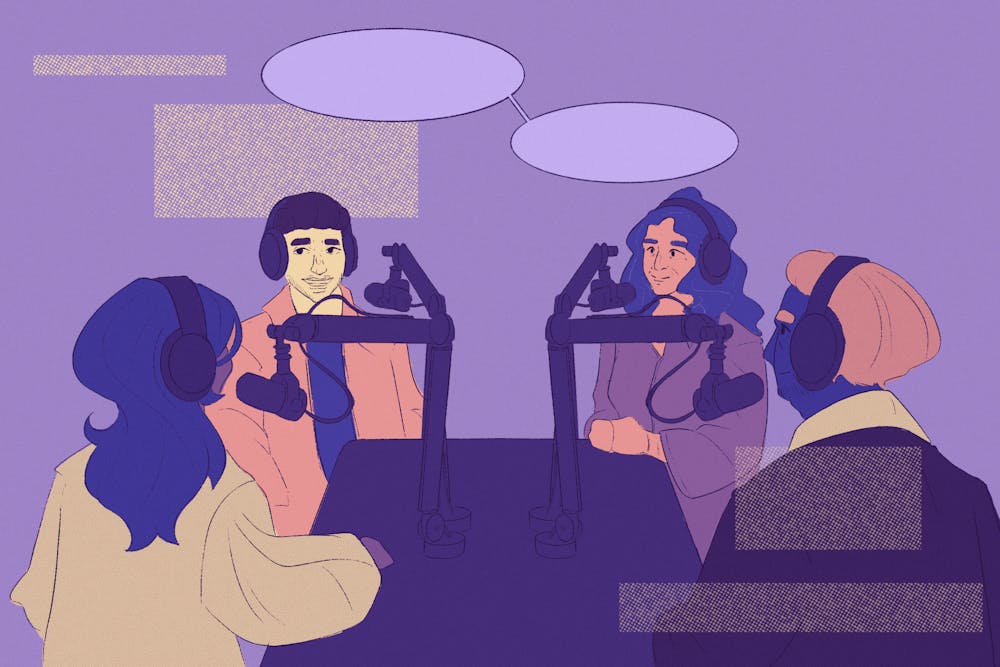
The Polytechnic campus is home to the Latinx Oral History Lab — a place packed with history and the opportunity to learn.
Vanessa Fonseca-Chávez, a professor at the School of Applied Sciences and Arts, said she and co-director Rafael Martínez, a professor at the School of Applied Sciences and Arts, wanted the lab to serve as a physical space to share oral history and provide students with research opportunities, conduct interviews, hold exhibits and put on events.
Fonseca-Chávez has written six books, but it was her recent book, "Hispanics in Concho," that would go on to inspire the creation of the Latinx Oral History Lab, she said.
After many visits to the town of Concho, Arizona, since 2020, Fonseca-Chávez began collaborating with the community to create a book filled with photos and stories about the community’s history.
Fonseca-Chávez said the town is an important part of Arizona history. The town is home to the first bank in Apache County, and it was part of the major sheep herding economies in the late 1800s and early 1900s, she said.
In June 2023, Fonseca-Chávez and Martínez took with them people to conduct interviews, scan documents and film the area for a documentary.
The team included directors from the University of Texas at Austin and a Pulitzer Prize-winning photographer, to the town. They spent their days collecting interviews and scanning around 1,200 documents from the community.
After returning from the trip, Martínez said the decision to start a lab felt organic. Between their work in documenting underrepresented communities, he said they wanted to bring their passion and experience into a formal research lab.
"It's important to have a place in campus that's visible, where students could feel represented and not only studied under a research agenda, but be collaborators of that knowledge production," Martínez said. "That's the thing that really excites us about having a lab … We're hoping to let students, collaborators, colleagues and (the) community be able to dictate where the future is going to take us for the lab."
Fonseca-Chávez said they wanted to focus on oral history because it "brings to the forefront the importance of one's lived experience in the way that they perceive and experience the world around them."
She said the lab is open for students with any background or experience. While the lab's main focus is oral history, she said it is a multidisciplinary project, and there are many ways students can contribute to the lab, noting a graduate student who recently signed on to be an illustrator.
She said they have several students help out the lab each semester and have worked on projects, such as creating a social media campaign and an impact report to show how far the lab has come.
"We're here to support communities," Fonseca-Chávez said. "We have fundamental responsibilities (to the) communities we serve, and these projects really speak to the heart of the work that we're called to do at ASU."
Martínez said the lab is also a place that serves as a platform to support faculty, where they can collaborate with students and bring visibility to independent projects.
As a volunteer for the lab, Sebastian Galindo, a junior studying engineering, said he helps out with different events and community service to get the community involved.
He said it is also important in representing Latino communities in education spaces because he often sees Latinos go straight into the workforce instead of seeing education as a path.
"When I first got here, there were very few of us, and it felt like I couldn't really fit in," Sebastian said. "Showcasing that there are Latinos that are actually here at college made me really want to get involved."
Galindo said participating with the lab and working alongside Martínez has not only taught him the importance of oral history but has shaped him as a person.
"Martínez is a role model for me because he just doesn't teach, but he helps you think,” Sebastian said. "He helped me develop my morals, develop my own sense of the world."
Claudia Aguilera, a senior studying interdisciplinary studies, said being an online student living in Texas and participating in a fellowship with the lab has helped her feel more involved with ASU, which is a Hispanic-Serving Institution, and resonate more with the Latino community.
Aguilera said her current project is helping with the summer institute that plans to teach people not only about oral history but also how to record stories, conduct interviews and create a digital story map.
She said oral history is important not only for carrying on stories but also to preserve how the stories are told from the communities they originate from.
"When you read the written record, the word can change," Aguilera said. "There's so many different traditions for every unique family and lineage that I think get lost without that oral history."
As students finish their time at the lab, Martínez said he hopes they take away a better understanding of their culture and the importance of storytelling in different avenues of their lives.
"(I hope) they're able to think of the importance of building storytelling projects in whatever capacity," Martínez said. "You see the impact that storytelling has on their development and growth."
Edited by Natalia Rodriguez, George Headley, Tiya Talwar and Ellis Preston.
Reach the reporter at alillest@asu.edu and follow @allylillestol on X.
Like The State Press on Facebook and follow @statepress on X.
Allison Lillestol is a reporter for the community and culture desk. She is in her 4th semester with the State Press. She also works for Arizona PBS.