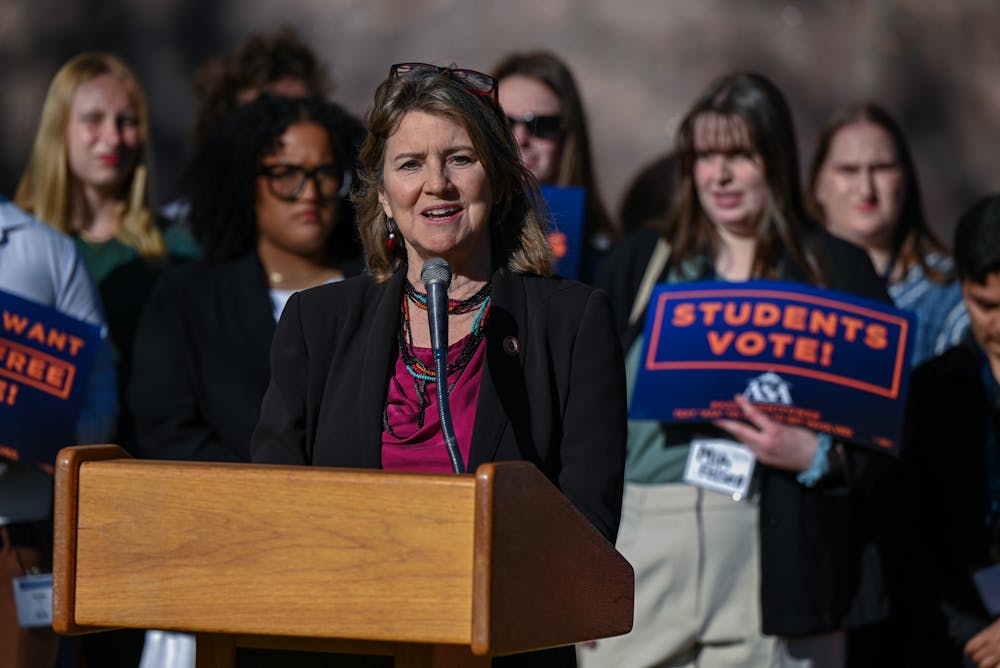
As Tempe works to propose a new event permit ordinance, opponents of its controversial predecessor are working with an ally: a state senator who was once on the Tempe City Council.
Despite serving on the City Council from 2014-22 and working closely with several members of the City Council in recent years, Democratic Sen. Lauren Kuby of District 8 worked with local organizations to reverse the controversial ordinance.
After efforts supported by Kuby and those organizations led to the ordinance being unanimously overturned during a Sept. 2 City Council meeting, the city is seeking to develop a new proposal with increased resident input and participation. It's doing so through a survey open to residents until Nov. 23.
According to Kuby, the passage of the original ordinance was "fundamentally" flawed in that it lacked community and stakeholder engagement. The July 1 City Council meeting in which the ordinance was adopted was only the second public hearing on the topic.
"I saw much less controversial issues that had multiple meetings across the city, neighborhood meetings, lots of money expended to get people's understanding and opinions, and I saw none of that with this issue," Kuby said. "That really disturbed me."
Kuby said she felt it necessary to voice her opinion on the proposal.
"I wasn't elected to sit back and be quiet and see things happening and not speak out," Kuby said. "To spark conversation, to spark dialogue, I think that's all healthy."
Among the speakers opposing the ordinance at the July City Council meeting was Kuby, who called in remotely to speak out.
One of her concerns was the potential barriers created by the ordinance for local mutual aid groups that use public parks to serve food to people experiencing homelessness. She added that local governments are typically unable to have the same "peer-to-peer and direct approach" as mutual aid organizations.
READ MORE: Tempe, nonprofits dispute collaboration on homelessness reduction
Bobby Nichols, a Tempe City Council candidate and a member of the Phoenix-Metro Democratic Socialists of America chapter, also spoke against the ordinance at two City Council meetings and has been involved in opposition efforts since.
Nichols wrote the referendum that led to the unanimous decision to revoke the City Council's original decision, and he agreed with Kuby that the city should protect mutual aid efforts.
"In terms of providing for the unhoused, providing for the hungry, hosting protests … I think those events should not require the same level of permanent scrutiny, because they are ultimately free speech and should be upheld and defended rather than suppressed," Nichols said.
Kuby also said the language of the Arizona Constitution is clear about protections for the public's right to assembly, which was one reason for her opposition.
"Fundamentally, that ordinance was creating barriers to mutual aid, to political protest (and) to gatherings in the park, and it was written in such a general way that it was constitutionally questionable," Kuby said.
After the July 1 meeting, Kuby worked with several local groups to inform Tempe residents about the referendum.
Morningstar Bloom, the secretary for Phoenix-Metro DSA and a strategist for the anti-ordinance campaign, said Kuby's involvement in the local community while promoting the referendum helped to motivate other activists.
Bloom said the state senator attended planning sessions with the Phoenix-Metro DSA, and Kuby said she worked alongside volunteers to knock on doors and distribute petition forms.
Furthermore, Bloom emphasized the importance of state legislators working with constituents and volunteers.
"When they are able to come out and hold the line with community in their neighborhoods and their districts, even on issues that aren't at the level of government that they're working on, it's a tremendous support," Bloom said.
In addition to working with the Phoenix-Metro DSA, Kuby worked with Sun Devils from the Arizona Students' Association who were a part of the grassroots effort to overturn the ordinance. Alberto Plantillas, the central regional director for ASA and a graduate student studying public policy, said students played a large role in the signature gathering process.
Plantillas commended the student volunteers for their efforts, as well as Kuby for her willingness to work with many different groups to push the referendum through.
"She's really good at talking to all the stakeholders and getting people to work together on issues and set aside a lot of differences in how to implement policy," he said.
READ MORE: After advocacy groups meet referendum requirements, Tempe rescinds ordinance
Since the original ordinance was revoked, the city of Tempe has held several public hearings and organized the online survey to write a new proposal.
According to a written statement from a city of Tempe spokesperson, the city of Tempe's special events code and parks and recreation codes have received "minor revisions" in the years since 1967. They said the codes need updates to reflect the growth of the city and the many events held in local parks.
The spokesperson said residents are encouraged to take the survey to weigh in on an updated ordinance.
As the new ordinance moves through the public input stage, Kuby said that the revised ordinance provides an opportunity to create better legislation.
"In Tempe, we have a lot of development issues that are driven by land use, attorneys and lobbyists, it's true," Kuby said. "But, there's also an ability to really reach deeply into the community, to build ordinances that are robust and people-first and neighborhood engaged."
Edited by Carsten Oyer, Senna James, Katrina Michalak and Pippa Fung.
Reach the reporter at kagore1@asu.edu and follow @kategore_17 on X.
Like The State Press on Facebook and follow @statepress on X.
Kate Gore is the Science and Tech Desk editor, ensuring accurate coverage of the scientific endeavors completed by ASU faculty and students and their impact on the broader community. She is beginning her second year on staff at The State Press. She previously worked as a Community and Culture Reporter, shining light on important events and happenings around campus.