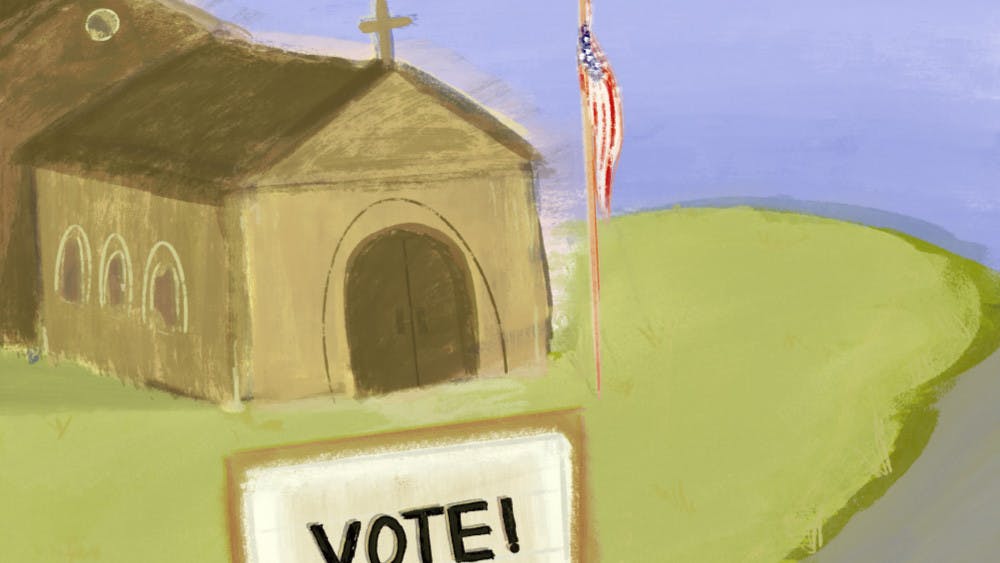
For decades, Christian faith has been slowly declining in the U.S. However, recent data suggests this trend may be stabilizing. A study by Pew Research Center found that the share of adults identifying as Christian has dropped from 78% in 2007 to about 62% today.
Although overall Christian numbers have been declining, some groups — particularly Evangelical communities — have become more vocal in political spaces. While this doesn't represent all Christians, it does highlight a population whose religious beliefs strongly influence their political engagement.
Jason Bruner, a professor at the School of Historical, Philosophical and Religious Studies, said this overlap between religion and politics isn't new — it's a repeated American tradition of moral and spiritual language being used in public life. But what's shifted, he noted, is the tone and its message.
"Religion has always been a part of American politics — it's not new," he said. "What's new is how totalizing it's become for some. It's not just an influence anymore, it's identity."
He added that the blend between belief and ideology has become especially visible because of social media and modern political organizing.
"Today, people can attend a service by Zoom — they can scroll and see some kind of inspirational message in 30 seconds," he said. "The sense of community is much more often thought about digitally rather than participating in this physical congregation with people that you meet with once or twice a week."
Figures like Charlie Kirk have helped reframe political activism as a religious calling. Kirk, once known for his secular conservative messaging, began addressing pastors and congregations directly through his "Turning Point Faith" initiative, encouraging believers to view civic participation as a spiritual duty.
In the years following Donald Trump's first presidency, Christian nationalism and the language of "spiritual warfare" gained visibility in certain conservative movements — from the New Apostolistic Reformation, whose leaders frame politics as a divine battle between good and evil to groups tied to the ReAwaken American Tour, where pastors, politicians and influencers blend revival-style worship with campaign messaging. This convergence between faith and ideology has redefined how many conservative Christians view their role in democracy.
However, not all believers see faith and politics as inseparable. Many pastors and theologians have voiced concern that tying Christianity too closely to political identity risks turning the gospel into a partisan brand.
When a quiet Sunday morning returns, Yanel Zazueta takes her seat among familiar faces, with her pastor's voice steady from the pulpit. In a time where some churches have turned services into political stages, her pastor reminds the congregation that faith and politics "have distinct roles."
He often turns to Matthew 22:21: "Render to Caesar the things that are Caesar's and to God the things that are God's" — a verse that Zazueta said her pastor uses to illustrate how church and government should remain separate.
"Our faith should be based on God, not humanity," she said. "The government is responsible for civil order, but the church's role is spiritual: spreading the gospel, loving God and loving people."
Before each sermon, Zazueta said her pastor begins with a prayer asking for "the Holy Spirit to work through him," so that his words come from faith, not flesh.
However, some congregants have expressed frustration over the absence of political talk. When this happens, her pastor doesn't shut that conversation down; he invites it. But he also remains firm in the church's purpose. "If that's what people are looking for, there are churches that do that," she recalls him saying. "But it won’t be this one."
Amid political tensions, especially within the Christian community, Zazueta said her pastor's recent sermon series focuses on humility, communication and breaking generational cycles, reflecting his belief that "loving God and loving people" should guide civic life more than ideology.
We can disagree with people we love, politics shouldn't define our relationships or our faith," she said.
To her pastor, political endorsements from the pulpit reflect a misuse of influence. "He believes that kind of energy could be used to serve the community instead," Zazueta said, referencing mission trips and aid projects that provide housing, clean water and food while spreading ministry. "That's how we're called to use our voices — to help people, not to idolize a human more than God."
Phoenix
While some pastors like Zazueta's work to keep faith distinct from partisanship, others have embraced a different approach — one that merges spiritual devotion with political fervor.
Where pastors once stood behind pulpits delivering sermons, similar scenes now play out in arenas. Stadium lights replace stained glass and worship bands share the stage with political speakers. Crowds sing praise songs, wave flags and listen as speakers link faith with the future of the country. For many, it's a powerful expression of shared conviction — for others, it blurs the line between religion and politics.
These ideas reach beyond church walls. The "seven mountains" belief — a concept that calls Christians to shape every part of society, from classrooms to Congress — has also seeped into conservative politics, seen in efforts like Turning Point Faith and local school board movements that frame civic engagement as a divine mission to reclaim culture.
Even for those who don't directly engage with the movement, its language of divine purpose has become a familiar thread in modern Christian political talk.
This growing integration of faith and politics was made especially visible after Kirk's assassination on Sept. 10 during a stop on his debate tour at Utah Valley University. Nearly 100,000 people attended his memorial in Glendale, Arizona, where prayer, worship music and political speeches shared the same stage.
Throughout his later years, Kirk's message evolved, blending worship with activism, with his events often resembling religious revivals. For many young conservatives, the combination of belonging, moral clarity and national identity offered a powerful sense of purpose, one that blurs the lines between civic engagement and religious conviction.
At college campuses across the country, including ASU, that same overlap is increasingly evident. Faith-based student organizations, conservative clubs and politically active ministries are bringing conversations about morality, government and personal conviction to the forefront — shaping how young voters experience and express their beliefs.
Although several on-campus conservative Christian student organizations at ASU — including TPUSA at ASU, Students for Life, Young Americans for Freedom and ASU College Republicans — did not respond for comment, they remain heavily influential.
The public statements and online posts from these groups greatly reflect their beliefs: that faith and political engagement are inseparable. TPUSA's mission, for example, focuses on educating students to defend freedom and limited government. Similarly, Students for Life frames political activism as a moral duty, encouraging Christian students to bring biblical truth into the public square.
In Sept. 2024, Kirk visited ASU for a "Greeks for Trump" voter registration event alongside Kari Lake. While Kirk handed out red MAGA hats to students, he was encouraging students to register and vote in the upcoming election.
After his death, a candlelight vigil co-hosted by TPUSA at ASU and the College Republicans drew around 10,000 registered attendees to Desert Financial Arena. The event featured prayer, worship music and speeches honoring Kirk's legacy.
For many who share these views, political engagement isn't seen as a distortment of faith, but an extension — a way to protect the values they feel are under threat.
In recent years, the overlap between faith and patriotism has become more than just a passing trend — it's a movement shaping American identity. A 2024 Public Religion Research Institute survey found that nearly 30% of Americans either align with or sympathize with Christian nationalism.
Groups like TPUSA echo that sentiment in their messaging, championing what they call "traditional American values" — family, freedom and respect for life.
At events like TPUSA's 2024 AmericaFest, a blend of faith and politics takes center stage. Speakers, including Kirk, credited electoral victories to divine favor, blurring the lines between political momentum and spiritual mission.
Bruner pointed out how this generational divide is more visible among younger Christians. While some have embraced a more active, external expression of faith that aligns with political causes, others are quietly resisting.
"Younger Christians are navigating a really complicated space where many of them are trying to figure out how to hold onto faith without it being hijacked by politics," Bruner said. "But at the same time, they see their peers who connect faith with activism and feel drawn to that sense of purpose and belonging."
For some, this struggle has become personal. Maddie Brooks, a junior studying medical studies and health solutions, said her faith helps her "stay sane and show love to others," however, she believes politics is not the place for religious influence.
"My faith is strong and I do think that in some scenarios it is appropriate to share the word and talk about what you believe in; however, to me, politics is not that space," she said. "Politics, to me, encompasses the space for conversations about how we as a country can improve and sustain the well-being of all people, and provide equality and the appropriate application of basic human ethics to all scenarios that take place in this country."
She noted how she's seen faith become more of a talking point among students in recent years, especially concerning controversial issues. While she believes it's OK to let faith guide one's own morals, she worries about religion being used to impose those values on others.
"In a country that accepts and supports anyone and everyone, I think there are a lot of issues right now that are being heavily influenced by religious beliefs, making the separation of church and state feel very foggy," Brooks said.
Her concerns extend beyond politics to Christianity itself. "The rate of young Christians is already on such a decline, and the chaos of this integration into politics is only going to cause a bad reputation for Christians and steer people away," she said.
When she sees large faith-based political rallies, Brooks said she feels uneasy for those involved.
"I wish they would be content with their individual journeys with Christ and not feel the need to change other people's perspectives based on a religion that individuals might know nothing about," Brooks said.
Edited by Leah Mesquita, Natalia Jarrett and Abigail Wilt. This story is part of The Herd Issue, which was released on November 5, 2025. See the entire publication here.
Reach the reporter at amsteinl@asu.edu and follow @aleah.milan on Instagram.
Like State Press Magazine on Facebook, follow @statepressmag on X and Instagram and read our releases on Issuu.