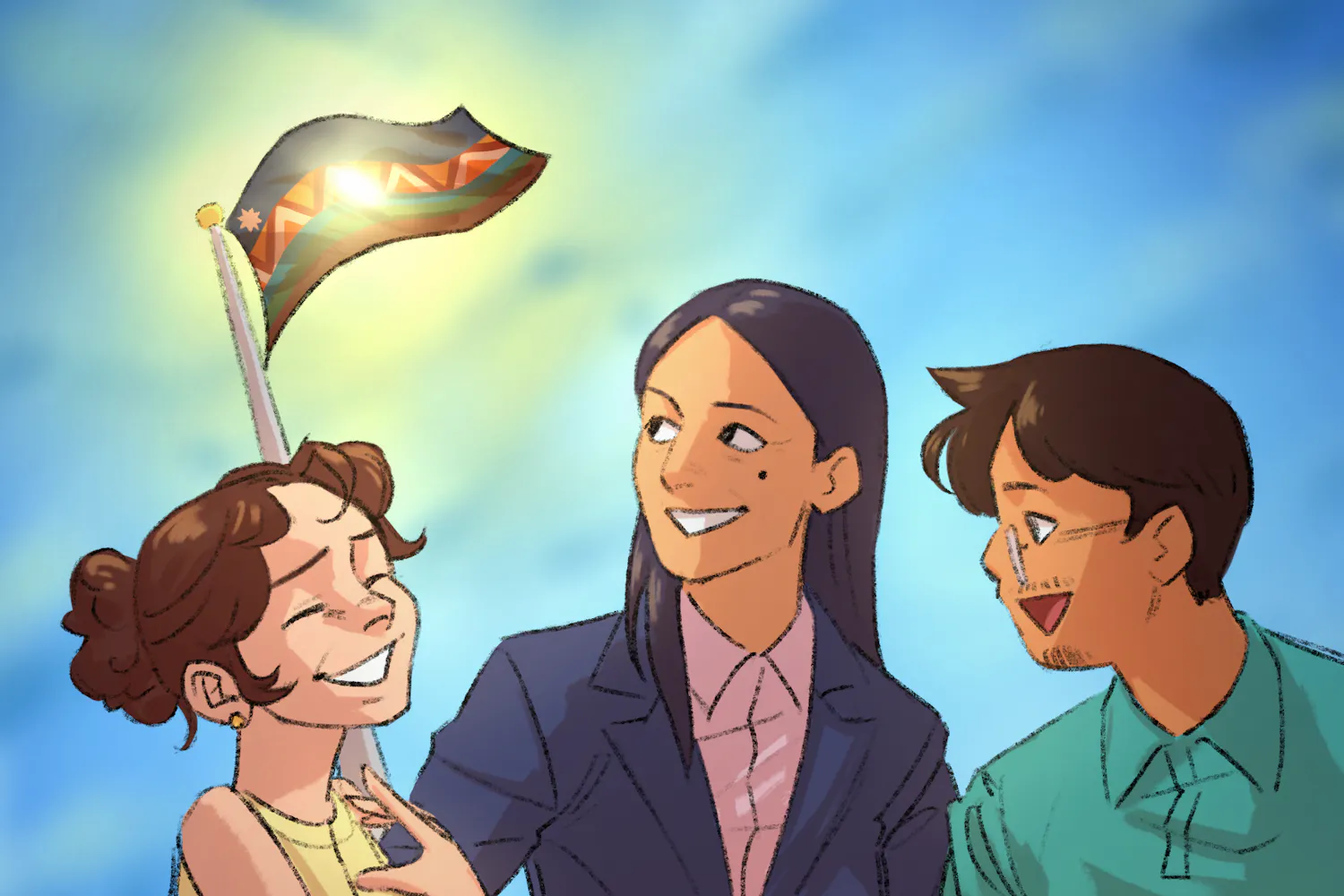
The phrase "name one good thing about Asians" still dwells in my mind to this day, even after three years. I don't remember the class I was in, nor what led to the conversation, but I do recall people I considered my friends looking at me and saying these words. In junior year of high school, I shared a table with two of my friends: one who I'd known since fifth grade, the other my water polo teammate. I don’t remember much of the conversation.
All I remember were the words "name one good thing about Asians" coming from the mouth of my teammate, followed by my other friend blaming COVID-19 on the entire Asian population. I immediately wanted to defend my community. I wanted to scream and shout at them for disrespecting my culture, my identity, my existence, but no words came out.
Instead, I turned my head away, stuck and speechless because I was consumed by what I heard. I had never experienced this kind of prejudice before. During my next class with them, I sat at a different table, still bothered by what they said. At first, they didn't notice me, but then one glanced in my direction, questioning my avoidance. I explained that their comments agitated me, and they responded with annoyance, as if I were being too sensitive.
They didn't apologize or try to correct any misunderstanding. One of them didn't even acknowledge that I moved tables or that the comment bothered me. The other did, but didn't understand why I was upset because, according to them, "it was just a joke." Despite experiencing this prejudice, I now realize the irony of the situation. As my community continues to be subjected to hate, our culture remains appropriated and popularized at others' convenience, even with the outside backlash.
Asian hate
When the COVID-19 pandemic caused nationwide restrictions like wearing masks and quarantining in 2020, Asian communities were deeply affected, especially because the initial cases originated from Wuhan, China. As a result, individuals like myself became vulnerable to hate and discrimination. In 2020, 4,431 hate acts were reported according to Stop AAPI Hate, a website created that year to document COVID-19-related anti-Asian racism by AAPI Equity Alliance, Chinese for Affirmative Action and San Francisco State University's Asian American Studies Department. These cases include acts like harassment, physical harm, institutional discrimination and property harm.

Over three years, 12,255 anti-Asian hate acts were reported. However, these statistics only reflect cases that were reported to Stop AAPI Hate. To combat this discrimination, former President Joe Biden signed the COVID-19 Hate Crimes Act into law on May 20, 2021. By January 2025, online slurs toward Asian communities increased by 66% since the presidential election, but slurs aimed specifically at South Asian people rose by 75%. In December 2024, physical violence threats against Asian communities also saw a 59% spike, while anti-South Asian threats displayed an 88% increase compared to November.
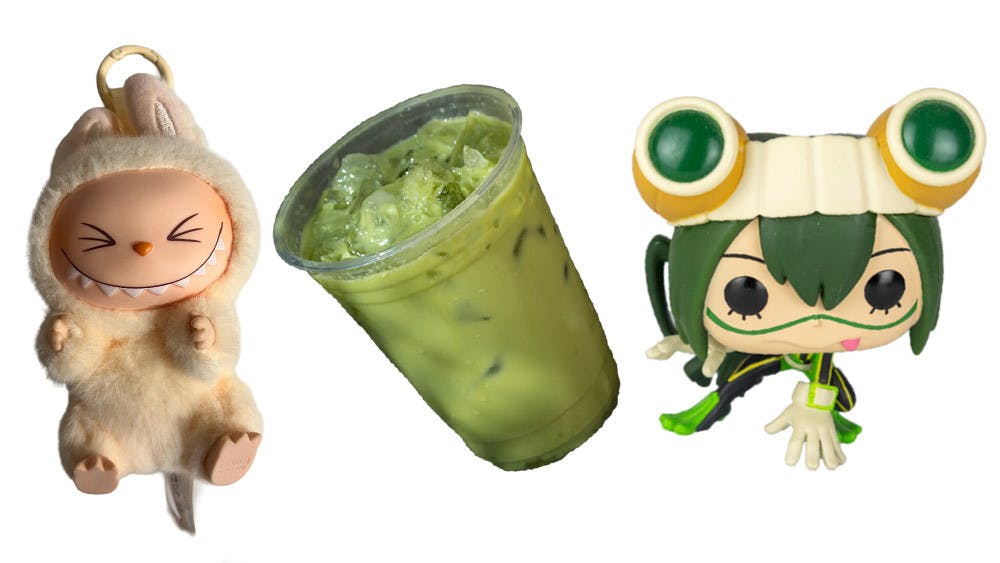
Despite an uptick in anti-Asian racism over the last five years, there seems to be a thriving interest in Asian-specific products like matcha and K-pop. Between 2020 and 2023, matcha remained a fixed line in popularity with slight increases and decreases, according to Google Trends. However, it later showed a gradual rise toward the end of 2023, reaching its peak in the summer of 2025. Matcha is a powdered ceremonial green tea originally from China, but was later introduced to Japan in the 1100s by Zen monks.
It is also essential in traditional Japanese tea ceremonies known as chadō or sadō. Murata Shukō, a disciple of Zen master and Abbot Ikkyū, is credited with founding it. Kumiko Hirano Gahan, an associate teaching professor, said traditional tea ceremonies have a strict and ordered routine. She said there is a certain way to walk, serve, prepare and drink matcha.
"How you pick up the lid, how you wipe the teacup and all that, everything is set," Hirano Gahan said. "You use matcha to make that tea in a formal way and serve it to your guest as a host. As a guest, (sweets are) served first to enjoy (with the tea)."
Due to a rise in demand, there is now a global matcha shortage. Additionally, Japan is also struggling to compensate because of both the lack of farmers and the recent rise in heat the country has been experiencing. Hirano Gahan said the shortage is a double-edged sword. "We can’t complain because business is there but some people are not happy because something they could enjoy in their daily life is not easily available," Hirano Gahan said. Aside from matcha, anime — a Japanese animation style — has also gained popularity.
One recent example is the movie "Demon Slayer: Kimetsu No Yaiba Infinity Castle," that released in the United States on Sept. 12. It received both a 98% approval rating on Rotten Tomatoes and earned approximately $128 million domestically, according to box office reports. Modern anime has existed since 1956 and was initially intended for Japanese children; however, it gained popularity through shows like "Dragon Ball Z" and "Pokémon." Despite the style already being well-known, Nafisha Patwoary, a sophomore studying computer science, said it started out with a niche fanbase.
Now with releases like "Demon Slayer" and celebrities like Megan Thee Stallion expressing interest in anime, there seems to be a growing appeal. However, Patwoary finds the shift from niche to trendy absurd. "Everyone called you weird for it," Patwoary said. "People literally judged who you are because of that and now there's this whole 360 like 'Oh yeah, that’s so cool.'" South Korea is also receiving an increase in attention due to K-pop and K-dramas.
Kayla Kim, a junior studying graphic design, said that people only know this aspect of South Korean culture and not anything else. "If you’re someone who’s a fan, who loves the culture, who loves all the pop culture aspects, it would be nice to dig deep into the culture, the history, the buildings and architecture," Kim said.
Another issue that Kim brought up was the romanticization of South Korean individuals due to K-dramas. "A lot of girls just (say) 'Oh, all Korean men are going to act this way' or like 'Oh, they’re gonna fall in love,'" Kim said. "There are terrible men in Korea and there are men who are just normal people." Additionally, there are TikToks where people seem to use "Korea" as an adjective.
Because of this, Kim feels that the word has become an accessory. "It's not the best feeling, I will say, because we're people too," Kim said. Although these products have risen in popularity, they are from East Asian countries like China, Japan and South Korea. South Asian trends do exist; however, they're often rebranded or Westernized, like chai.
Masala chai is an Indian black brewed tea mixed with a variety of spices like ginger and cardamom. Masala means "spices" and chai means "tea," but it is often referred to as chai tea outside of India. This beverage can also be ordered at Starbucks and becomes especially popular during the fall season when it’s mixed with other flavors like pumpkin.
Another example is the dupatta, a traditional long piece of cloth from South Asia worn over the shoulder and head. Rather than reference its formal name, it's become a fashion trend on TikTok called the "Scandinavian scarf." Additionally, Prada recently received backlash after it featured footwear that mirrored Kolhapuri Chappals in seven of their looks at the Spring 2026 Menswear Show. Kolhapuri Chappals are handcrafted leather sandals that Indians have worn for centuries.
The Italian fashion brand faced controversy for this due to both cultural appropriation and design theft from India. While Prada issued an apology and a statement claiming they recognized the origins, they did not initially provide credit.
Patwoary said that while it's good they eventually gave credit, it still doesn't compensate for failing to initially present it. "South Asian culture is slowly, slowly getting more appropriated," Patwoary said. "If you're not giving credit, it's appropriation, but if you give credit, it's appreciation."
Disregard for other Asian countries
Navjot Singh, a senior studying digital marketing and is Punjabi, said people state they like Asian cultures but mainly refer to East Asia, often disregarding other regions. "If I ever introduce myself like 'Yeah, I'm Asian or South Asian,' people would be confused that I don't look like the media they've been consuming or what they're expecting," Singh said.
Singh also recalled witnessing hate toward South Asians, especially toward Indians, through mediums like memes. A common theme he noticed is the characterization of Indians as unattractive. However, this hate declined once KATSEYE's Lara Raj, who is Tamil, gained popularity. Singh added that this is the first time he's seen acceptance for a South Asian in the media, but that it's still upsetting.
"All it takes is something trendy and hot to be put in front of you to respect us as people," Singh said. "It's sad to know that the world is still in a state or our country's still in a state where not everyone is fully accepted when you don't have a positive influence for them." Another aspect of the disregard is classifying all South Asians as Indians. South Asia consists of Afghanistan, Bangladesh, Bhutan, India, Nepal, Pakistan, Sri Lanka and the Maldives.
It's also inaccurate to label all Indians the same, as there are countless cultures in India. Patwoary is Bangladeshi, but she recalls people mistaking her for Indian or simply dismissing her because they did not understand her background. This lack of understanding is what she said leads to the disregard for South Asia. "People dismiss me all the time and people dismiss what they don't know," Patwoary said.
Although South Asia is often disregarded, it's not alone, as there are other regions like Central Asia and Southeast Asia that share this experience. Both are overlooked and there isn't exposure for those countries.
Pop culture
Patwoary also believes the reason people gravitate toward East Asian products is because of pop culture. However, even with the fascination toward East Asia, Patwoary said people only know about the popular aspects rather than the traditions and history.
Brian To, a junior studying organizational leadership and project management, also agrees that people are only interested in Asian culture because their products are popular. He also believes this could be beneficial because it provides exposure to these countries by boosting tourism. "It's never gonna hurt having more people accepting of your culture," To said.
"It's just gonna hurt if more people become more aggressive against your culture." While To thinks the trends can be good, there was a point when he didn't view them positively and felt there was too much attraction. This was due to witnessing Westerners impose their values; however, To came to terms that this is inevitable. "It's not like I can stop it or prevent it in any way," To said. "(So) instead of letting the boat crash into the wall, I should help steer the boat into a more clear path."
Whether or not the spotlight on Asian cultures is positive, To said the lack of exposure is why there are stereotypes and hatred persists. "There's this saying that all exposure is good exposure and even bad exposure is exposure," To said.
As someone who is Indonesian-American, I agree with the disregard for our heritage because I grew up in a predominantly white and Hispanic community. I was often the only Asian, and even if there were others, I was the only Indonesian. People would also often mistake me for other ethnicities like Filipina or disregard my identity altogether. Despite Indonesia being the fourth most populated country in the world, there seems to be a lack of acknowledgement among Westerners.
The country consists of about 17,500 islands, meaning there are many distinct cultures within the country, yet people only really know Bali — a popular tropical vacation destination. Although there may be a lack of exposure and understanding, that is no excuse for the Asian community experiencing discrimination and hate during and after COVID-19. Society may have forgotten; however, I, along with the Asian community, have not.
One person may have doubted the impact of the Asian community by telling me to "name one good thing about Asians." But given the popularity of many Asian or Asian-inspired trends and products — whether they are westernized, rebranded or not credited — it seems there actually happens to be countless good qualities.
Edited by Leah Mesquita, Natalia Jarrett and Abigail Wilt. This story is part of The Herd Issue, which was released on November 5, 2025. See the entire publication here.
Reach the reporter at akpaulic@asu.edu and follow @akp.reports on Instagram
Like State Press Magazine on Facebook, follow @statepressmag on X and Instagram and read our releases on Issuu.