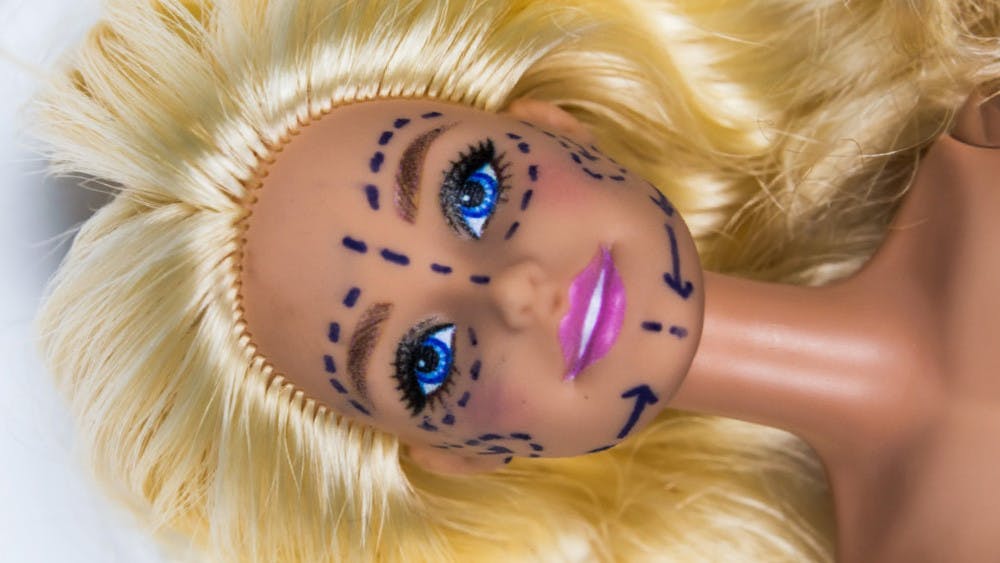
"Just one last poke," the injector says. "And you're done."
She hands you a mirror and you look at two swollen lips. They're a bit purple from the bruising, but you're not worried, the injector says it'll be about a week before the swelling goes down. So, you wait a week — it's your first time getting filler, so you're not familiar with the process. The week comes and goes, but by the end, you feel your lips are a tad smaller than the initial appointment.
"It's fine, I'll just go for the full syringe next month," you think. The cycle repeats and within a year, your face is suddenly unrecognizable. Your lips that once had half a syringe of filler, now have three. Your nose that was once a collection of your ancestry, is now sloped to perfection.
It's a choice to undergo cosmetic procedures. For the past 20 years, celebrities, influencers and even students have become more transparent about the work they've gotten done than at any other point in history. This wouldn't be the case if it weren't for the legal and societal freedoms granted by the feminist movements of the 20th century.
Many women feel these procedures empower them, maybe even improve their quality of life, but other women feel they reinforce the idea that a woman is defined by her beauty. There are, of course, women who lie in the middle, saying that if a woman feels unhappy with her features and has the means to change them, she should.
Every day, thousands of women undergo cosmetic procedures. These can range from a simple syringe of botox in the neck to a more complex breast augmentation. The ages of women seeking these procedures get younger through the years, with 21% of college students expressing interest.
The rise of med spas
The med spa industry has grown at a rapid pace over the last 15 years. Between 2010 and 2023, med spa locations nationwide increased from 1,600 to 10,000, and their revenue doubled. Much like other major cities, the area surrounding ASU has no shortage of med spa options.
Jett Summers is an ASU alum and the owner of Method Wellness & Infusion in Tempe. Prior to opening a med spa, Summers worked in the laser industry. He sold professional medical lasers to clinics and practitioners. Seeing the effect laser procedures had on patients' lives, he decided to venture into the med spa industry.
"Say somebody had really bad cystic acne growing up and they have those acne scars," Summers said. "For a lot of people, that's an insecurity that they carry with them on their face every single day. So we're able to eliminate those scars and give fresh, clean skin."
Summers said he feels as though the med spa industry has gone through significant modifications as trends advance. Ten years ago, clients sought drastic, bold changes. Today, they seek minor, subtle fixes. According to Summers, every wellness facility has its own approach.
"You'd be surprised if you think that they're coming in here for some crazy revamps or something like that," Summers said. "A lot of people are now on this wave of doing the bare minimum to get them the results that they need."
Located on Mill Avenue, Method Wellness is close to campus. "Being close to ASU, you have a lot of first-time users of these things," he said.
According to Summers, 90% of their clients are female, but there are males who also seek procedures. "Quite a few males are doing what you call 'bro-tox,' or Botox," he said. "But I would say our main demographic is probably girls, age(d) from, I want to say 19 to mid-20s."
Med spas engage in marketing campaigns similar to other businesses in the beauty industry. The known campaigns would include influencer and social media marketing while the lesser-known would be group discounts. Med spas in Arizona have been known to give discounts to groups of women, such as those in Greek life.
According to Summers, the special group rates are a chance to spread the word about the med spa and get a lot of people in at once.
"You hope that they promote you on social media, or you hope that you do word of mouth alongside that," Summers said. "The intent is you're providing them with good work. You're giving them a discount. You're building that relationship. And then you have walking billboards who are walking around with the work that you've done."
Pros and cons
Talia Breyer is an Arizona local and New York University alum with a degree in media, culture and communication. Breyer’s experience with cosmetic procedures started at 19 when she underwent a rhinoplasty.
"When I was in high school, I was like 'I would never do that, love yourself the way you are' and then as I got into college and became more familiar with the real world, I was like 'OK I'm getting treated differently for how I look,'" Breyer said.
"I want the best for myself and I want the best opportunities, so why would I not want to put myself in the position to be the one that's getting listened to, getting more views on social media?" Breyer said.
While Breyer felt as though she was alone in her cosmetic journey, she soon realized that many of her peers had also undergone cosmetic procedures. "Once I had it (the rhinoplasty) done and started talking to other people about it, I realized how many other people had it done without telling me or didn't talk about it really," Breyer said.
Breyer describes herself as "an open book" and feels it's important for society to be open about cosmetic enhancements. After her initial rhinoplasty, she still wanted to undergo more procedures.
"First, I got the nose job, then I got hair extensions. That's something people don't talk about but it's like thousands of dollars and you have to go every six to eight weeks to get them moved up," Breyer said. "I got filler, lip filler, cheek filler, chin filler ... I'm on Ozempic. That was kind of a body image thing, but that was also like mostly a mental thing with food noise." While Breyer said that getting filler and hair extensions was for fun, she emphasized the temporary enhancements they offer. In regards to the rhinoplasty, a permanent operation, Breyer feels as though her augmented nose has "always" been her nose, referring to it as an "extension of (herself)."
Seeking to give advice to young people looking to undergo cosmetic procedures, Breyer emphasized the importance of self-love and realistic expectations. "My thought process was 'it's not gonna be perfect, but I just want it to be better' ... I do have confidence in how I look, I'm not chasing perfection, I just want to be happy."
Laila Almansour is a junior studying computer systems engineering. She has not undergone any cosmetic procedures, but believes that women should have the choice to do so as long as they are well-informed about the risks.
"I see so many social media posts on a day-to-day basis talking about the cosmetic surgeries they have gotten done. And it worked for them, sure, but it does not mean that it will work on me," Almansour said.
Almansour feels that cosmetic procedures have become popular because of social media and that popularity has come at the cost of downplaying risks.
"It has been glamorized a lot more because they think it's brave to come and talk about it online," she said. "In my opinion, at the end of the day, just because something worked out for someone else doesn't mean that it'll work out for me or I'll get the same results."
Almansour also feels worried about the loosening of regulations in the industry. In Arizona, non-physicians can administer injections. "Only doctors should be doing these procedures. There is so much that comes when you make any kind of change to yourself ... I think when it comes to an esthetician to do it, it's more of a commercial thing," she said.
Social media has warped the perception of many young women when it comes to certain procedures. Lip filler is often seen as temporary and reversible, but research has shown that hyaluronic acid fillers do not dissolve or disappear from the body.
"When it comes to makeup or hair, it's so easy to go back," Almansour said. "It's so easy to want something different. It's so easy to express yourself differently. When it comes to something like cosmetic surgery, there is no turning back; you cannot express yourself in any different way. That's just you forever."
Cultural elements
While cosmetic procedures have gained popularity in the West in recent years, they have been significant in the Middle East for decades, particularly the "coming of age" nose job.
Nuha Jabbar is a junior studying political science. She is a Palestinian-American who graduated from high school in Ramallah, Palestine. Having experienced both cultures, she has observed differences and similarities.
"It's very common to get nose jobs and just change your ethnic features to look more westernized," Jabbar said.
Much like the rest of the world, Arab women feel pressured to keep up with beauty standards, both regionally and globally. However, while rhinoplasty has been prevalent in Arab countries for decades, cosmetic procedures are becoming popular with young Westerners too.
Jabbar feels that the freedom that's often accompanied by college, can contribute to the reason more young women are seeking cosmetic procedures. "I think they just feel a sense of freedom. I guess in college you are considered an adult, kind of like that shift into adulthood, or maybe just insecurities that you've had since high school follow you to college," she said.
In addition to personal freedoms, young adults may also feel that cosmetic procedures are more accessible now than ever before. The prevalence of med spas has meant that these procedures are more accessible and more affordable than in the past.
Jabbar felt that many procedures such as dermal fillers were not as temporary as they were marketed to be, leading to long term deformations that look unnatural.
"(The procedures) being easily accessible definitely makes it more popular. If filler was more expensive, 'broke' college students wouldn't get it done," Jabbar said. "It's not even seen as changing yourself anymore. It's seen as being pampered. It's like going to the salon and dyeing your hair. It's so easy."
Jabbar expressed concerns that young adults may feel regretful after undergoing a permanent or invasive procedure.
"Just wait it out. Because you are still growing, you feel like an adult the minute you get into college, but by the end of college, you're a whole new person. So maybe try to wait it out," she said.
Edited by Leah Mesquita, Natalia Jarrett and Abigail Wilt. This story is part of The Herd Issue, which was released on November 5, 2025. See the entire publication here.
Reach the reporter at banihanijude@gmail.com and follow @jud3moody on Instagram.
Like State Press Magazine on Facebook, follow @statepressmag on X and Instagram and read our releases on Issuu.
Jude is a junior studying finance. This is her second semester with The State Press.