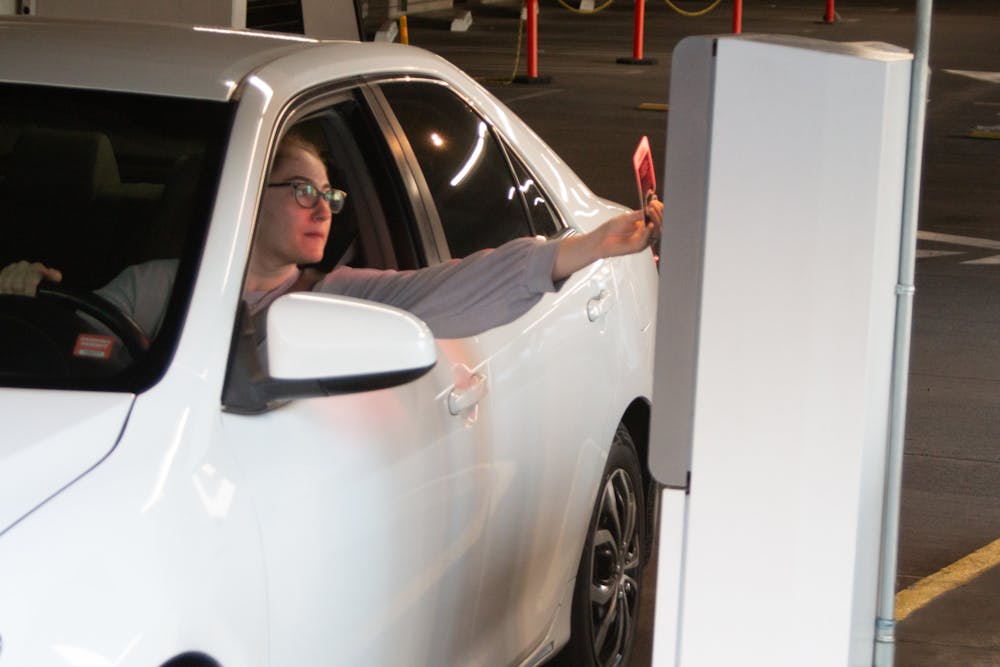
As the ASU campus quiets down with Sun Devils leaving for holiday break, some students have to leave their car behind in one of the University's many parking garages. However, the safety of a student's car often depends on the steps a student takes before leaving.
A spokesperson for the University's Parking and Transportation Services wrote that the parking permits are "intended for use while students are actively on campus." They also said the University breaks are a time for scheduled maintenance and improvements to the parking facility.
READ MORE: Insight: The trials and tribulations of parking in Lot 59
"While it is not advised to leave a vehicle on campus during the break, resident permit holders are not typically cited if their vehicles remain parked over this period," the spokesperson said in a statement. "However, doing so is still at the owner’s risk, as the university cannot guarantee that vehicles won’t need to be moved for maintenance or other operational reasons."
Although most residents remove their cars in compliance with the University policy, the spokesperson said they have not needed to implement any more measures regarding security or surveillance.
Riley Blocker, a senior studying music and French, said that although he had heard about a student allegedly getting their car broken into, he did not have any concerns with leaving his car for extended periods of time in one of ASU's downtown Phoenix parking garages.
He said he would recommend the parking garages to a friend needing a place to store their car for long breaks, but Blocker had to jumpstart his vehicle after leaving it at his paid parking spot for a few days in the winter.
Tatum Robinson, a freshman studying speech and hearing science, said leaving a car for an extended period of time is not a concern because of the many safety measures in place at the ASU Tempe garages, such as the emergency call boxes.
"I'm fine with leaving my car (a) couple days a week, overnight," Robinson said. "I haven't heard about any unsafe parking garage instances on campuses, so I'm not particularly worried about it at all."
For students who do leave their cars, ASU Police Officer Michael Ybarra said the ASU Police Department works to ensure the safety of the students and their cars all year long.
The parking and transit department checks the parking garages three to four times a day, he said, which is why it is important for students to keep their parking pass visible.
"We take it upon ourselves to be proactive, and we check out the garages constantly," Ybarra said. "If we see it, we're going to report it."
While long breaks do not typically see a higher crime rate compared to the rest of the year, he said the police department sees vehicle burglaries, thefts and criminal damage to vehicles more than anything.
Other common issues are dead batteries or flat tires due to changes in weather, Ybarra said.
The easiest way a student can protect their car is to start by locking the doors and fully closing the windows, Ybarra said. Most of the incidents the police department came across could have been prevented had a student double-checked that their doors were locked.
Students should also ensure all items are out of sight or, if able to, completely remove valuable items from their vehicle, Ybarra said.
If students have them, locking the steering wheel and setting alarms also serves as a deterrent.
"Keeping everything out of sight helps tremendously because then that crime of opportunity isn't there," he said.
Ybarra also advises students to take pictures of what is in their vehicle or personalize the items they have in their car so if their car does get burglarized, the police department can better track down the missing items.
Keeping information up to date, such as maintaining an active registration, also aids in helping students if they do find their car victimized, he said.
While the parking garages have cameras capturing the cars entering and exiting the structure, he added that a safer spot for students to leave their cars in the parking garages tends to be corners due to higher foot traffic and the presence of emergency call boxes.
If a student comes back from break and their car has been victimized, the first step a student should take is to call 911.
"We want to get that in the system immediately, especially if it's something that may have any type of serial numbers," he said.
Although break is fast approaching, Ybarra said it is important for students to stay proactive and take the necessary measures to protect their vehicles.
"That's the main thing, keeping your doors locked, windows secured (and) keeping stuff out of sight," he said. "Don't make anything accessible."
Edited by Natalia Rodriguez, Senna James, George Headley and Ellis Preston.
Reach the reporter at alillest@asu.edu and follow @allylillestol on X.
Like The State Press on Facebook and follow @statepress on X.
Allison Lillestol is a reporter for the community and culture desk. She is in her 4th semester with the State Press. She also works for Arizona PBS.