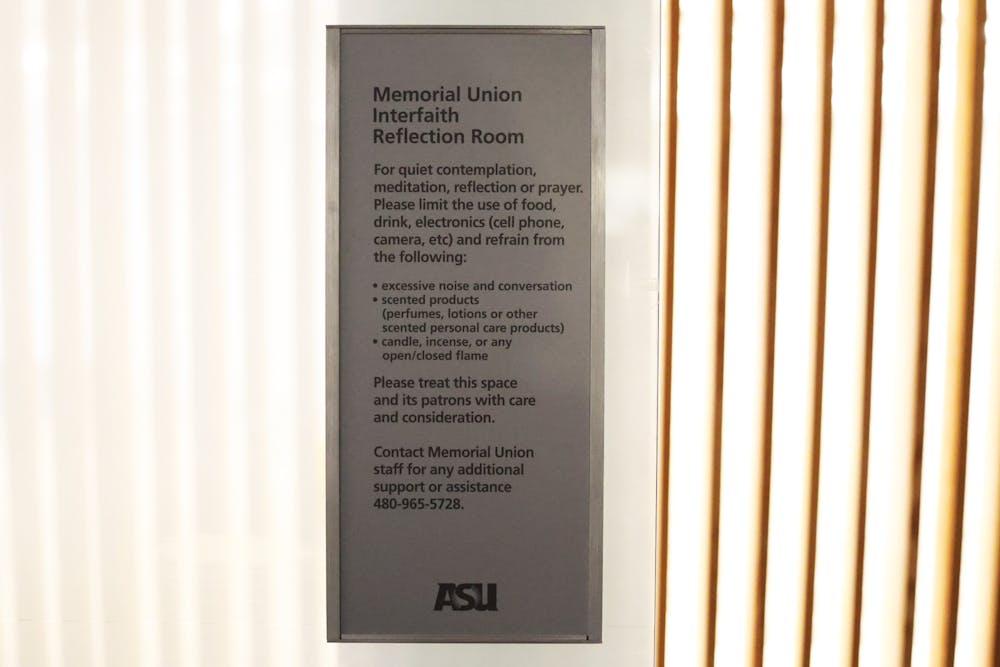
Tucked into a quiet corner of the Memorial Union's lower level and on Hayden Library's concourse level, several secluded rooms offer students an opportunity to step away into a moment of stillness.
The interfaith spaces, which include an ablution room and an area for group prayer, are reserved for quiet contemplation, meditation, reflection or prayer.
Sophia El Imrani, a freshman studying biomedical engineering, said while Islam, her religion, doesn't have strict restrictions on where one can pray, it is pleasant to have a room equipped for that purpose.
"I have prayed in parking lots, sidewalks, you name it," El Imrani said. "But it is nice to have a clean, quiet room to pray most of the time."
An ablution, a ritual washing or cleaning associated with religious observance, is another important resource the interfaith spaces provide students.
El Imrani said an ablution room is not a regular bathroom — it only contains a Wudu sink. The room provides the necessary discretion, especially for women who wear religious head coverings and cannot take them off in public.
Shefin Sharif, a sophomore studying business data analytics and supply chain management, said discovering a place to conduct his daily prayers close to his classes — instead of walking 15 minutes to the Tempe mosque — was a delight.
El Imrani said interfaith spaces do have their drawbacks. She shared an experience where her sister went to the space to pray, but found another person meditating with their dog.
She said if a dog's saliva touches a space, they cannot pray there until it is cleansed.
"Obviously, she has the right to use that space, but it goes back to different people have different practices," El Imrani said. "When we all share the same space, that can get a little convoluted."
Imrani pointed out that many of the people she sees use the space are Muslim, so having one dedicated to her religion on campus would be nice to avoid situations from happening that could disrupt Islamic practices.
The large Muslim population on campus also allows students to pray in congregation, which El Imrani said is a very spiritual and calming activity that nurtures a sense of community. An ASU News story said there were more than 8,000 Muslim students, staff and faculty at the University in 2023.
"It's nice to know that there are other people who share your identity, that you can just come and not even know them and pray with them," El Imrani said.
On the other hand, Sharif prefers the interfaith approach because exposure to different religious practices helps students connect with each other.
"Let's say I went there, (and) I saw a person who was praying — let's say he was from some other religion, which I didn't know much about — I could talk to him, I could learn what he does, or I could at least see," he said. "That could get rid of some misconceptions."
Terry Shoemaker, a professor in the School of Historical, Philosophical and Religious Studies, said interfaith spaces are a hub for students from all around the world to intermingle and share their cultures, often reducing "discriminatory ignorance."
"Knowledge is power," Shoemaker said. "The more you know about something, the less weird it becomes."
While Shoemaker sees the value in interfaith spaces, he is noticing a decline in the number of people in the U.S. who practice or affiliate with traditional religious institutions. About 22% of Americans are categorized as spiritual but not religious, while 21% are categorized as neither spiritual nor religious, according to a study done by Pew Research in 2023.
The growing trend, Shoemaker said, is the rise of people who are not affiliated with any religion or who identify as spiritual but not religious, a pattern especially common among millennials and Gen Z.
According to the same study, in the 18 to 29 age cohort, about 21% are spiritual but not religious. However, in the 30 to 49 cohort, 37% identify as spiritual but not religious.
"If people are becoming less religious, then the question becomes, do we need to use a room for interfaith spaces, if your generation and the preceding generation simply aren't interested that much in religion?" Shoemaker asked.
Still, for students like Sharif and El Imrani, the interfaith spaces remain a valuable campus resource.
Edited by Natalia Rodriguez, George Headley, Tiya Talwar, Sophia Braccio and Ellis Preston.
Reach the reporter at dkovalen@asu.edu.
Like The State Press on Facebook and follow @statepress on X.
Diana reports on ASU’s diverse community and culture for The State Press. She is pursuing a degree in Journalism and Mass Communication with a minor in Political Science. In addition, she is a reporter for The Cut Network and a radio host at Blaze Radio.