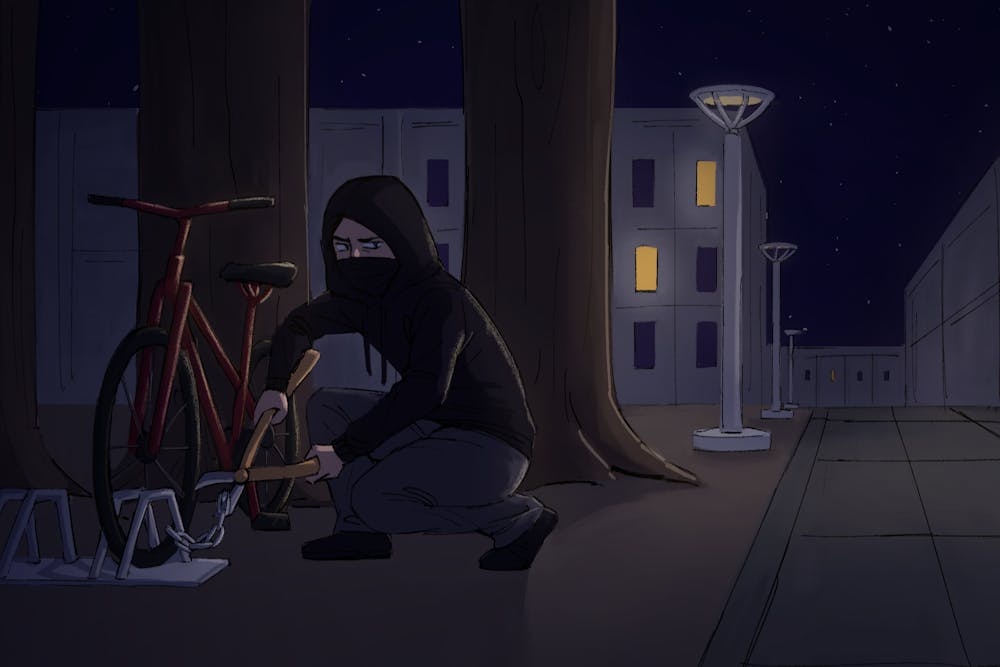
Many Sun Devils rely on personal modes of transportation, like scooters, skateboards and bicycles. With a large presence of these vehicles on campus, theft has become ASU's No. 1 issue.
Personal transportation device theft was reported 95 times between the end of September through November of 2025, which makes up 20% of all reported crimes for that period, according to the ASU Police Department's Clery report.
About 65% of these cases were currently marked as inactive or having no solvability factors. This means that all current leads have been exhausted, not that the investigation has ended, said David Ramer, assistant chief of police for ASU PD.
"It's still an ongoing case," Ramer said. "Typically these suspects are repeat offenders, they're going to come back and do the exact same thing, and it's just a matter of time before we find them (the offenders)."
Nicolas Castaneda, a freshman studying finance, said when his bike got stolen in September, it came as a surprise to him.
"It was pretty early in the semester, so I still didn't really know how bad the theft was at the campus," Castaneda said. "I didn't think I was going to need to do anything more than just leave it locked."
After the incident, Castaneda said he invested in more protection for his new scooter. This included getting it an AirTag, buying a more resistant lock and noting down its serial number.
Not knowing a device's serial number is the biggest factor in cases of theft being suspended, Ramer said. Project 529 is an app that allows users to register their vehicles with ASU, which increases the likelihood of returning the property to the owner.
According to data collected by ASU PD, less than 10% of stolen items were registered.
"We all live in a super busy life, and we're going along, and we don't think this is going to happen to us," Ramer said. "Just take a few minutes. Register your bike, register your scooter, take some pictures of your serial number."
READ MORE: Hundreds of bikes are stolen on ASU campuses, solutions are hard to come by
Pratham Manish Savjani, a graduate student studying data science, analytics and engineering, had his bicycle stolen in November after spending about six hours at the library.
Despite using a combination padlock to secure his property, his bicycle and lock were gone when he left.
Cable locks, like the one Savjani used, are easy to break. Ramer said a good pair of wire strippers can quickly cut it.
Cable locks account for nearly 80% of thefts, and are usually cut or tampered with, according to data from ASU PD. Ramer advises students to use a U-lock instead, as it provides better security despite a higher price.
"Probably 90% to 95% of our thefts involve either a cable lock or it wasn't secured properly," Ramer said. "Very rarely do we see a scooter or a bike that is stolen because of a U-lock that was used properly."
Other advice recommended to students is to decorate their vehicles, to make them more distinct from others, Castaneda said.
However, despite the issue of theft remaining one of ASU PD's top priorities, the official data shows a decreasing trend in the number of occurrences.
Between July and October 2025 there were 90 thefts, which is a 21% decrease from the same period last year and a 26% decrease from the same period two years ago, according to ASU PD data.
If the estimated 22% per month pace continues, it is projected around 270 to 300 thefts will occur in the 25 to 26 fiscal year, marking a 5-year low.
"When we're able to lower crime, it's not just a police department, it's a partnership," Ramer said. "It's the entire University working together, and that includes the student population partnering on this, and we need that partnership."
Edited by Natalia Rodriguez, Senna James and Pippa Fung.
Reach the reporter at dkovalen@asu.edu.
Like The State Press on Facebook and follow @statepress on X.
Diana reports on ASU’s diverse community and culture for The State Press. She is pursuing a degree in Journalism and Mass Communication with a minor in Political Science. In addition, she is a reporter for The Cut Network and a radio host at Blaze Radio.