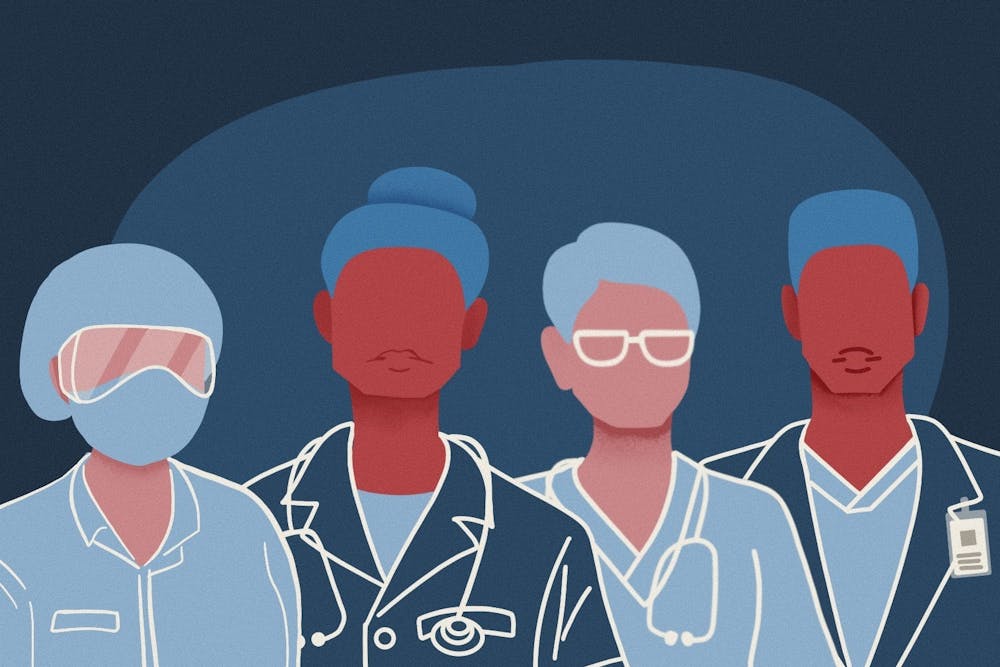
The Trump administration declassified nursing as a professional degree, evoking outrage and financial fears from several nursing students at ASU.
The One Big Beautiful Bill Act, which was passed in July, instructed the Department of Education to make the change, which caps graduate nursing students' federal loans to a lifetime limit of $100,000. When the degree was considered professional, students were allowed to borrow up to $200,000.
The new rules will take effect in July 2026.
According to a DOE press release, the classification of professional degrees only relates to how much money students can borrow and "has no bearing on whether a program is professional in nature or not."
READ MORE: New federal law will force tough decisions for student loan borrowers
The loan amounts are exactly the problem, said some University nursing students.
Abigale Fajardo, a junior studying nursing who is currently working night shifts in clinicals, called the change a "smack in the face" to nurses and the health care field overall.
She said she is less sure about enrolling in graduate school because of the loan limit. Despite working, she wouldn't be able to afford further education, and she worries about taking on private loans with higher interest rates.
Fajardo said the decision will deter people from entering graduate school for nursing entirely, exacerbating an existing scarcity.
"We're dealing with these types of health care fields that are strenuous for us, and some of us are already leaving, hence why we have a shortage," Fajardo said.
Many nursing students pursuing graduate school have families, and the financial responsibility of both school and taking care of their children is already a strain, Fajardo said.
Brooklyn Gardner, a freshman studying community health, is planning to apply for the University's clinical nursing program. Growing up, she said she watched her own mother study nursing and experienced the economic challenges that came with it.
"She has three kids, and she put all of that on the line to go back and get a higher degree of education, to be able to do something that she was really passionate about," Gardner said.
Gardner and her sister are both nursing students, and she said their mother felt hurt knowing her daughters' careers were no longer deemed professional.
"Nurses are the ones holding people's hands as they pass away, and they're the ones that are going to care for you and for your loved ones," Gardner said. "To declassify them and make getting this education harder... that is really heartbreaking to hear."
Gardner also said the limits on borrowing disproportionately hurt women, as nursing is a female-dominated field, according to the U.S. Census Bureau. The change places another burden on their careers, she said.
Kamora Young, a sophomore studying community health and intending to apply for the nursing program, said she was "in shock" when she learned of the change.
"We're in school to learn how to save lives," Young said. "I don't understand how you don't classify that as professional when we're such a vital part of American society."
READ MORE: Prop 409 passes, funding healthcare resources and education for students
Young said the declassification will deter many students from pursuing a graduate degree because of the decrease in federal loan options. To achieve her goal of becoming a nurse practitioner, she needs a graduate degree, but the change has led her to rethink her options.
"That was my dream," Young said. "There's definitely a dent."
She said nurses deserve recognition as professionals for the rigor and specialization of their field.
The National Center for Health Workforce Analysis estimates the supply and demand of the nursing workforce in the U.S. will continue to widen until 2037.
"It just takes away from the hard work that every single nurse is doing in this country," Young said.
To her, the nursing field is as deserving of the professional designation as they come.
"We are such a vital part of what is done in the hospitals," Young said. "How could you consider what we do unprofessional?"
Edited by Carsten Oyer, George Headley and Ellis Preston.
Reach the reporter at apruiz@asu.edu and follow @andiruiz2405 on X.
Like The State Press on Facebook and follow @statepress on X.
Andi Ruiz is a politics editor at The State Press. She was formerly a lead politics reporter and anchor at The Cut Network. This is her second semester at The State Press and is committed to bringing credible and accurate information to the ASU community.