I learned at a young age that my body type was different.
It isn't difficult when the rest of your friends wear crop tops and tank tops, and you were the odd one out, hiding as much as you could under baggy clothes.
Although I had friends who accepted me for who I was and never made me feel uncomfortable, that never truly made my insecurities disappear. While they exposed their skin with dainty, "itty bitty" tops, I could only stare at them, wishing I were them as I hid my stomach, legs and just about every inch of my body.
Throughout grade school, I played sports. I competitively swam for eight years and played water polo for three. I even trained post-seasons and during school breaks. My family and I would hike, swim and bike. And yet, I still looked like the unfit friend.
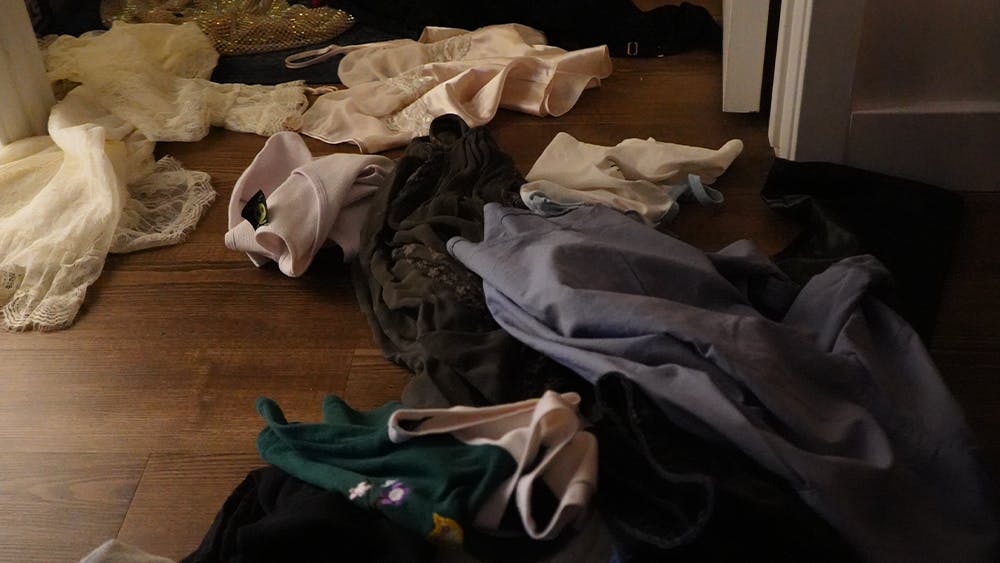
I also dreaded shopping. While I was excited in the moment, it quickly faded into exhaustion and irritation because I could never find the right clothes that fit me. Even if I ended up finding something, I always had difficulty when trying it on as I had a larger chest and legs, but a smaller waist — meaning clothes would either fit my waist or my legs, but not both.
In addition, I actively avoided clothes that revealed too much skin or enhanced certain features. Though my insecurities were the main reason for my discomfort, the societal pressure to cover up to prevent unwanted attention was another.
That said, the societal pressure to hide my body not only affects me, but other women as well. In situations involving sexual harassment and assault, the justification is often "What was she wearing?" or "If she wasn't wearing that, it wouldn’t have happened".
Jocelynn Barraza Rodríguez, a junior studying criminology, recalled several occasions in high school where she was harassed and "catcalled" by older men. She said in some of those instances, her skin was fully covered since she was part of a military program.
"It's (her uniform) some long pants and they're not even jeans, (they're) like actual business wearing pants, a button-up that we had to wear as tight as we could because it would wrinkle," Barraza Rodríguez said. "Even then, I'm covered head to toe and I would wear a sweater on top of it."
Barraza Rodríguez said because of these instances, she felt uncomfortable walking home from school. To feel at ease, she'd walk through neighborhoods instead of the streets or walk in the company of friends.
However, she added that regardless of what she wore, harassment still occurred, mainly due to her body type.
"It's kind of absurd," Barraza Rodríguez said. "Whether you're wearing tight clothing or wearing loose clothing or you're wearing nothing or you're wearing something, you're going to be (cat) called for it."
Different body types
Emily Pavan Carranza, a junior studying emergency management and homeland security, remembered a time when a customer at her job complained that her clothing was inappropriate, despite it never being an issue before. She described the situation as both uncomfortable and frustrating.
"I've always had more of a voluptuous figure, I have a bit more to cover," Pavan Carranza said. "If I had been a petite white woman wearing these clothes, this wouldn’t have been an issue."
Pavan Carranza understood that in particular environments like a workplace, there is a required level of professionalism. She also said it was unfair that she specifically received this complaint due to her body type.
"There's other people at work that wear certain things and they don't get called out for it but God forbid I did it," Pavan Carranza said.
A universal body type does not exist, meaning that clothes will never truly fit one person the same. Pavan Carranza said due to her body type, she avoids wearing or buying clothes that are short or uncomfortable to prevent unwanted attention.
"I would wear whatever I wanted, anything I wanted if there weren’t those external factors of what could happen to me," Pavan Carranza said.
She added that the constant awareness of potential unwanted interactions is upsetting because women are forced to consider whether something as simple as clothing could compromise their safety. However, even if acknowledged, it doesn't reduce the possibility of a situation occurring.
"You could be wearing sweats, look crazy and whatever, and unfortunately things will still happen," Pavan Carranza said. "That’s just the sad reality of being a woman."
There is a traveling gallery installation known as "What Were You Wearing," that displays sexual assault survivors' stories and the clothing they wore during their assaults. Many of the pieces showcased either a minor, someone who wore a school or work uniform and/or people who were fully covered. The installation was intended to show that clothing has no correlation to instances of assault.
In addition, there are also videos on TikTok under #WhatWereYouWearing where women explain their sexual assaults through the lens of the clothing they had on. One woman presented an oversized t-shirt and the athletic shorts she wore when she was assaulted.
Although men's comments and actions are the main reason Pavan Carranza feels uncomfortable wearing certain clothing, she also said women have encouraged this sexualization, as it was a woman who complained to her boss regarding her clothes.
"Having another woman shut that down, it feels kind of like betrayal," Pavan Carranza said.
Despite the backlash, she said it’s a result of how different generations of women were raised to think and believe.
"You have to realize how much liberty we had as women in each generation," Pavan Carranza said. "That generation (older ones) didn't really have that voice to really be out there and express themselves through clothing, through makeup, through their personalities."
Generational issue
Elizabeth Cady Stanton was the first major voice for women, bringing their issues to light during the Women's Rights Movement in 1848. Stanton, along with her three friends, expressed discontentment about their situations as women, despite the American efforts to be freed from oppression during the revolution. At that time, women were still dependent on men, facing discrimination in education, the workforce and most prominently, did not have civic obligations.
It wasn't until the early 20th century that women began to gain their independence. During World War I, women were encouraged to take on jobs to support the men at war. Later, the ratification of the 19th Amendment occurred, granting women the power to vote in 1920.
Amid these events, women's fashion evolved from the Gibson Girls' long skirts and tight corsets to the Flappers' loose, shorter dresses that revealed more of a woman's neckline and legs. These women also wore bold makeup and hairstyles. Along with their distinct style, Flappers also symbolized rebellion from the societal boundaries of that time. They engaged in what was considered "unlady-like" activities such as drinking and smoking. However, these bold choices did not exist without criticism.
Although women today have more freedom compared to this polarizing time, the cycle of criticism continues. This occurs in several ways, including in the beginning stages of childhood. Barraza Rodríguez said she was raised to cover up and maintain other forms of modesty like wearing extra garments under clothing.
"You have to dress this way because you never know who's going to be around," Barraza Rodríguez said. "It was always 'Close your legs, don't wear shorts, only wear shorts to sleep.'"
Despite continuing to live by these rules to feel secure, Barraza Rodríguez questioned the need to tailor her clothing to feel comfortable.
"Why is there a need to wear shorts?" she asked. "Who's going to be looking up my skirt? Why should somebody find the need to look up my skirt that I need to be wearing (shorts) or be self-conscious about?"
Sexualization of women’s bodies
In 1992, an 18-year-old Italian girl was sexually assaulted by her 45-year-old driving instructor during her first driving lesson. The instructor was arrested and sentenced to jail, however later appealed the case, saying their interaction was consensual. The Italian Supreme Court released the perpetrator, claiming that due to the tight jeans the victim was wearing, she had to have helped him remove them, which constituted it as consensual. This became known throughout Italy as the "jeans alibi."
As a result, women who worked for the Italian Parliament protested against the Supreme Court by wearing jeans. This reached international media and also inspired similar protests in California. This case is most known for the creation of Denim Day in 1999. This initially started as a campaign by Peace Over Violence Executive Director Patricia Giggans, but is now recognized on the last Wednesday in April during Sexual Assault Awareness Month.
Furthermore, this criticism of women's clothing seems to be encouraged with videos made by Dallin H. Oaks, the president of the Church of Jesus Christ of Latter-day Saints, where he stated that if women dress immodestly, they are "magnifying this problem by becoming pornography" to men.
Although external factors like the video affect women's clothing, Alanna Rothell, a senior studying English linguistics, said it can also be traced back to internalized misogyny.
"I hate walking out, seeing a girl and thinking 'Oh, wow that is really revealing,'" Rothell said. "I then immediately check myself and I think 'First of all, why is it any of my business? Second of all, why would there be anything negative about that?'"
Rothell described dressing as a woman is exhausting because whether you choose to dress modestly or immodestly, dressing yourself impacts how you are perceived. She added that if a woman dresses modestly, she will be respected, but if she chooses to reveal more skin, she'll be sexualized.
"It literally doesn't matter which one I wear because if I'm dressed modestly and respectably or if I'm just revealing, I'm going to be desired, I'm going to be stared at and also going to be disrespected," Rothell said.
Edited by Leah Mesquita, Natalia Jarrett and Abigail Wilt. This story is part of The Purity Issue, which was released on December 3, 2025. See the entire publication here.
Reach the reporter at akpaulic@asu.edu and follow @akp.reports on Instagram
Like State Press Magazine on Facebook, follow @statepressmag on X and Instagram and read our releases on Issuu.