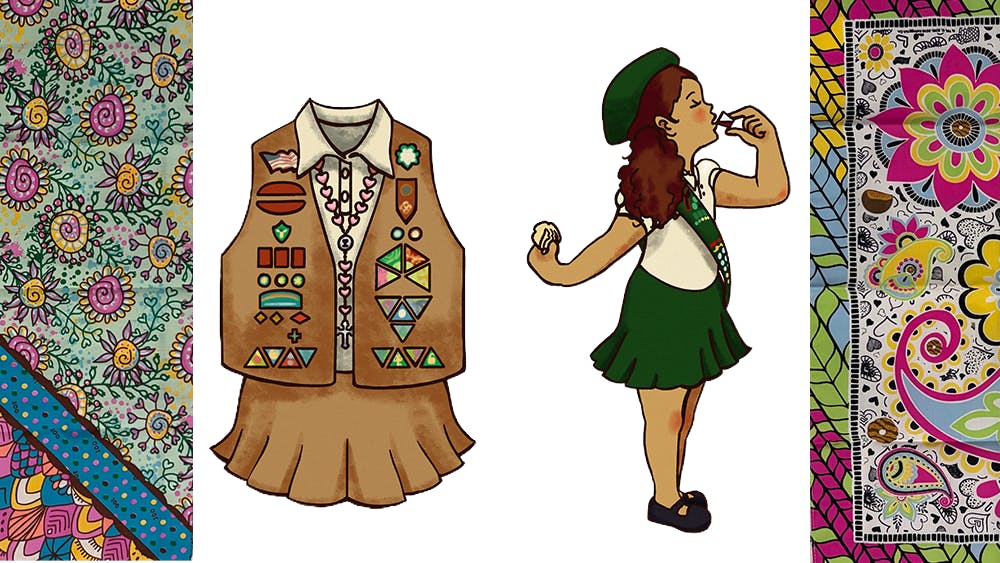
The Girl Scouts and a group of local satanists walk into a room... with a 6-foot-tall vagina sculpture.
Every scouting alumni I talk to has a slew of different stories to tell, and many, like mine, sound like the start of a stand-up set. We all worked toward the same badges, but the true spirit of scouts, for me, was in the unplanned — the mishaps, the surprises, the moments that made us question things.
I attribute much of my worldview, my independence, my successes, and yes, my relationship to my faith, to Troop 700, and to the not-so- flawless world of Girl Scouts.
Not your mother's Girl Scouts
As scouts, we learned how to dress a wound, how to pitch a two-man tent and how to make just about every craft under the sun. We learned how to build a fire too, but that one never really stuck for me.
Much of what we did was traditional scouting, but as I moved up the ranks, Girl Scouts became less about empowering girls with skills, and more about empowering them through their thoughts.
I remember sitting in a middle school classroom, in my plaid school uniform with my matching red Chuck Taylors, as a mom led us through a worksheet about the stereotypes women face and how we could defy them.
What would really defy stereotypes is if we got out of this classroom and did something exciting, I thought to myself.
Going into the 2000s, there was a broad restructuring of the Girl Scout program. The curriculum emphasized "Journeys" for older scouts, which became prerequisites for the highest achievements, earning you the coolest medals — the Bronze, Silver and Gold awards.
Though skill-based badges still range in topic from first aid to financial literacy, real progress toward the highest achievements is indicated today through completing a curriculum and project that emphasizes leadership, cultural awareness and community service.
To the credit of the women leading my troop, we often traveled, camped and took little adventures around Phoenix. On more than one occasion, we camped through rainstorms. We were a tough bunch, and only ever abandoned a trip once when the stomach flu swept through our campground.
The outings that never went as planned made me independent, adaptable and forged a few of the friendships that I'll carry with me for a lifetime. And despite my resentment, mainly rooted in boredom, those conversations and fluffy worksheets made me think about how the world views girls, and the expectations placed upon us.
The period party
When we hit high school, our troop was growing apart. We all went to different schools with new interests and limited time. We decided that in our last "Journey" together, we would focus on helping other girls.
Our mission was to destigmatize menstrual cycles to raise awareness about period poverty. We were also awkward high school freshmen who wanted very little to do with talking about our bodies.
READ MORE: The cycle of stigma and the fight against period poverty
I spent hours crafting a flyer that made tampons and pads palatable enough to share on our Instagram feeds and send to the ladies at church. The color scheme I settled on was purple, because pink was cliché and red would’ve been too gross.
After collecting boxes of pads and tampons from friends, family and classmates, we brought them to an event hosted by a local organization to make them into period kits for middle schools.
When we got to the event, it hit me that we were probably the ones who needed to let go of some stigma. The venue was a corporate event space decorated for an all-out period party, complete with pastries drizzled in shimmery red raspberry blood.
The most remarkable decoration, however, was the previously-mentioned vagina sculpture, constructed out of PVC pipe, foam and satin, adorned with a tiny pink disco ball at the top.
The organization partnered with all sorts of community members outside of the Girl Scouts: mothers and daughters volunteering together, college students, etc.
We did not know the Satanic Temple was one of them. And it was a shock.
For my troop, scouting and religion were intertwined. We wore our sashes to mass on Scout Sunday. We attended Catholic scouting retreats where they performed campfire skits based on the New Testament. I even attended special meetings about religion to earn an award for living my faith as a scout.
But for some time, there was still a lingering tension between the Church and the state of scouting, fueled by culture wars and online rumors. One time, a church member shared that they would be boycotting our cookies because the sales supported Planned Parenthood and abortions.
Girl Scouts has denied these claims and others that they engage in political issues. But more importantly to me, fighting a culture war was not in the Girl Scout Promise.
"On my honor, I will try:
To serve God and my country,
To help people at all times,
And to live by the Girl Scout Law."
As a troop, we were charitable and service-oriented. Those at the center of my scouting experience — my mom and my troop leader — were, and continue to be, among the most faithful, generous women I know. And as for the girls in my troop, I always felt that I could have open conversations with them because they were loyal, accepting friends.
That was the Girl Scout way. It stung me that not everyone saw that. But during my time as a Girl Scout, I learned that who I was and what I valued were not things other people dictated.
So there we were, living out the Girl Scout way with the help of Satanic Temple members, a group of people who would never agree with us on many matters, but who, in that moment, were working to make the same change we wanted to in our community.
Epilogue
Recently, a friend challenged me with this question: If I have a daughter someday, will I put her in Girl Scouts? Here's my answer:
Over 100 years ago, Juliette Gordon Low founded Girl Scouts. Toward the end of my scouting journey in high school, I questioned whether the need for such an organization persists in a world where women can vote, lead nations, be entrepreneurs, be breadwinners, and choose who they love and how they live. I felt this conflict as our moms and leaders tried to usher a troop of Gen Z girls through a mandatory curriculum about becoming a #girlboss who #defiesstereotypes.
But now I see just how necessary and formative Girl Scouts was, not because of the badges or worksheets, but because of each misadventure. Today, more than ever, girls need a space offline and away from the noise of faraway adults telling them who they should be, to explore just what it means to be a girl and wrestle with every issue that identity entails.
I don't know what scouting will look like in the years to come, but I do know that if I ever have a daughter, I hope she can have a community to navigate a big, messy girlhood with.
Edited by Leah Mesquita, Natalia Jarrett and Abigail Wilt. This story is part of The Purity Issue, which was released on December 3, 2025. See the entire publication here.
Reach the reporter at spbracci@asu.edu and follow @SophiaBraccio on X.
Like State Press Magazine on Facebook, follow @statepressmag on X and Instagram and read our releases on Issuu.
Sophia is a senior studying journalism and mass communication. This is her sixth semester with The State Press. She has also worked at Nomads with Notebooks and Blaze Radio and interned for The Arizona Republic.