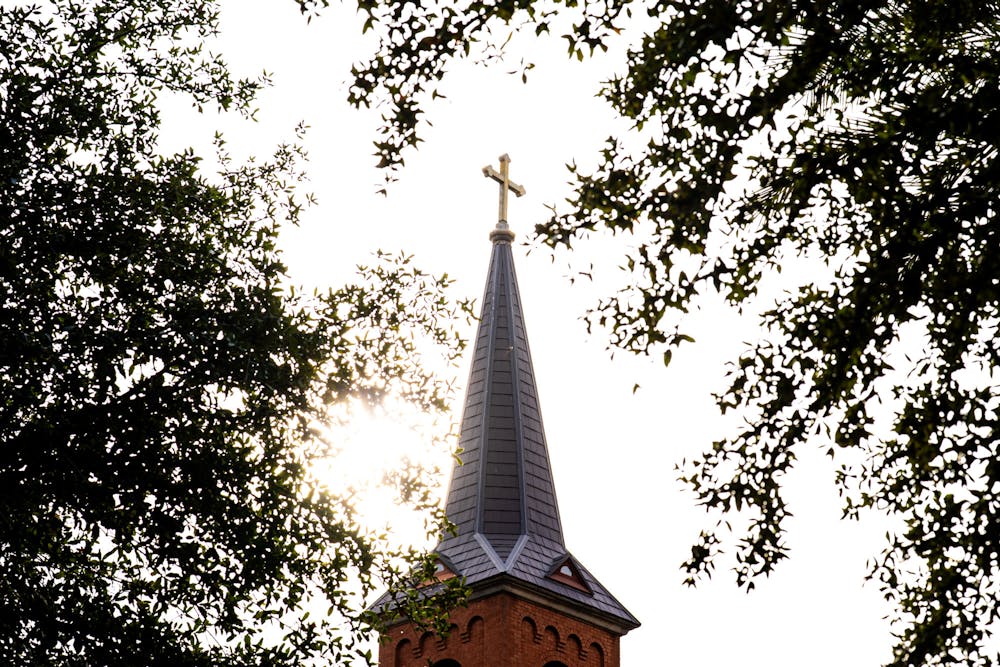
At the end of the fall semester, the Newman Center at ASU saw 52 students join the Catholic faith. A spokesperson said it's the largest cohort that the staff knows of.
The Rev. Aaron Qureshi, a chaplain who has worked at the Newman Center for three and a half years, usually witnesses about 15 to 20 people complete the sacraments of initiation each year. He said in addition to those who completed the sacraments in the fall, there will be more in the spring.
"We've been blessed here at the Newman Center with a lot of interest among our students, our Gen Z population," Qureshi said.
Cameron Bailey, a sophomore studying data science, is one of those students who committed to Catholicism in college.
Despite growing up in a Protestant Christian family, Bailey did not start embracing religion until high school. Last Easter, Bailey received confirmation and first Holy Communion at the Newman Center.
Conversations between Bailey and Latter-day Saint friends prompted a deeper interest in faith.
"My conversion, I guess, was very much intellectual in that way," Bailey said. "It was mainly me doing research and wrestling with questions and praying to God, begging him to reveal the truth to me."
Analise Kresge, a freshman studying biomedical engineering, believes as people get older, they are trying to discover the truth in the world, which leads them to the Catholic faith.
This trend, however, is not specific to the ASU population. EWTN News, a Catholic news network, reported that campus ministries at University of Michigan at Ann Arbor and University of Nebraska-Lincoln have also seen recent upticks in conversions.
Pew Research polling published in December 2025, however, did not find "clear evidence of a religious revival among young adults."
Qureshi said while it is too early to say if this is going to be a long-term trend or not, it is certainly not a "statistical blip."
At a recent conference with campus ministers from across the nation, everyone, without exception, experienced rapid growth in the past year, Qureshi said.
"So it does seem to us that God is doing something — the Holy Spirit, we would say, is doing something — to draw people again to faith," Qureshi said. "I can't help but think this is going to be the start of some kind of cultural change."
Daniel Bednarek, a junior studying computer information systems, believes this trend is linked to the independence that college students experience, typically for the first time in their lives.
"I think college is a good place for most people to explore themselves, especially in faith," Bednarek said. "Your mom and dad are no longer waking you up to go (to church on) Sunday. If you want to go to church, it's on you."
Bailey believes, through modern culture, some young people, especially young men, do not have a feeling of direction, which could contribute to mental health struggles.
Bednarek said students can attempt to medicate with good grades or "sin struggles," but will eventually feel empty during their college experience, which leads them back to faith.
Qureshi said that one of the reasons the current generation of students is attracted to the Newman Center is because of the challenges of loneliness they face on college campuses.
In response to that, the Newman Center is positioning itself as a place of intentional friendship, Qureshi said. The center puts effort and emphasis on fostering friendship through various informal events and gatherings, the chaplain said.
The center also teaches "intellectual offerings," like the classes taught by Mary College to answer the popular question: "What is the meaning of life?" Qureshi said this question comes with being a young person in today's culture.
"That's a second thing that we were very deliberate about, is reminding people your life, it's not meaningless," Qureshi said. "In fact, it has an infinite dignity and an infinite worth."
Edited by Natalia Rodriguez, Senna James, Emilio Alvarado, Sophia Braccio and Pippa Fung.
Reach the reporter at dkovalen@asu.edu.
Like The State Press on Facebook and follow @statepress on X.
Diana Nychyporuk is a Podcast Reporter at The State Press. She previously worked as a reporter for the Community & Culture desk. Diana is pursuing a degree in Journalism with a minor in Political Science.