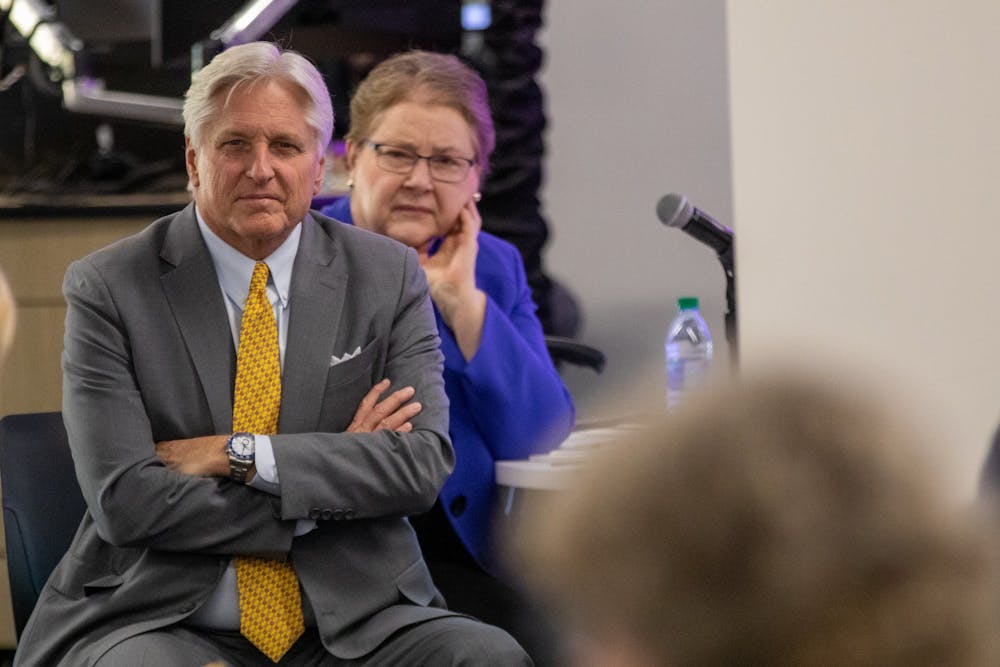
The Arizona Board of Regents approved a grant in November to fund university research for technologies with both national defense and commercial applications.
The Regent's Research Grant, approved at ABOR's November meeting and administered with the assistance of the Arizona Commerce Authority, funds eight dual-use research projects. Four of those projects are at ASU.
Regent Fred DuVal said the grant was developed to tangibly improve the lives of the citizens whose taxes fund research in the state.
"In addition to teaching students, providing research that create breakthrough solutions that improve our lives is part of our mission," DuVal said.
By starting with Arizonans as the "end user" of the research, DuVal said ABOR can invest in projects that will have the greatest impact. ABOR focuses on investing in projects that can be easily explained to the public.
Patrick Ptak, the ACA's executive vice president of executive initiatives, said state officials saw defense technology as an important economic sector to develop in Arizona.
The focus on national security this year intends to maximize opportunities in Arizona's defense industry, Ptak said.
Wiley Larsen, director of SBIR/STTR and university partnerships at the ACA, said the dual-use focus was a response to the research funding environment under President Donald Trump's administration. The federal government has prioritized projects with dual-use opportunities.
The state's growing economy and research capacity allow Arizona universities to deliver on those priorities, Larsen said.
"It's important to take some of these state resources and help with some of these projects, because it does take a lot of time, it takes a lot of money, it takes a lot of people," Larsen said.
Larsen said the Regent's Research Grant has broad returns on investment. Innovation breeds job growth, a larger tax base and a stronger higher education system.
"Becoming a hub for technology and for startups and creating an environment where they're supported and flourished is to the benefit of all Arizonans," Larsen said.
ABOR and the ACA worked closely with the Southwest Mission Acceleration Center to narrow down 58 applications to the final eight projects, Larsen said. Those selections met the military's needs and those of the general public.
Ayan Mallik, a recipient of the grant and an engineering professor at The Polytechnic School at ASU, is developing a drone charging system that is quicker, more efficient and keeps drones in the air for longer periods, with applications in both defense and commercial contexts.
Larsen said the Department of Defense sees drones as a way to eliminate human casualties in conflict, while the technology is also applicable for package deliveries or autonomous vehicle services.
Each project selected for the grant secured $90,000 for six months of focused research, according to an ACA press release and ABOR meeting agenda.
"Funding these types of research to universities is really good," Mallik said. "You can get the technology developed in the lab, and whatever the professors or the (principal investigators) have been working on … will definitely come into play in building some tangible product."
He emphasized the potential for commercialization following the research period. The researchers will work in a startup accelerator to identify customers interested in further investment in each project, according to the press release.
Mallik said researchers will be able to leverage their advancements to seek out additional funds from potential investors at the end of those six months. He added that such collaboration with a customer is crucial for developing final products and manufacturing the technology at a large scale.
"If there is a commercialization arm that can be leveraged to basically take this technology from the lab to the market, that's going to be really cool," he said. "Many of the funded projects that stay in the lab, they just start in the lab, and they end their lives in the lab."
Saeed Zeinolabedinzadeh, another recipient and a professor at ASU's School of Electrical, Computer and Energy Engineering, is using the grant to develop extremely precise positioning, navigation and timing systems that operate where GPS cannot.
Zeinolabedinzadeh said the technology will be beneficial for individuals in areas where GPS is unavailable, such as subway tunnels, indoor environments and the countryside. The system could also function as an alternative to GPS due to its reliability and resilience.
"That is important for some applications, like defense applications," he said. "You can't lose navigation, and you can't tolerate interruption in your navigation, especially for autonomous systems."
Using the grant, Zeinolabedinzadeh aims to improve the technology's readiness by completing more demonstrations, development and testing. He hopes it will become deployable for use in the near future.
"The importance of this technology cannot be overemphasized," Zeinolabedinzadeh said.
Edited by Niall Rosenberg, Henry Smardo and Pippa Fung.
Reach the reporters at kagore1@asu.edu and coyer1@asu.edu and follow @kategore_17 and @carstenoyer on X.
Like The State Press on Facebook and follow @statepress on X.
Kate Gore is the Science and Tech Desk editor, ensuring accurate coverage of the scientific endeavors completed by ASU faculty and students and their impact on the broader community. She is beginning her second year on staff at The State Press. She previously worked as a Community and Culture Reporter, shining light on important events and happenings around campus.
Carsten Oyer is a managing editor at The State Press. He has previously served as a politics reporter and a politics editor, and this is his fourth semester at The State Press. He is a junior studying journalism and political science at Arizona State University. Oyer has also worked for Cronkite News and interned at PolitiFact.