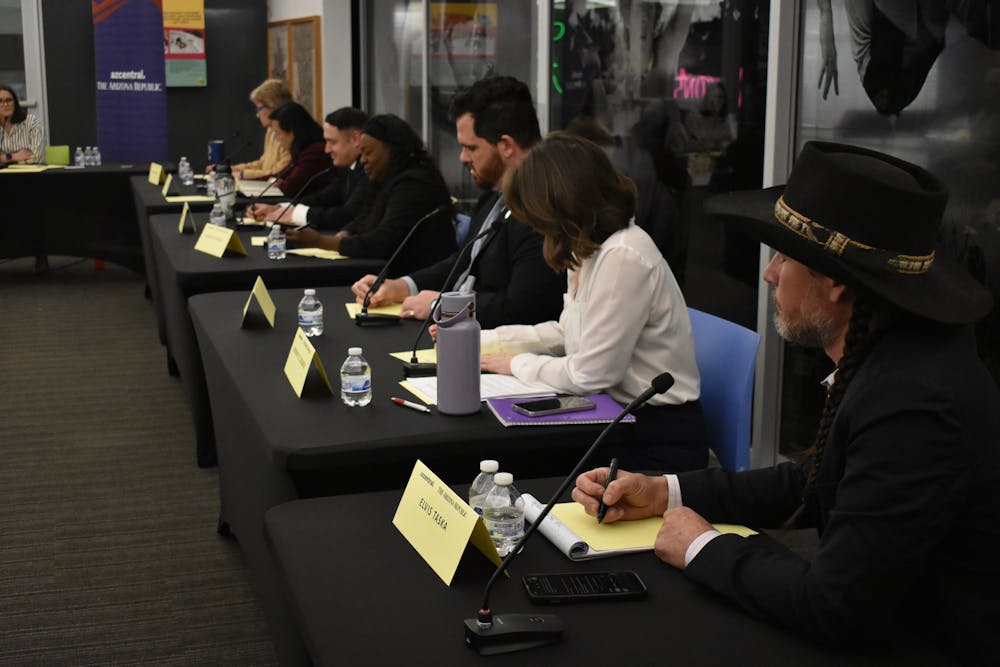
Questions about housing, homelessness, federal immigration enforcement and including the public in the policymaking process dominated Jan. 14's forum for candidates in Tempe's upcoming City Council election.
Seven candidates are running for three seats on the Tempe City Council. Jennifer Adams, Arlene Chin and Berdetta Hodge, the three incumbents, are running for re-election.
Candidates Joe Forte, Bobby Nichols, Brooke St. George and Elvis Taska are aiming to unseat the current council members.
The candidates answered questions from moderator Taylor Seely, a reporter from The Arizona Republic, and members of the audience. It was the second candidate forum for the 2026 City Council election.
Housing and homelessness
A major focus of the event was how candidates proposed to reduce the cost of living to make it easier for young families to afford living in Tempe.
Adams said this could be achieved by sticking with Tempe's General Plan 2050.
"If we follow the General Plan, we'll be okay," Adams said. "I would like to build more housing, more workforce housing, affordable housing, and we even are low on luxury housing in Tempe."
Chin said the issue is not only a need for more housing, but that the city should take a "multi-pronged approach."
"Here's the other non-housing strategy: attracting more higher-paying wages for people so that they can afford housing," Chin said.
The discussion also focused on solutions for homelessness in the city. St. George and Nichols advocated for a housing first model that helps people without housing acquire it, helping remove barriers to a stable life.
"People can rebuild their lives from a foundation of safety and stability," St. George said. "You can't get sober, get a job or reunite with your family if you're sleeping outside."
READ MORE: Tempe, nonprofits dispute collaboration on homelessness reduction
Hodge said the issue is more complex.
"You can solve limited housing, you can put someone in a house, you can feed them, but if we don't hit the root cause of why they're out there on the streets, guess what? Statistically wise, they will be back in it if we don't help them," Hodge said.
To solve this issue, Hodge said there needs to be more investment in mental health resources for residents alongside building housing.
Response to ICE
One concern voiced by residents was the presence of the U.S. Immigration and Customs Enforcement in Tempe.
Hodge said interference with immigration enforcement operations is not possible because ICE is a federal agency outside the city's jurisdiction. Others agreed that Tempe should avoid engaging with ICE.
Some candidates proposed citywide changes to provide more information and protection to residents.
Taska said Tempe ought to launch campaigns to help people know their rights. He also proposed other ways to inform the public on immigration enforcement activity.
"There should be police outreach so that residents know who their local officers are and understand what protections they're granted as City of Tempe residents," Taska said.
St. George and Nichols advocated for a reevaluation of contracts with Flock Safety, whose cameras have generated controversy among residents.
Nichols pointed to reports that ICE monitors data captured by the cameras.
"We cannot be exposing our residents to this kind of dangerous surveillance, which has been established to be used by ICE," Nichols said.
Chin emphasized that the safety of Tempe residents is a top priority and said that the city has a duty "to protect our community and community members."
Public input and implementing change
Candidates also discussed how the City Council can incorporate public opinion into their decisions.
For many, including Forte, the input of Tempe residents matters deeply when casting votes.
"I put weight in people showing up and sharing their public opinion, and I would put the brakes on proposals that have overwhelming public opposition," Forte said.
Nichols said he would support public comment and transparency.
"I will not allow for decisions to be made in private, secret meetings," Nichols said. "I will not support the illusion of unanimity."
READ MORE: Tempe defends controversial ordinance changing event permit requirements
As a final question, the candidates were asked if residents would see a change or the status quo from them if elected. All seven candidates responded with "change."
The primary election for the Tempe City Council will be held on March 10. If fewer than three candidates receive a majority of the votes, a runoff election will be held in May.
Edited by Carsten Oyer, Henry Smardo and Pippa Fung.
Reach the reporter at msweador@asu.edu and follow @miasweador on X.
Like The State Press on Facebook and follow @statepress on X.