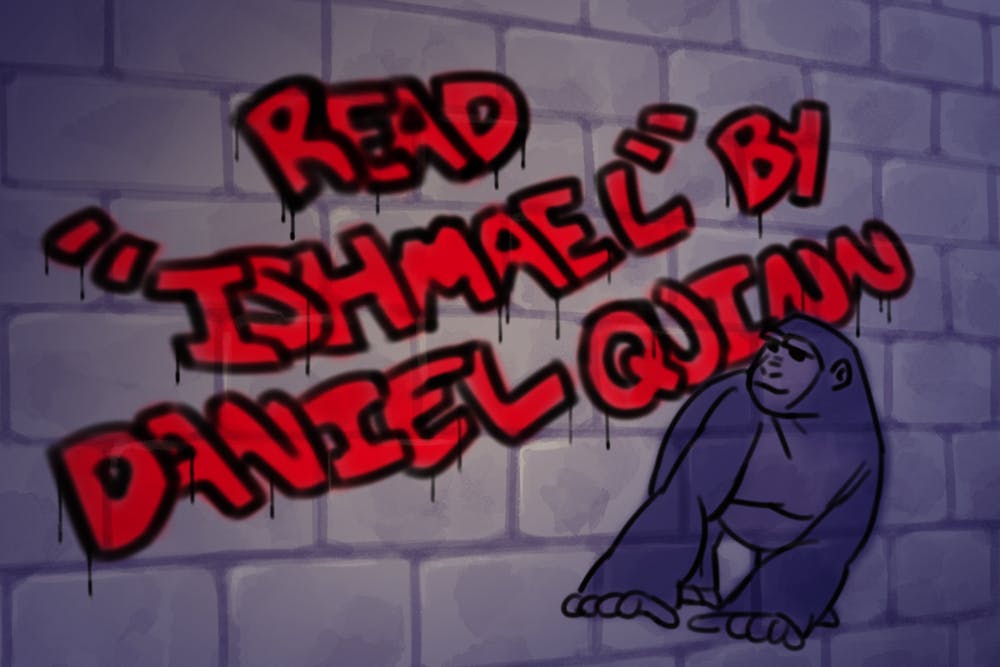
"Please, read Ishmael by Daniel Quinn."
This slogan has increasingly been tagged across downtown Phoenix, multiplying every week on sidewalks, signs and alleyways. Often accompanied by a "please," and occasionally a "thank you."
The plea-like slogan has haunted my friends and me who live in the Phoenix metro area. We make it a game of who can find the newest "Ishmael" graffiti before it gets washed away. But, we aren't the only ones wondering what's up with "Ishmael."
The growing fascination leads me to wonder what's so special about this book that someone is running around Phoenix plastering it on every surface.
Phoenix isn't the only city sporting "Ishmael" graffiti. It's become a phenomenon centered around Daniel Quinn's 1992 philosophy book about a telepathic gorilla.
The book is dialectic, but the conversations never bore or grow repetitive. It reads like a lecture about the "right" way to live. Ishamel, the gorilla, argues there isn't one. Each chapter is relatively short, keeping the teachings digestible.
The book has cultivated a large audience. There are multiple organizations across the globe, each with different goals: Some create art, music, podcasts or ballets.
Anything you can dream of has a connection to "Ishmael"-themed work.
In an increasingly online culture, it's refreshing to see a book have such widespread impact. According to these communities, "Ishmael" changed their life.
They are, self-reportedly, trying to save the world.
That may seem a tad pretentious; saving the world through vandalization is not a promising premise at first. After taking to the pages of the book, the message became clearer.
READ MORE: Review: Kamala Harris' '107 Days' raises the question of what if?
As far as philosophy books go, I expect confusing jargon and complex concepts that are difficult to follow. "Ishmael" wasn't like that.
The book is immersive from the first page. The protagonist, an unnamed character, is a self-insert for the reader. He is a middle-class man living a middle-of-the-road existence. There is nothing extraordinary about him except his hunger for knowledge and a reasonable dash of nihilism — something we can all relate to.
The man answers an ad in his local paper: "Teacher seeking pupil. Must have an earnest desire to save the world."
Here is where the philosophy kicks in. Save the world from what, exactly? Ishmael, the gorilla, guides us through exactly that.

Ishmael monologues to his pupil about how the world came to be. Through centuries of development, he believes that humans have built themselves a cage that they cannot find the bars of.
"Ishmael" deals with themes of climate change, captivity (both physical and mental) and hope versus despair.
"You're captives of a civilizational system that more or less compels you to go on destroying the world in order to live," Ishamel said in the book.
Despite the heavy subject matter, Quinn keeps the tone light. Ishmael is a charming and likeable mentor, even cracking a joke or two amidst the existential dread.
The book's simplicity may be its weakness. I expected it to contain more challenging concepts, considering its extensive fanbase.
While thought-provoking, this book ultimately explores entry-level philosophical ideas. For young adults and college students, it could be the perfect foundation for further philosophical learning.
But it won't send you into an existential crisis, not by a long shot.
The legend of "Ishmael" is more fascinating than the reading itself. The book's impact is so tangible, you'd think a telepathic gorilla really is out there somewhere. "Ishmael" fans are so invested they make it their mission to spread the word, thus the graffiti sprawled across Phoenix.
Several sentiments in the book resonated with me, such as when Quinn wrote, "The world is not going to survive very much longer as humanity's captive."
In "Ishmael," Quinn holds up a mirror to his readers. He forces people to acknowledge the bleak future of the world if humans continue to consume at our current rate.
The ability to spread this message, to even inspire just a handful of people still makes a worthwhile impact.
There may not be a handbook for saving the world, but "Ishmael" is a start. In a world that can be overwhelming with despair, it's hard to know what you should, or even can, do to make a difference.
Our local graffiti artist seems to have literally taken a page out of Quinn's book: "Do what you can, where you are."
Rating: ★ ★ ★ ★ ☆
Editor's note: The opinions presented in this review are the author's and do not imply any endorsement from The State Press or its editors.
Edited by Kasturi Tale, Senna James, Emilio Alvarado and Ellis Preston.
Reach the reporter at ajanusee@asu.edu and follow @lexijanusee on X.
Like The State Press on Facebook and follow @statepress on X.
Lexi Janusee is a senior reporter at The State Press. She is a sophomore studying Journalism with a minor in Theatre. This is her third semester with The State Press, working previously as a full-time Echo reporter.