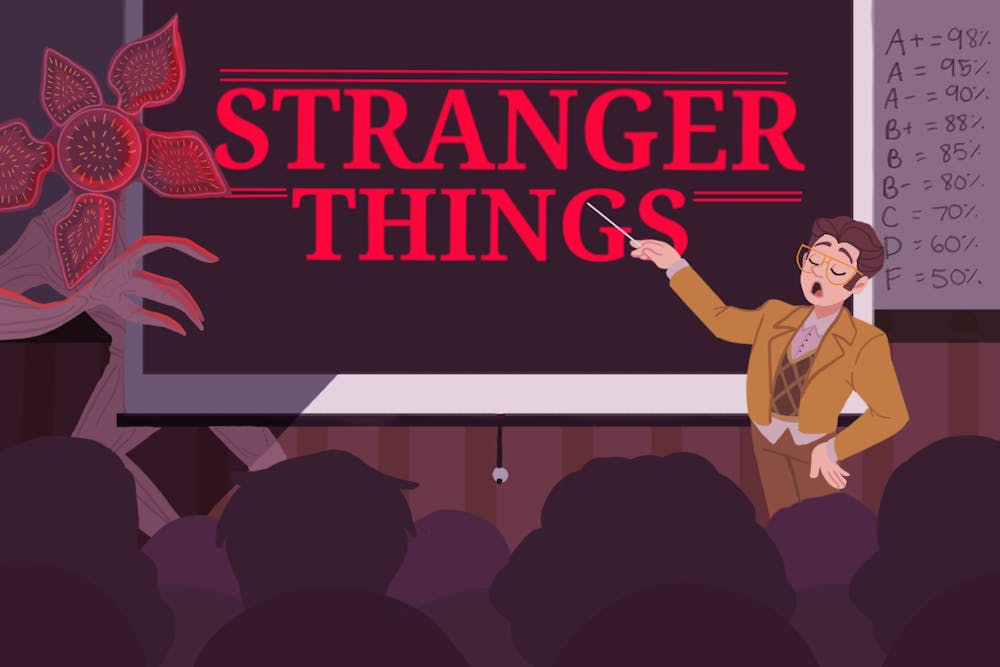
The College of Integrative Sciences and Arts has invited students to explore the mysteries of the Upside Down through a new course centered on the narrative world of the Netflix show "Stranger Things."
Titled ENG 494/509 Studies in Narrative Writing, the course is a core component of CISA's Master's of Narrative Studies program but is also available for undergraduate students. The course was developed by Wendy Williams, a professor at CISA who also created ENG 466, the Studio Ghibli films course.
READ MORE: Exploring new frontiers: ASU's Star Trek class and humanity's course through space
The course will be offered as an online iCourse during Session B in the spring semester. Students interested in enrolling can locate the class by searching for "Studies in Narrative Writing" in the ASU class search tool.
"I love it because it's a chance to be creative, but also logical," Williams said. "I love planning a class because it's like there's a puzzle, and you have to get all the pieces in order and have it make sense."
Williams said she was inspired to center the course around "Stranger Things" after watching Volume 1 of the final season over Thanksgiving break. Because adding a new topic to an existing course is a time-consuming process, the show's title is not included in the course name this semester.
"In CISA, we always try to design courses that meet students where culture actually leads," Manuel Aviles-Santiago, the interim dean at CISA, said. "'Stranger Things', it's part of that contemporary imagination, if you think about it. It also allows us to make interesting connections with nostalgia."
Williams said the most interesting aspect of the show is that it is set in the '80s. The absence of modern technology and the freedom it allowed kids at the time is nostalgic and central to the show.
Vikram Vinod, a graduate student studying global management and a fan of the show, said the most intriguing parts of the show are the storytelling and the way the show portrays superpowers, government research and illegal experimentation.
Aviles-Santiago also started a series on social media called "If I could," highlighting courses he would take if he were an undergraduate student again. The first post in the series featured this course with an AI-generated poster of him in the Upside Down universe.
"I read (Williams') work and her work, it's very in connection with what's happening in pop culture, but also in literature and in the political and cultural atmosphere," Aviles-Santiago said. "That's a recipe for success when designing courses that resonate with students."
Williams said the world-building of the show is part of what makes it great.
"The fact that it's set in the '80s and these kids have freedom means that they can go off and have these adventures, instead of their mothers saying, 'Oh, I have a scheduled playdate for you,'" Williams said. "The time and the place actually matters for the story itself, and helps to advance the story in interesting ways."
Williams also said the visuals and music are essential contributors to the narrative and are a very important aspect of the show when studying it.
Aviles-Santiago said that students are no longer passive consumers; they are active critics and creators who use platforms like TikTok to build alternate storylines and analyze character arcs. This makes the show align with the college's think, do, learn approach.
"The show activates curiosity," Aviles-Santiago said. "And in my opinion, curiosity is the engine of learning, the engine of retention and belonging."
Edited by Natalia Rodriguez, Jack McCarthy and Pippa Fung.
Reach the reporter at ktale@asu.edu and follow @KasturiTale on X.
Like The State Press on Facebook and follow @statepress on X.
Kasturi Tale is the Echo desk editor at the State Press. She has previously worked on her own blog and has a background in creative writing.