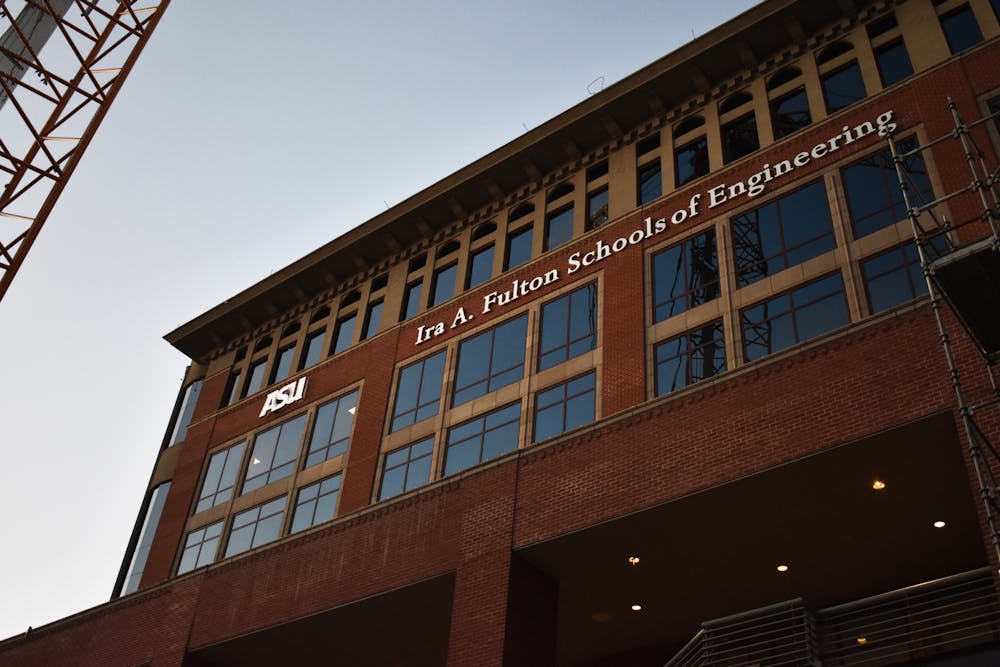
At ASU's School of Computing and Augmented Intelligence, the Autonomous Agents and Intelligent Robots Lab focuses on developing AI systems that can reason, plan and adapt to new environments.
Siddharth Srivastava, director of the AAIR Lab and a professor at SCAI, said the lab's goal is to enable AI systems, including robots and digital assistants, to reuse knowledge across different tasks, rather than learning each task independently. He added that the lab aims to make these systems more functional over time.
"In order to make more productive use of AI systems, we need to reach a level where users can identify what their AI systems can safely do and let them do it autonomously," Srivastava said. "This requires research in the assessment of AI systems so that we can efficiently do this even while the systems are changing."
Srivastava said a key focus of the lab is developing generalizable learning and planning to ensure the models can perform across various environments. Daniel Bramblett, a doctoral student studying computer science, added that the lab's work ensures that autonomous agents can reliably perform tasks in real-world settings and conditions.
"AI is a huge field, so we're trying to focus on the planning side of it," Bramblett said.
Bramblett added that the lab's research also focuses on measuring what tasks AI systems are capable of doing safely and the success rate of those tasks. The research also involves investigating how confident users must be when assigning agents tasks.
While much of the work at the AAIR Lab involves theoretical research, it also operates with multiple robotic platforms that allow researchers to test algorithms in physical environments. Srivastava said experimentation with real robots often reveals assumptions that must be addressed before systems can really be reliably deployed.
"Assumption is so important that if you remove it, many of the existing methods don't work at all," he said.
The lab purchased three research robots that can be programmed to perform various tasks. The robots are so important to the research that they are featured in the "People" section of the AAIR Lab website. The robots are Alfred, a mobile manipulator robot, HoShi-R, a Toyota human support robot and YuMi, a tabletop robot.
Undergraduate, master's and doctoral students play a role working in the lab. The student researchers collaborate on projects, mentor the newer lab members and contribute to overall research.
Nhi Tran, a doctoral student studying computer science and a new member of the lab, said the students frequently work together across experience levels, helping one another develop research skills and complete projects.
"The lab culture is very supportive in terms of how we collaborate," Tran said. "Usually, we have someone that is a little bit more senior in the lab, or currently working on a project, working with someone like me who is brand new to the lab."
According to Tran, in a more automated world, robots can help perform tasks that many people may not be able to complete regularly. She added that the systems can be used in scenarios from warehouses to households.
Looking ahead, Srivastava said the lab's long-term goal is to make autonomous systems both more capable and more trustworthy, enabling them to operate more efficiently and safely alongside humans in everyday environments.
"We don't make robots, we make robots intelligent," Srivastava said.
Edited by Kate Gore, Henry Smardo and Pippa Fung.
Reach the reporter at ngmohta@asu.edu.
Like The State Press on Facebook and follow @statepress on X.
Nikhil Mohta is a sophomore studying B.S. in Finance and is currently a Business Community Leader for the W.P. Carey School of business. He is also an active member in various clubs on campus like PIERA.