Rather than the usual mix of Sun Devil football staff and fans, Mountain America Stadium was filled with students from local Arizona schools on Tuesday, geared up to focus on engineering challenges.
The American Council of Engineering Companies of Arizona hosted the fourth annual STEM "Game Day" at ASU to teach middle school students about engineering and how engineers make a Sun Devil game day possible. About 160 volunteers, including University students, helped the approximately 600 students throughout the event.
Zach Lambros, the event lead, said the "Game Day" was a response to concerns about a shortage of engineers in the industry. He said introducing engineering as a career early on is important so students know the path is an attainable option.
"The big crux of the event is explaining to the kids that what you see on the field is amazing, but all the work, all the thought, all the systems in place outside of the field is really what we're about," Lambros said. "With the stadium as the backdrop, we are able to speak to all the engineering that goes into a game day."
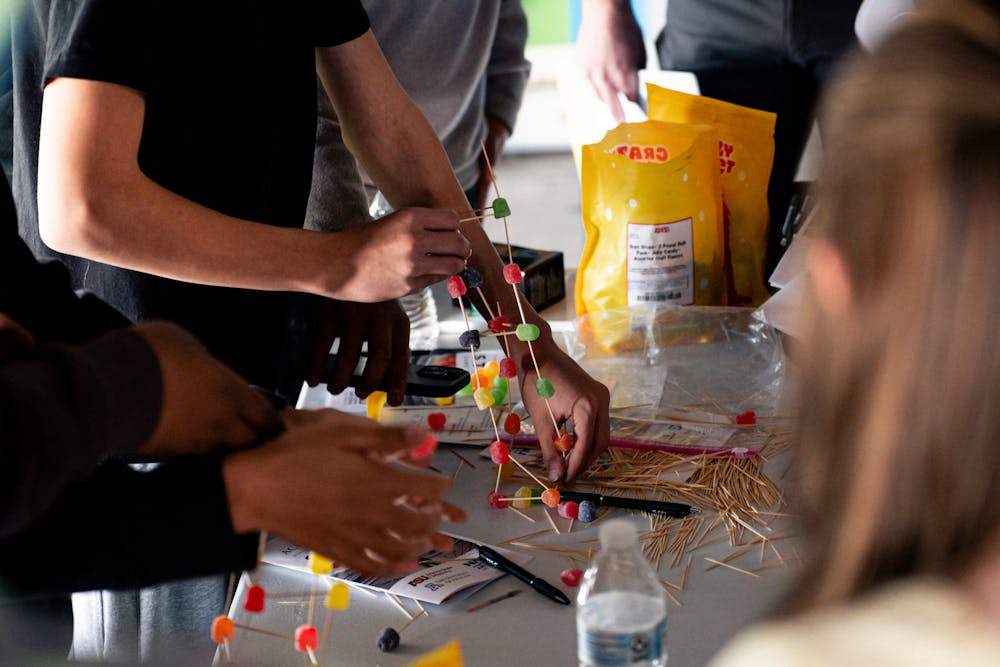
Lambros said the students participate in hands-on activities to apply the engineering concepts they learn throughout the day. He said the event would showcase how structure, transportation and utilities all come together, as well as the ins-and-outs of being an engineer.
"A lot of times we use this infrastructure and we don't even realize we're using it, so (we are) just opening their eyes to that world," Lambros said. "It's very attainable for them, and if they don't even know it exists then it's a missed opportunity."
Most of the volunteers participating were professionals in the engineering field and a number of ASU students volunteered for the first time this year, Lambros said.
Esther Low, a senior studying biomedical engineering and global health and a volunteer at the event, said she was first introduced to STEM at an early age and continued her passion throughout high school and college.
She said determining what career to pursue can be difficult and teaching students about potential paths and fields early on can help them to explore and find their passions.
"Introducing something that you may be interested in, whether that's STEM, whether that's something else, at a very young age, provides kids the opportunity to find out what they're passionate about," Low said.
In addition to engaging with students, Low said the event is a way for her to network and connect with industry professionals working in the field she eventually wants to work in.
"I've met so many people, alumni who have such open arms and are willing to help students like me," Low said. "It always is just so encouraging meeting them."
Nicole Moon, the volunteer coordinator, said when the event first started four years ago, they had about 40 volunteers initially and have grown since then.
She said when students see volunteers coming from diverse educational backgrounds, it opens the door for them to learn about different educational paths they can take. She added anyone can play an important role in the field without attending engineering school or excelling in a related subject area.
"You don't have to be a wiz at math or science," Moon said. "You can be part of the process of making our world, designing our world, without having to go through all that."
Lambros said ACEC will host another iteration of the event at UA and NAU in April while expanding the model nationwide to states like Nebraska, Colorado, New Mexico and Tennessee. He said it is exciting to see the event being brought to different stadiums.
"You can't have a game day without engineers," Lambros said. "When it's game day on the field, it's game day for us too because all of our infrastructure needs to work in order to have that successful game day experience."
Edited by Kate Gore, Senna James and Ellis Preston.
Reach the reporter at alillest@asu.edu and follow @allylillestol on X.
Like The State Press on Facebook and follow @statepress on X.
Allison Lillestol is a reporter for the community and culture desk. She is in her 4th semester with the State Press. She also works for Arizona PBS.